Glossary

Quick definitions used across WattNeeds guides. Niche: camping / home backup / van-life only.

Watt (W)

Rate of power use right now. A 60 W light draws 60 joules per second.

Watt-hour (Wh)

Energy = watts × hours. A 60 W light for 5 hours uses 300 Wh. Power stations are sold by nameplate Wh.
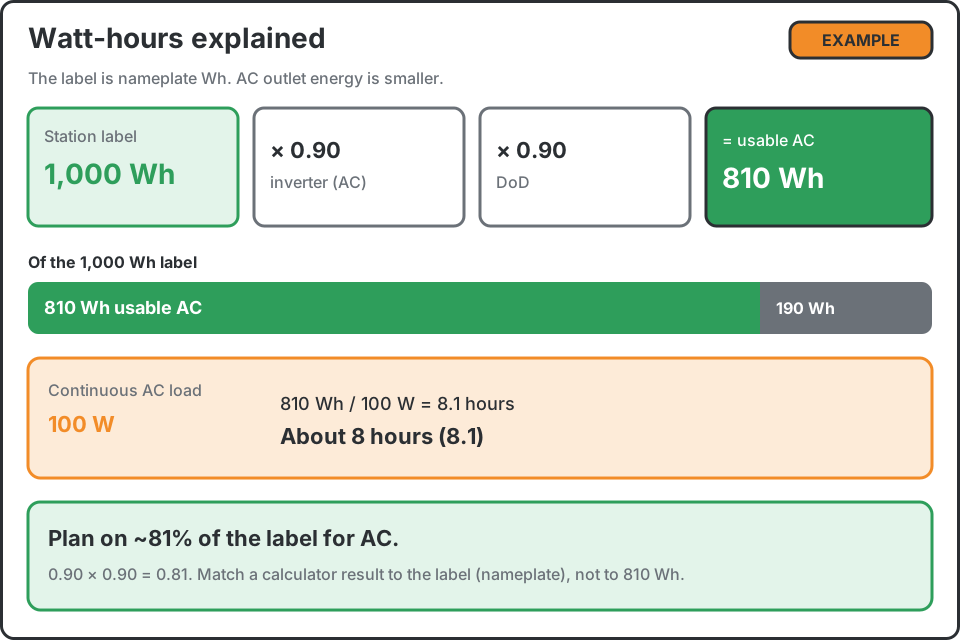
Example: a 1,000 Wh station label times 0.90 inverter efficiency times 0.90 depth of discharge equals 810 Wh usable on AC. A continuous 100 W AC load runs 8.1 hours, about 8 hours. Plan on about 81 percent of the label for AC.
EXAMPLE. 1,000 × 0.90 × 0.90 = 810 Wh usable AC. 810 / 100 W = 8.1 hours. Plan on ~81% of the label for AC.

Nameplate Wh vs usable Wh

Nameplate is the rated pack energy. Usable energy is lower after BMS reserves (DoD) and conversion losses.

Depth of discharge (DoD)

Fraction of the pack you plan to use. WattNeeds default 0.90 for LiFePO₄ planning.

Inverter efficiency (η)

AC conversion efficiency. Default 0.90; use ~0.85 if mostly uncertain AC loads; higher if mostly DC/USB.

Buffer / headroom

Extra planning margin (default 15%) for imperfect estimates and real-world variance.

Surge / continuous watts

Inverter limits: continuous = steady load; surge = short startup spikes (compressors, motors). Capacity (Wh) ≠ ability to start a load.
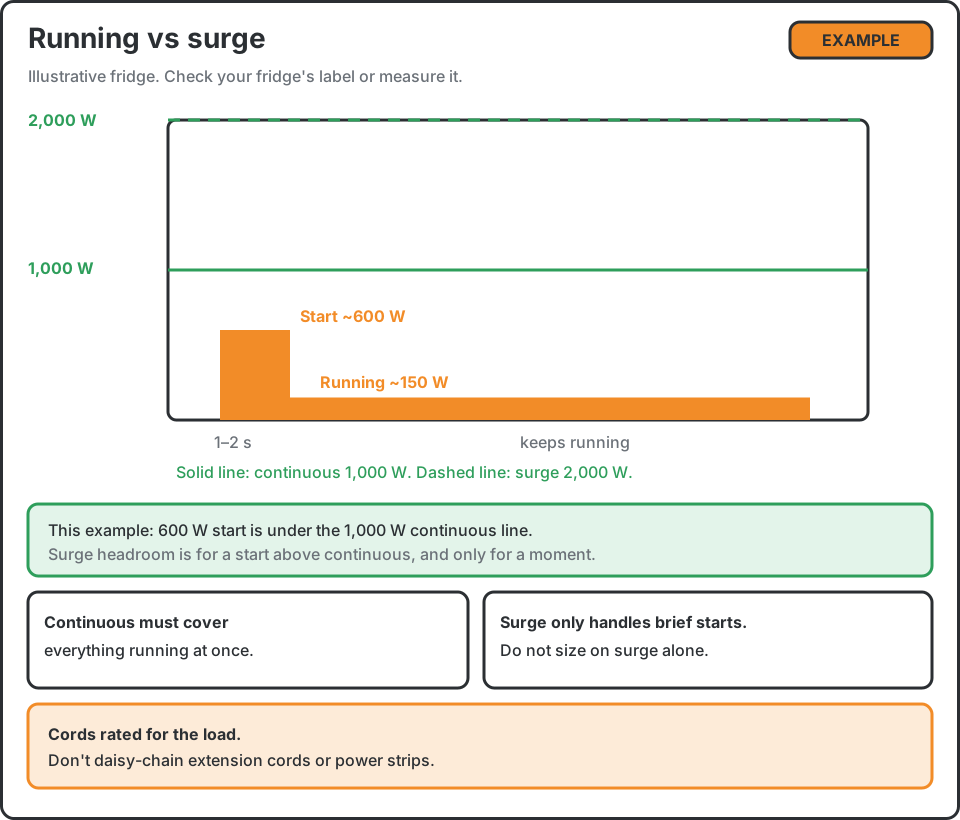
Example, not a measurement: a fridge runs at about 150 W and the motor start is about 600 W for 1 to 2 seconds. Check the fridge label or measure it. Station continuous output is a solid line at 1,000 W and surge is a dashed line at 2,000 W. Continuous watts must cover everything running at once. Surge only handles brief starts. Do not size on surge alone. Use cords rated for the load. Don't daisy-chain extension cords or power strips.
EXAMPLE, not a lab trace. Running ~150 W, start ~600 W for 1–2 seconds. Continuous 1,000 W is the solid line. Surge 2,000 W is dashed. This start is under the continuous line. Do not size on surge alone.

Autonomy

Days you need to run without a reliable recharge (mains, solar, vehicle).

Calculator · How it works