How the calculator works

Planning math, not a lab measurement. Public manufacturer guides use the same W × hours first step.

WattNeeds defaults: inverter efficiency η=0.90, DoD=0.90, buffer=0.15. One-liner: nameplateWh = (whPerDay × days × 1.15) / (0.90 × 0.90). Always re-check continuous watts and surge against the station inverter.
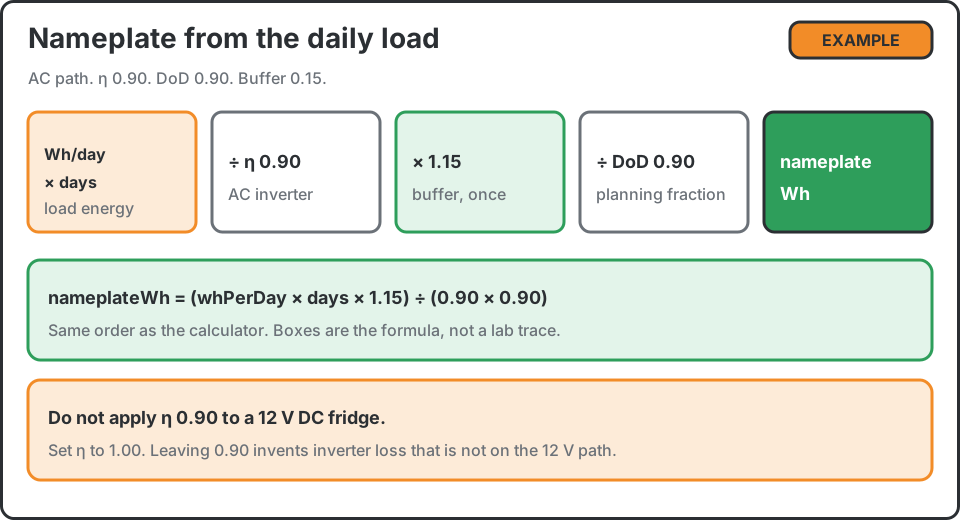
AC path nameplate: Wh per day times days, divided by inverter efficiency 0.90, times 1.15 buffer, divided by depth of discharge 0.90. Do not apply 0.90 to a 12 V DC fridge. Set efficiency to 1.00 on that path.
EXAMPLE. AC-path defaults. 12 V DC fridge: set η = 1.00 (see cooler vs fridge). Citations: EcoFlow W × hours = Wh · Bluetti ÷ ~0.85 · Jackery buying advice · Jackery FAQ ×0.8.
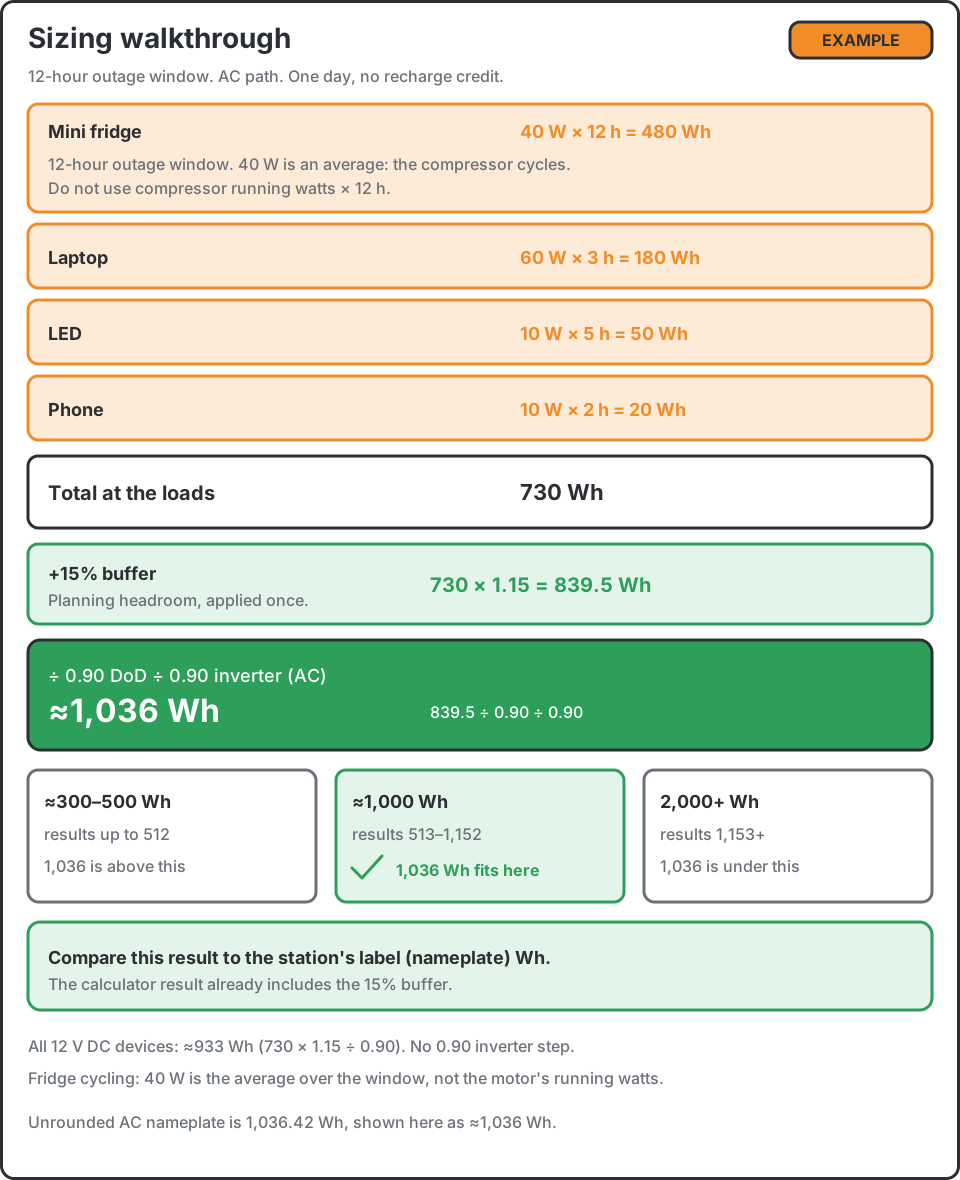
Example sizing for a 12-hour outage: mini fridge 40 watts times 12 hours is 480 Wh, laptop 180 Wh, LED 50 Wh, phone 20 Wh, total 730 Wh. A 15 percent buffer makes 839.5 Wh. Divided by 0.90 depth of discharge and 0.90 inverter efficiency, the AC nameplate is about 1,036 Wh, which fits the about 1,000 Wh class (results 513 to 1,152). Compare that result to the station label. All 12 V DC devices would be about 933 Wh. The fridge 40 W is an average because the compressor cycles.
EXAMPLE. 480 + 180 + 50 + 20 = 730 Wh. 730 × 1.15 = 839.5. 839.5 / 0.90 / 0.90 = 1,036.42, shown as ~1,036 Wh. 12 V DC skips the inverter: 839.5 / 0.90 = 932.78, shown as ~933 Wh. Fridge 40 W is an average over the window.
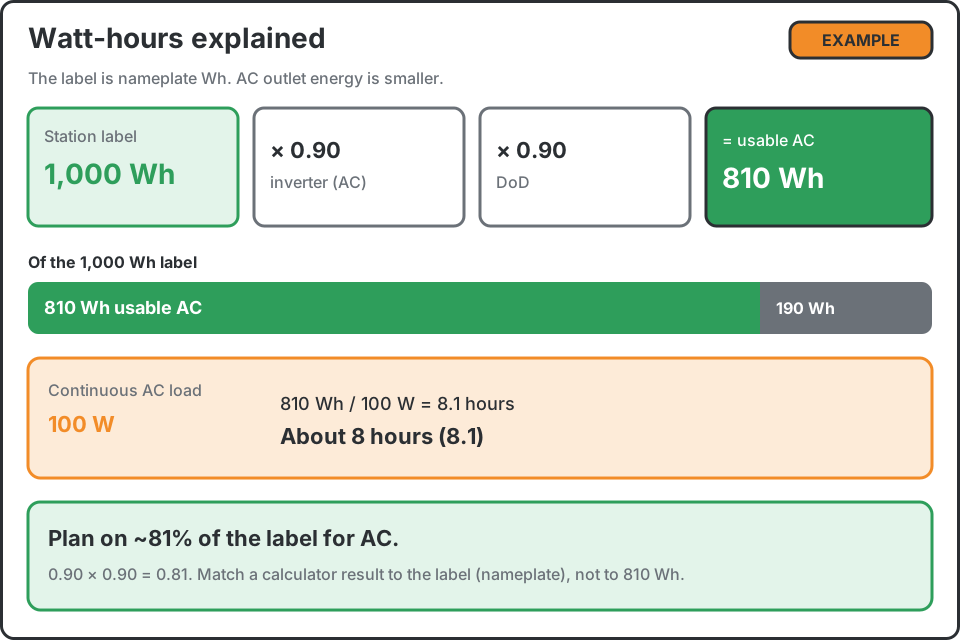
Example: a 1,000 Wh station label times 0.90 inverter efficiency times 0.90 depth of discharge equals 810 Wh usable on AC. A continuous 100 W AC load runs 8.1 hours, about 8 hours. Plan on about 81 percent of the label for AC.
EXAMPLE. 1,000 × 0.90 × 0.90 = 810 Wh usable AC. 810 / 100 W = 8.1 hours. Plan on ~81% of the label for AC.

Steps

  1. Device daily energy — Wh/day if provided, else watts × hours/day.
  2. Sum — total Wh per day delivered to loads.
  3. × days of autonomy — energy needed before a reliable recharge.
  4. ÷ inverter efficiency — AC path default 0.90. 12V DC fridge: set η = 1.00; do not leave 0.90.
  5. × (1 + buffer) — planning headroom (default 15%).
  6. ÷ DoD — convert usable energy to nameplate Wh (default 0.90).

Combined formula

nameplateWh = (whPerDay × days × (1 + buffer)) / (dod × inverterEfficiency)

What we do not model (MVP)

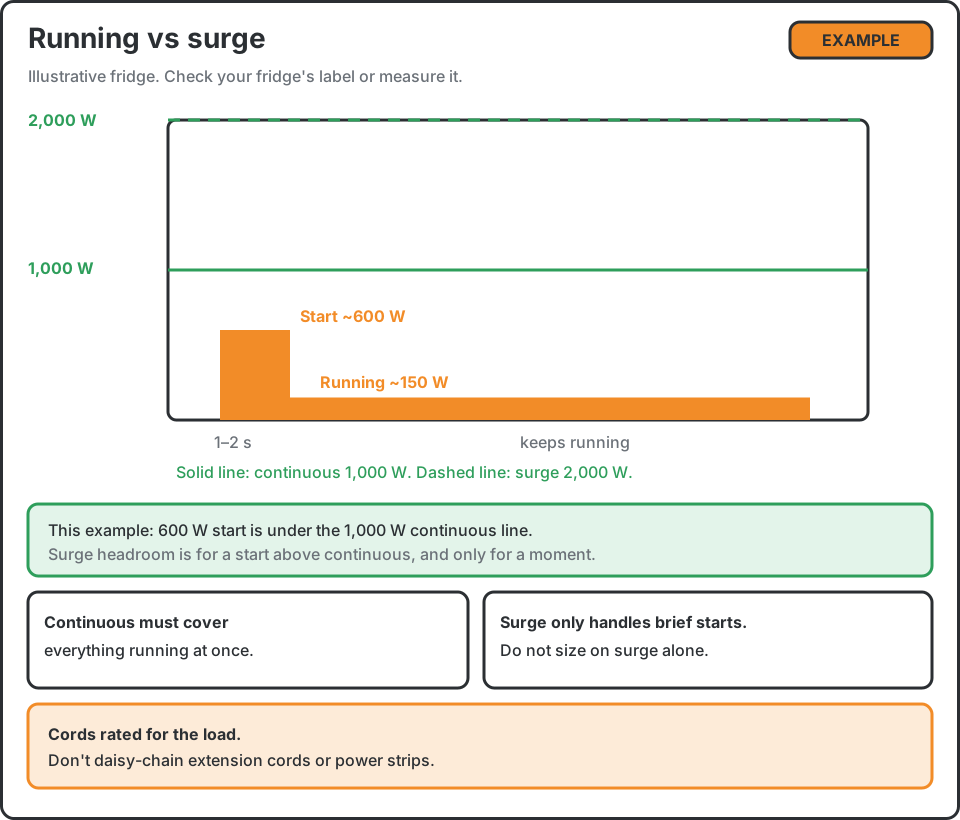
Example, not a measurement: a fridge runs at about 150 W and the motor start is about 600 W for 1 to 2 seconds. Check the fridge label or measure it. Station continuous output is a solid line at 1,000 W and surge is a dashed line at 2,000 W. Continuous watts must cover everything running at once. Surge only handles brief starts. Do not size on surge alone. Use cords rated for the load. Don't daisy-chain extension cords or power strips.
EXAMPLE, not a lab trace. Running ~150 W, start ~600 W for 1–2 seconds. Continuous 1,000 W is the solid line. Surge 2,000 W is dashed. This start is under the continuous line. Do not size on surge alone.

Inverter continuous and surge watts are a separate check from Wh capacity — a station can have enough Wh and still fail to start a microwave.

Wh calculator · Surge traps · Glossary