Surge traps
Running watts, startup watts, and watt-hours are three checks. A full battery can still trip when a motor starts. Sheets on this page were read 2026-10-28.
Three numbers, three jobs
Running watts are what the load draws after it is already going. Startup watts, also called surge, are the brief spike when a motor or compressor starts. Watt-hours are running watts times hours. The Wh calculator answers the third number. It does not answer the first two.
An inverter trips on power and current in that moment. The battery’s watt-hours are the integral over time. A 1,024 Wh pack still opens its overload protection if the start current is over the inverter’s limit. Stored energy does not flow through a tripped inverter. Buying the next watt-hour class does not fix a watts miss. Where each label stops on energy alone is 500 vs 1,000 Wh and 1,000 vs 2,000 Wh.
| Label | 12 V / USB delivered | AC delivered |
|---|---|---|
| 500 Wh | 500 × 0.90 = 450 Wh | 500 × 0.81 = 405 Wh |
| 1,000 Wh | 1,000 × 0.90 = 900 Wh | 1,000 × 0.81 = 810 Wh |
| 2,000 Wh | 2,000 × 0.90 = 1,800 Wh | 2,000 × 0.81 = 1,620 Wh |
Those six products are exact. DoD=0.90 is a planning fraction of the label. It is not a BMS guarantee. The 15% buffer is headroom, not a measured loss. The runtime check does not apply the buffer again on the way down. Round a nameplate once, half-up, the way Math.round does.
Inverter lines used below
Three manuals, read 2026-10-28. They are the watt lines in the verdicts. They are not a ranking. The same sheets are already on 500 vs 1,000 Wh, 1,000 vs 2,000 Wh, and EcoFlow vs Jackery vs Bluetti.
| Line | RIVER 2 Max | DELTA 2 | DELTA 2 Max |
|---|---|---|---|
| Printed capacity | 512 Wh. Not a 500 Wh label. | 1,024 Wh. Not a 1,000 Wh label. | 2,048 Wh. Not a 2,000 Wh label. |
| AC output | Pure sine, 500 W total (1,000 W peak), 120 V. Duration not published: the manual gives no seconds for this number. Ask EcoFlow, or test with your own load, before counting on it for a motor start. | Pure sine, 1,800 W total (surge 2,700 W), 120 V. Duration not published: the manual gives no seconds for this number. Ask EcoFlow, or test with your own load, before counting on it for a motor start. | Pure sine, 2,400 W total (surge 4,800 W), 120 V. Duration not published: the manual gives no seconds for this number. Ask EcoFlow, or test with your own load, before counting on it for a motor start. |
| X-Boost | Devices rated up to 1,000 W. The manual says it suits heating and motor-driven devices and to test them. The FAQ says keep the sum under rated power. Our sizing rule, same as 500 vs 1,000 Wh: voltage-reduction lift modes are for resistive heating loads only. Reduced voltage can stall or overheat motor and compressor loads. Not a surge rating. Do not size on it. | 2,200 W on the spec line. More suitable for heating devices. Not for appliances with voltage protection. Test is the manual’s instruction. Same sizing rule. Not a surge rating. Do not size on it. | 3,400 W on the spec line. Same family of limits. Same sizing rule. Not a surge rating. Do not size on it. |
A current screen on this page divides a printed watt rating by 115 V when the load sheet is 115 V. That quotient is amps only if the inverter’s watt rating is treated as real power at unity power factor. The manuals print watts. They do not print that amp. The screen is a comparison, not a trip test this site ran.
Home backup: a small compressor freezer
The full-size fridge on home outage is a GE EnergyGuide, 434 kWh/year, published there as 1,189 Wh/day. That sticker does not print running watts or a locked-rotor amp. This section is a different appliance. Do not paste 1,189 Wh/day onto it.
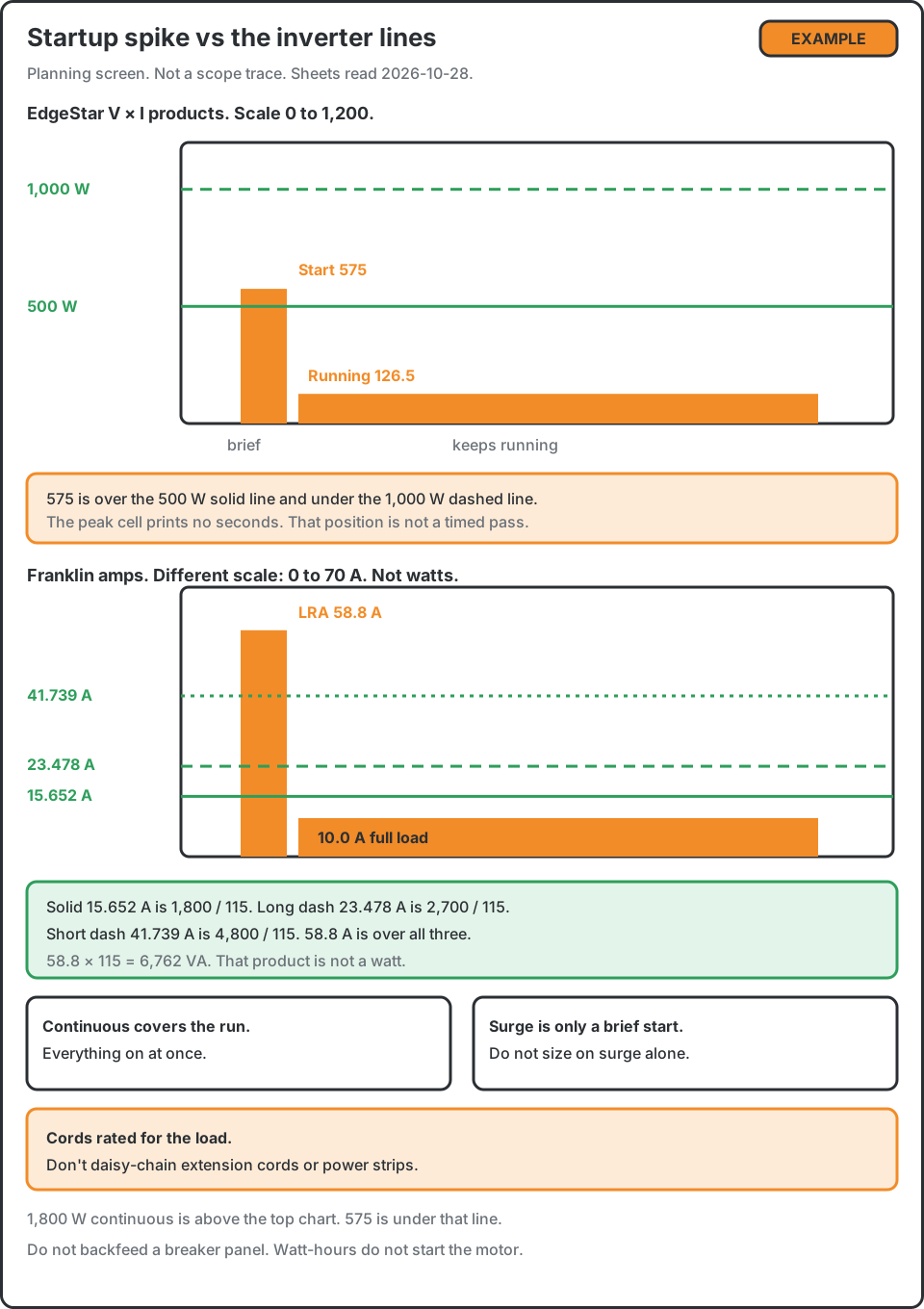
EdgeStar’s support article on running and surge watts uses model CRF150SS-1. The live host did not complete a direct fetch from this check. The text below is the 15 Feb 2025 archive capture of that URL, re-read 2026-10-28. The article’s table prints 115 V / 60 Hz and rated current 1.1 A. EdgeStar’s formula on that page is watts = amps × voltage. They print 1.1 A × 115 V = 126.5 watts and call 126.5 the running watts. No separate power factor is printed. This page reports 126.5 as their product.
The same article says a compressor start is usually less than a few seconds, that startup power can typically be 2–3 times running watts, and that a precautionary rule of thumb is up to 6 times rated current. For this model it then points at a compressor-label photo and states the locked-rotor amp in that example is 5 A, and 5 A × 115 V = 575 watts. This page uses that stated 5 A. It does not re-measure the photo. 575 is the worked startup figure. 575 is label amps × volts, so it is VA, the same caveat as the 6,762 VA line. The 2–3× band and the 6× rule of thumb stay labeled as their ranges, not as a second test.
| Figure | Where it comes from | Value |
|---|---|---|
| Running | 1.1 A × 115 V, their product | 126.5 W |
| Startup example | 5 A LRA × 115 V, their product | 575 W |
| Their 2× running | 2 × 126.5, the low end of “2–3 times” | 253 W |
| Their 3× running | 3 × 126.5 | 379.5 W |
| Their 6× current rule | 6 × 1.1 A = 6.6 A, then × 115 V | 759 W |
In JavaScript, 1.1 * 115 lands on 126.50000000000001, and 6 * 1.1 * 115 lands on 759.0000000000001. This page uses the decimal products 126.5 and 759. The worked verdict uses 575 W, the figure next to the 5 A example. 759 is still over 500 and under 1,000 and under 1,800, so the pass/fail below does not flip inside that rule of thumb. 253 and 379.5 are under the 500 W line. They are the article’s typical band, not the 5 A example. Do not shop the low end of the band and ignore the 575 W line they printed next to the label.
126.5 W is rated current turned into a product. It is not a measured day. The compressor cycles. 126.5 × 24 = 3,036 Wh is the wrong daily product, the same kind of miss as holding a camping fridge’s rated watts for 24 hours. One hour at that rated product is this page’s ceiling window, not a duty cycle EdgeStar printed.
126.5 W × 1 h = 126.5 Wh
126.5 × 1.15 / 0.81 = 179.599 → 180 Wh
3,036 × 1.15 / 0.81 = 4,310.370 → 4,310 Wh (wrong method, not the plan)
A 500 Wh label delivers 405 Wh on AC. 405 / 126.5 = 3.202 hours if 126.5 W held the whole time. A 1,000 Wh label delivers 810 Wh: 6.403 hours. A 2,000 Wh label delivers 1,620 Wh: 12.806 hours. The buffered one-hour plan is 180 Wh. A 500 Wh label covers that energy. The class ceiling for results up to 512 Wh is above 180. Energy is not the miss.
| Check | RIVER 2 Max 500 W / 1,000 W peak | DELTA 2 1,800 W / 2,700 W surge |
|---|---|---|
| Running 126.5 W | Under 500 W continuous. | Under 1,800 W continuous. |
| Startup example 575 W | Over 500 W continuous. Under the 1,000 W peak number. That cell's duration is not published. Ask EcoFlow or test with the load. EdgeStar’s “less than a few seconds” is not that cell. Not a timed pass. | Under the 1,800 W continuous line. The 2,700 W surge is not what covers it. |
| One-hour nameplate 180 Wh | Energy covers. The start does not. | Energy covers. The watt screen covers 575 W for this unit alone. |
X-Boost is not the pass. On the RIVER 2 Max the ceiling is 1,000 W and the FAQ still says keep the sum under rated power. On DELTA 2 the continuous line already covers 575 W, so X-Boost is idle. Reduced voltage is the wrong tool for a compressor. Do not size this freezer on it.
A well motor, then a sump whose start amps are not on the sheet
Both of these are home-backup water loads. Neither is a camping cord. Franklin’s AIM manual is an installation manual. This page uses the specification table and the fuse-table row. It does not repeat cable lengths, control-box wiring, or a start procedure. Zoeller’s data sheet says installation of controls, protection devices, and wiring is work for a qualified licensed electrician. Do not backfeed a breaker panel. A hardwired well motor needs a licensed electrician and a transfer switch or inlet.
The motor is Franklin Electric prefix 244504, 1/2 HP, 115 V, 60 Hz, 2-wire. The product page for 2445049004 GS prints full-load amps 10 A, service-factor amps 12 A, 115 VAC, full-load efficiency 56%, and service-factor efficiency 60%. It does not print watts or a locked-rotor amp.
The 2026 AIM manual (linked from franklinwater.com/resources/franklin-aim) prints two 115 V rows for prefix 244504. The row “with G suffix” prints full-load 10.0 A and 660 W, service-factor load 12.0 A and 1,000 W, efficiency 60% at service factor and 56% at full load, and locked-rotor amps 58.8. That efficiency pair matches the product page. The row without the G suffix prints service-factor efficiency 62% and locked-rotor amps 64.4. It does not match the product page’s 60%, so it is not used. AIM says the table’s performance is typical, not guaranteed, at the specified voltage. 660 W and 58.8 A are that table. They are not a bench test this site ran.
The same G-suffix row prints a power-factor pair. In header order the efficiency pair is service factor then full load (60, 56), then the power-factor pair in that same order, then locked-rotor amps. Read that way, power factor is 78% at service factor and 64% at full load. 10.0 × 115 × 0.64 = 736, which is not the printed 660 W. The sheet prints 660 W as full-load watts and doesn't say how it was measured, so it won't exactly equal amps × volts × PF. This page does not “fix” that gap. Running watts are the printed 660 W and 1,000 W. Startup watts are not in the table. Locked-rotor current is 58.8 A. 58.8 × 115 = 6,762 VA. That product is not a watt.
Ten minutes is this page’s short pump window. AIM does not print that runtime.
660 W × (10/60) h = 110 Wh
110 × 1.15 / 0.81 = 156.173 → 156 Wh
1,000 W × (10/60) h = 166.667 Wh
166.667 × 1.15 / 0.81 = 236.626 → 237 Wh
Do not round 166.667 up to 167 before the nameplate. A 500 Wh label delivers 405 Wh on AC. 405 / 660 = 0.614 hours if 660 W held. 405 / 1,000 = 0.405 hours at the service-factor watt. A 2,000 Wh label delivers 1,620 Wh: 1,620 / 660 = 2.455 hours, and 1,620 / 1,000 = 1.620 hours. The buffered 156 Wh plan and the buffered 237 Wh plan both sit under a 500 Wh label. Energy is not the miss.
| Check | RIVER 2 Max | DELTA 2 | DELTA 2 Max |
|---|---|---|---|
| Full-load 660 W | Over 500 W continuous. Fail running. | Under 1,800 W continuous. | Under 2,400 W continuous. |
| Service-factor 1,000 W | Over 500 W. Equal to the 1,000 W peak number, which prints no seconds (duration not published), and the FAQ says stay under rated power. Not a pass. | Under 1,800 W continuous. | Under 2,400 W continuous. |
| Locked rotor 58.8 A, 6,762 VA | 58.8 is over 500 / 115 = 4.348 A and over 1,000 / 115 = 8.696 A. Fail. | 58.8 is over 1,800 / 115 = 15.652 A and over 2,700 / 115 = 23.478 A. 6,762 VA is over the 2,700 W cell even if that cell is read as VA. Fail the start. | 58.8 is over 4,800 / 115 = 41.739 A. 6,762 is over 4,800. Fail the start. A larger surge cell does not cover this row. |
The AIM fuse table says its sizing is the same for standard, G, and 700-series motors. The 244504, 115 V, 2-wire row prints six amp cells in this order: 35, 20, 30, 30, 15, 30. The header above them is standard fuse, dual-element time-delay fuse, and circuit breaker, then that trio again for the typical-submersible group. Locked-rotor 58.8 A is over the largest cell in the row, 35. Full-load 10.0 A is under the smallest cell, 15. This page does not pick a breaker. It does not tell anyone to upsize past the NEC cell. A station surge rating is not one of those six cells.
The sump is a different machine. Zoeller FM2778 (0724) prints model M53 / 53 as 115 V, 1 phase, 9.7 A, 3/10 HP, shaded pole, 60 Hz, with a grounded plug on the automatic cord. The sheet prints amps. It does not print watts, a power factor, or a starting amp. A retailer “starting amps” figure is not used. 9.7 × 115 = 1,115.5 VA. That product is not a watt, and this page does not turn it into watt-hours.
| M53 screen at 115 V | Quotient | 9.7 A |
|---|---|---|
| 500 W / 115 V | 4.348 A | Over. Fail this screen. |
| 1,000 W / 115 V | 8.696 A | Over. The peak cell is not a pass. |
| 1,800 W / 115 V | 15.652 A | Under. Running current only. Not a start pass. |
| 2,700 W / 115 V | 23.478 A | No starting amp is on the Zoeller sheet. No surge pass. |
9.7 A of shaded-pole current can be a small watt-hour total on a short cycle and still miss a 500 W inverter. The watt-hour total is not computable from FM2778. That is the trap. Do not invent the missing start amp to make the row close.
Van kitchen: a microwave and a drip coffee maker
A magnetron cook and a heater brew last minutes. The peak line is not those minutes. No surge multiple is invented here. No scope trace. These two windows are the same clocks already used on 500 vs 1,000 Wh.
The Comfee manual for AM720C2RA-R, AM720C2RA-A, and AM720C2RA-G prints 120 V~ 60 Hz, rated microwave input 1,050 W, rated microwave output 700 W, capacity 0.7 cu ft. 700 W is cooking output. The wall draw on that sheet is 1,050 W. The sheet does not print a power factor or an inrush. Six minutes is this page’s reheat window.
1,050 W × (6/60) h = 105 Wh
105 × 1.15 / 0.81 = 149.074 → 149 Wh
405 / 105 = 3.857 windows on a 500 Wh label. 810 / 105 = 7.714 windows on a 1,000 Wh label. 1,620 / 105 = 15.429 windows on a 2,000 Wh label. All three labels store one cook.
1,050 W is over the RIVER 2 Max rated 500 W, over the 1,000 W peak, and over the X-Boost ceiling of 1,000 W. Fail every printed ceiling on that sheet. 1,050 W is under DELTA 2 continuous 1,800 W and under DELTA 2 Max continuous 2,400 W. The surge cells are not what covers a six-minute cook. The 1,000 vs 2,000 page’s 2,000 W oven input is a different appliance, and it misses the 1,800 W line. This 1,050 W input does not.
The Hamilton Beach use-and-care PDF lists models 48350 and 48351, then Características Eléctricas 120 V ~ 60 Hz 900 W. The English warranty block does not restate 900 W. Ten minutes is this page’s brew window. The PDF does not print a brew time or a separate start watt. 900 W is a heater for those ten minutes.
900 W × (10/60) h = 150 Wh
150 × 1.15 / 0.81 = 212.963 → 213 Wh
405 / 150 = 2.700 windows on a 500 Wh label. 810 / 150 = 5.400 on a 1,000 Wh label. 1,620 / 150 = 10.800 on a 2,000 Wh label. The energy fits. 900 W is over the 500 W rated line. It is under the 1,000 W peak number and under the X-Boost ceiling, and the brew is still minutes. This page does not call 900 W a pass on the RIVER 2 Max. DELTA 2’s 1,800 W continuous line covers 900 W without X-Boost.
The oven plugs into the station. Use cords rated for the load. Don't daisy-chain extension cords or power strips. Do not backfeed a breaker panel.
A small window AC will not cover a night
The old 1,000 W × 8 h line on this page had no sheet behind it. It is gone. This section uses one product specifications sheet.
The Frigidaire specifications sheet for FHWC054TE1 (version 01/24, Electrolux letterhead) prints 5,000 BTU, voltage rating 115 V, amps (cool) 4.6 A, watts (cool) 450 W. The same sheet prints ENERGY STAR Certified No. It does not print a locked-rotor amp. Eight hours is this page’s night window, not a runtime on the sheet. One hour is the shorter window, so the night miss is not confused with a one-hour miss.
4.6 A × 115 V = 529 VA
450 / 529 = 0.851
0.851 is 450 divided by 529, to three decimals. It is the ratio of the two printed numbers. It is not a separate power-factor test. 450 W is under a 500 W continuous line. 529 VA is over that 500 W number. The RIVER 2 Max manual does not print a VA rating. This page does not call the cooling load a pass on that sheet.
450 W × 1 h = 450 Wh
450 × 1.15 / 0.81 = 638.889 → 639 Wh
450 W × 8 h = 3,600 Wh
3,600 × 1.15 / 0.81 = 5,111.111 → 5,111 Wh
If 450 W held, a 500 Wh label delivers 405 Wh: 405 / 450 = 0.900 hours. A 1,000 Wh label delivers 810 Wh: 1.800 hours. A 2,000 Wh label delivers 1,620 Wh: 3.600 hours. 1,620 / 3,600 = 0.450 of the eight-hour window. The buffered one-hour plan is 639 Wh. A 500 Wh label is short of it. A 1,000 Wh label covers 639 Wh and still has only 1.800 hours at 450 W, buffer off. The buffered eight-hour plan is 5,111 Wh. A 1,000 Wh label and a 2,000 Wh label are both short. A 2,048 Wh sheet is short by 5,111 − 2,048 = 3,063 Wh.
| Check | RIVER 2 Max 500 / 1,000 | DELTA 2 1,800 / 2,700 |
|---|---|---|
| Cooling 450 W and 4.6 A | 450 is under 500. 529 VA is over 500. 4.6 A is over 500 / 115 = 4.348 A. Not a pass. | 450 W and 529 VA are under 1,800. Running screen only. |
| Startup | No LRA on the sheet. No surge pass. | No LRA on the sheet. The 2,700 W cell does not prove a start. |
| 8-hour nameplate 5,111 Wh | Short. | Short. A 2,000 Wh label is short too. |
This is the won’t-work trap. The cooling watt looks small next to an 1,800 W inverter, the one-hour energy can fit a 1,000 Wh label, and the night still does not. The missing locked-rotor amp means even the running screen is not a start. Central air and a multi-kW compressor are outside this portable scope. Skip them. Do not backfeed a breaker panel to reach a window unit that the station cannot sit next to.
What actually moves the result
Soft-start. A soft-start kit is a compressor accessory. Kit makers publish their own reduction claims. This page does not apply a percentage to 575 W or to 58.8 A. No kit sheet cited here is a test of the CRF150SS-1 or of motor prefix 244504. A kit does not add watt-hours, and it does not change Zoeller’s missing start amp into a known amp.
Stagger. Two motors that start in the same second ask the surge line for the sum. Let the freezer fall back to running before the next motor starts. That sequence does not fix a start that is already over the line alone. The 58.8 A locked-rotor figure is already over the 4,800 W screen with nothing else on.
A 12 V fridge, when the fridge is actually 12 V. The EdgeStar article is a 115 V appliance. This page does not invent a 12 V cord for it. A compressor camping fridge on the station’s 12 V port skips the inverter, so the surge check becomes the port’s amp ceiling. The CFX3 35 test point used on camping fridge is 0.98 Ah/h at 12 V. 0.98 × 12 × 24 = 282.24, published as 282 Wh/day. Rated DC current 7.5 A is 90 W. Rated AC input 50 W held all day is 1,200 Wh. Neither is the test point. Average power at the test point is 282 / 24 = 11.75 W.
282 × 1.15 / 0.90 = 360.333 → 360 Wh on 12 V, η=1.00
282 × 1.15 / 0.81 = 400.370 → 400 Wh on AC, η=0.90
DELTA 2’s 12 V output line is 12.6 V, 10 A, 126 W max. 7.5 A is under 10 A, and 90 W is under 126 W. That is a rating comparison. It is not a compressor start. The CFX3 sheet does not print a start surge. Wh math still does not prove the port can start it.
Headroom on the inverter, not on the watt-hours. Continuous watts have to cover everything that is running at once. Surge is only a brief start, and only when the device sheet and the inverter sheet are talking about the same kind of moment. EdgeStar says the compressor start is usually less than a few seconds. The RIVER 2 Max peak cell and the DELTA surge cells print no seconds (duration not published). Those sentences are not one clock. Do not size the station on the surge number. Do not size it on X-Boost. If the running load is already over the continuous line, the surge line is the wrong rescue.
Pass / fail
“Energy covers” means the round label is at least the buffered AC nameplate. It does not mean the inverter starts the load.
| Case | Running | Startup | Energy | Verdict |
|---|---|---|---|---|
| CRF150SS-1, one hour at the rated-current product | 126.5 W | 575 W example | 180 Wh nameplate | Energy covers a 500 Wh label. RIVER 2 Max: start is over 500 W and is not a timed pass on the 1,000 W peak. DELTA 2: 575 is under 1,800 W continuous. |
| Franklin 244504, 10 min at full load | 660 W (1,000 W at service factor) | 58.8 A, 6,762 VA. Surge watts not printed. | 156 Wh nameplate | Energy covers a 500 Wh label. Running fails 500 W. Start fails 2,700 W and 4,800 W screens. |
| Zoeller M53 | 9.7 A, 1,115.5 VA. Watts not printed. | Not on the sheet. | Not computable from the sheet. | Running current fails the 500 W and 1,000 W screens. No start pass. |
| Comfee, 6 min | 1,050 W input | Not on the sheet. Minutes, not a spike. | 149 Wh nameplate | Energy covers. Fails every RIVER 2 Max ceiling. Under DELTA 2 continuous 1,800 W. |
| Hamilton Beach 48350 / 48351, 10 min | 900 W | Not on the sheet. A heater for the whole window. | 213 Wh nameplate | Energy covers. Over 500 W rated. Not an X-Boost pass. Under 1,800 W continuous. |
| FHWC054TE1, 8 h at cooling watts | 450 W and 4.6 A (529 VA) | Not on the sheet. | 5,111 Wh nameplate | Won’t cover the night on a 1,000 Wh or a 2,000 Wh label. 450 W under 500 W is not a pass once 529 VA and the missing LRA are in the row. |
Order of operations: the Wh calculator for the watt-hours, one η per pass, then this page’s continuous and startup lines against the station manual. If the watts fail, drop the load or change the inverter line. Do not buy more Wh to repair a watts miss.
Related: 500 vs 1,000 Wh · 1,000 vs 2,000 Wh · home outage · van daily Wh · camping fridge · ~1,000 Wh class · ~2,000 Wh class · surge vs continuous
Wh calculator — one η per pass. 12 V and USB: set inverter efficiency to 1.00. AC outlets: leave η at 0.90. nameplate = (Wh/day × days × 1.15) / (0.90 × η).
Where to check pricing
As an Amazon Associate, we earn from qualifying purchases at no extra cost to you. EcoFlow, Jackery, and Bluetti partner programs are not live yet.
See on Amazon EcoFlow — Coming soon Jackery — Coming soon Bluetti — Coming soon