EcoFlow vs Jackery vs Bluetti — read the Wh label
Six official sheets, two size bands, read on 2026-10-21. The job is to turn a printed watt-hour label into energy at your loads. There is no winner and no hands-on test on this page.
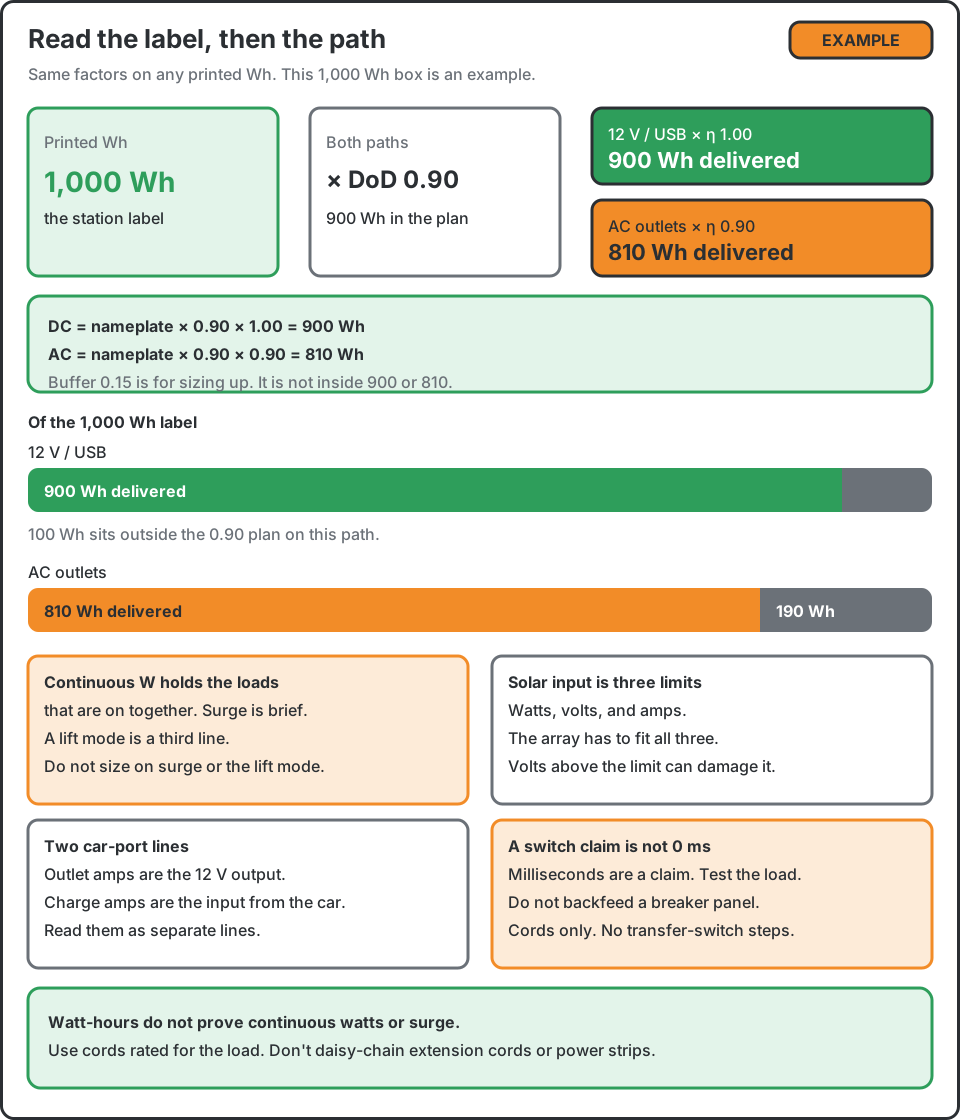
Usable Wh from the printed label
The drawing uses a round 1,000 Wh label so the factors are easy to see. The six shop labels below are not 1,000 Wh. Apply the same two products. Round the delivered watt-hours once, with Math.round. Days later in this page divide the exact product, not that rounded watt-hour.
On a phone, swipe the tables sideways.
| Sheet | Printed Wh | 12 V / USB exact | 12 V rounded | AC exact | AC rounded |
|---|---|---|---|---|---|
| EcoFlow DELTA 2 | 1,024 | 921.6 | 922 Wh | 829.44 | 829 Wh |
| Jackery Explorer 1000 v2 | 1,070 | 963 | 963 Wh | 866.7 | 867 Wh |
| BLUETTI AC180 | 1,152 | 1,036.8 | 1,037 Wh | 933.12 | 933 Wh |
| EcoFlow DELTA 2 Max | 2,048 | 1,843.2 | 1,843 Wh | 1,658.88 | 1,659 Wh |
| Jackery Explorer 2000 v2 | 2,042 | 1,837.8 | 1,838 Wh | 1,654.02 | 1,654 Wh |
| BLUETTI AC200L | 2,048 | 1,843.2 | 1,843 Wh | 1,658.88 | 1,659 Wh |
1,024 × 0.90 = 921.6 → 922 Wh on 12 V. 1,024 × 0.81 = 829.44 → 829 Wh on AC.
DELTA 2 Max and the AC200L print the same 2,048 Wh, so these two rows match. Explorer 2000 v2 prints 2,042 Wh, six watt-hours lower on the label. 6 × 0.81 = 4.86 Wh on the AC product before rounding. Chemistry, cycle endpoint, solar limits, car-charge limits, and expansion are the lines that still differ. The ~1,000 Wh class on this site runs from 513 Wh through 1,152 Wh, so 1,152 Wh is the class ceiling. 2,042 Wh and 2,048 Wh sit in the 1,153 Wh and up band.
What each sheet actually prints
All six base units print a LiFePO4 (LFP) cell. Cycle counts are not one test: EcoFlow’s manuals stop at 80%+, the Jackery sheets stop at 70%+, and the two BLUETTI product pages stop at 80% of original capacity. A higher count with a lower leftover percent is a different claim. The LiFePO4 vs NMC page is the chemistry primer. These six base sheets do not include an NMC station. The EcoFlow extra-battery page does: it lists a 2,016 Wh pack, chemistry NCM, 800 cycles to 80%, as applicable to DELTA 2. The station’s LFP line does not carry over to that pack. Day counts below stay on the base labels.
Continuous watts are the holding number. Surge, X-Boost, and Power Lifting are other lines. Jackery’s FAQ calls the short number “Maximum Instantaneous Output Power.”
| Sheet | Cell and cycles | Continuous AC | Short or timed high output | Third output line | Weight, as printed |
|---|---|---|---|---|---|
| DELTA 2 manual | LFP. 3,000 cycles to 80%+ capacity. | 1,800 W total, 120 V, pure sine. Surge 2,700 W on that same line. | Surge 2,700 W, printed with the 1,800 W line. | X-Boost 2,200 W. Manual: on by default, off in bypass, not for every appliance, more suitable for heating. Test is the manual’s instruction, not a result from this site. X-Boost works by lowering the output voltage. It is for resistive (heating) loads only and is not a surge rating. Don’t size on it. | About 12 kg (27 lbs) |
| Explorer 1000 v2 FAQ | LiFePO4. 4,000 cycles to 70%+ capacity. Updated 2026-10-15. | 120 V, 1,500 W per port, 1,500 W total, 3 ports. | Maximum instantaneous output 3,000 W. | The FAQ does not print an X-Boost or Power Lifting line. | Around 10.8 kg |
| AC180 manual | LiFePO4. Cycle count is not in the manual spec table. The US product page prints 3,500+ cycles to 80% original capacity. | 1,800 W total. US column: 120 V / 15 A. | Manual discharge section: surge of 2,700 W. | Power Lifting, off by default, resistive loads up to 2,700 W; lowers output voltage; not a surge rating. Rated output stays 1,800 W. Unavailable while AC charging, because that source bypasses the inverter. | Manual: about 16.4 kg / 36.16 lbs. The US product page prints about 16 kg / 35.27 lbs. This row uses the manual. |
| DELTA 2 Max manual | LFP. 3,000 cycles to 80%+ capacity. | 2,400 W total, 120 V, pure sine. Surge 4,800 W on that same line. | Surge 4,800 W, printed with the 2,400 W line. | X-Boost 3,400 W. Same family of limits as DELTA 2: off in bypass, not for every appliance. X-Boost works by lowering the output voltage. It is for resistive (heating) loads only and is not a surge rating. Don’t size on it. | About 23 kg (50 lbs) |
| Explorer 2000 v2 product page | LiFePO4. 4,000 cycles to 70%+ capacity. The page also prints 45.6 Ah / 44.8 V DC (2,042 Wh). 45.6 × 44.8 = 2,042.88. The sheet’s watt-hour line is 2,042 Wh, and that is the number used here. | 2,200 W rated, 120 V, 60 Hz, 18.3 A, 3 outlets. | 4,400 W surge peak, printed with the 2,200 W line. | The product page does not print an X-Boost or Power Lifting line. The FAQ (updated 2026-09-24) caps AC output at 1,500 W while charging and discharging together, under the 2,200 W rating. | Around 39.5 lbs (17.9 kg) |
| AC200L manual | LiFePO4. Cycle count is not in the manual spec table. The US product page prints 3,000+ cycles to 80% original capacity. | 2,400 W total, 120 V / 20 A. | Manual overload line: 2,520–3,000 W for 2 min, 3,000–3,600 W for 5 s, above 3,600 W for 0.5 s. The product page also prints “Surge Power: 7,200 W.” This page uses the manual’s timed bands and does not treat 7,200 W as the manual’s surge. | Power Lifting up to 3,600 W, resistive loads, off by default; lowers output voltage; not a surge rating. | 28.3 kg / 62.4 lb |
Charge limits, the 12 V port, and expansion
Solar input fails if any one of watts, voltage, or current is outside the line. Car-outlet amps run a 12 V load. Car-charge amps, or watts, are what the station draws from the vehicle. A millisecond figure is the sheet’s switch claim. It is not a 0 ms UPS, and it is not a test performed here.
| Sheet | AC charge input | Solar input | 12 V outlet | Charge from the vehicle | Switch claim | More capacity |
|---|---|---|---|---|---|---|
| DELTA 2 | X-Stream 1,200 W max, 100–120 V, 10 A. | 11–60 V, 15 A, 500 W max. | 12.6 V, 10 A, 126 W max. Shares that 126 W with the DC5521 ports. | 12 V / 24 V battery, default 8 A. | EPS within 30 ms. Manual: basic UPS, not 0 ms. Not for data servers or workstations. Test first. One device recommended. | Station manual: one Smart Extra Battery. That battery’s manual prints 1,024 Wh, LFP, 3,000 cycles to 80%+. The extra-battery page prints “Extra 1024Wh battery for EcoFlow DELTA 2” and “EcoFlow DELTA 2: 1 × Extra Battery.” The same page’s applicable-models lines also name DELTA 2 for a 2,016 Wh NCM pack (800 cycles to 80%) and a 2,048 Wh LFP pack (3,000 cycles to 80%+). It says not every extra battery fits every station. Day counts use the 1,024 Wh base. 1,024 + 1,024 = 2,048 is arithmetic on the two LFP labels. The page does not print that sum. |
| Explorer 1000 v2 | 100–120 V, max 15 A, max input 1,000 W ± 50 W. | 16–60 V. One port 10.5 A / 200 W. Two ports 21 A / 400 W. Ports are parallel. Mismatched panel watts are not supported. Solar and car charge together are not supported. | 12 V / 10 A. The pass-through line also prints 12 V, 10 A, max 120 W. | 12–16 V, current limit 8 A, one port or both. | FAQ: UPS within 20 ms. Not 0 ms. Not for data servers or workstations. Pass-through: yes. Simultaneous AC output while charging: 1,500 W. | FAQ row “Does the product support battery packs?” Answer: not supported. Parallel operation: not supported. |
| AC180 | Manual: 1,440 W max at 10–30°C / 50–86°F. US column 120 V, 15 A. Product page also prints a standard mode of 1,000 W max and a turbo mode of 1,440 W. Both lines stay. This page does not merge them into one watt. | 12–60 V DC, 500 W / 10 A max. Open-circuit voltage above 60 V is outside the manual’s warning. | 12 V DC / 10 A, regulated cigarette-lighter port. | Manual section: connect to the vehicle’s 12 V cigarette lighter. No amp and no watt on that paragraph. Product page recharge line: 12 V / 24 V car outlet, 100 W / 200 W. Both lines stay. This page does not convert 100 W into an amp. | Manual: switching time ≤20 ms. Test before use. Turn Grid Enhancement off when using it as a UPS, or the switch takes longer. Pass-through behavior: while AC charging, the AC source bypasses the inverter. | The manual spec table does not list an expansion port. The US product page names B80 (806 Wh), B230 (2,048 Wh), and B300 (3,072 Wh), and a total up to 4,224 Wh. Day counts below use the 1,152 Wh base only. |
| DELTA 2 Max | X-Stream max 1,800 W, 100–120 V, max 15 A. | 11–60 V, 15 A. One port 500 W. Two ports 1,000 W. | 12.6 V, 10 A, 126 W max. | 12 V / 24 V battery, default 8 A. | EPS within 30 ms. Manual: not 0 ms. Not for data servers or workstations. In bypass, the grid feeds the AC outlets. X-Boost is off in that state. | Manual: up to two Smart Extra Batteries. The US product page prints 6,144 Wh with those two. The extra-battery page prints a 2,048 Wh extra battery for DELTA 2 Max. 2,048 × 3 = 6,144 matches that product-page total. Day counts below use the 2,048 Wh base only. |
| Explorer 2000 v2 | Product page charge mode: 100–120 V, 60 Hz, 15 A max. No watt is printed on that line. FAQ: max input power 1,800 W ± 50 W. | Product page DC input: 11–16 V at 8 A max, still 8 A with both ports; 16–60 V at 12 A, both ports together 21 A / 400 W max. FAQ splits those ports: solar, one port 12 A / 200 W; car charge 11–16 V at 8 A. FAQ: mismatched panel watts are not supported, and solar plus car together are not supported. | Product page: 12 V, 10 A max. FAQ pass-through line: 12 V, 10 A, max 120 W. | 11–16 V, 8 A max, on the product-page DC input line and on the FAQ. | Product page: UPS under 20 ms, and bypass AC input/output 100–120 V, 12 A max. FAQ: within 20 ms, not 0 ms, not for data servers or workstations, pass-through yes. FAQ simultaneous AC output while charging: 1,500 W. The 12 A line and the 1,500 W line both stay. This page does not turn 12 A into a watt. | The product-page spec block does not list an extra battery. FAQ: battery packs not supported. Parallel operation not supported. |
| AC200L | Manual: 2,400 W max, 120 V, 20 A max, with the note 0–80% in 60 minutes at 25°C / 77°F. | 12–145 V DC, 1,200 W max, 15 A max. Open-circuit voltage above 145 V DC is outside the manual’s warning. | Cigarette lighter 12 V DC / 10 A. A separate 48 V / 8 A port is on the same output block. It is not the 12 V car outlet. | Manual: 12 V cigarette lighter, 96 W max, stop if input drops below 10.5 V. Product page recharge line prints 12 V / 24 V at 100 W / 200 W. Both lines stay. This page does not average 96 W and 100 W. | Manual: switching time ≤20 ms. Manual warning: do not use it as a high-performance UPS for data servers, workstations, or medical equipment. Manual danger line: do not connect the AC output to the grid. Product page prints pass-through charging: yes. | Manual: up to two B210 or two B300 units, and only one B230. Two B300 units: 8,192 Wh in the manual’s introduction. Day counts below use the 2,048 Wh base only. |
The van guide cites the CFX3 35 rated DC input of 7.5 A. At 12 V that rating is 90 W. Every 12 V outlet in the table prints 10 A. 7.5 A is under 10 A. EcoFlow’s shared cap is 126 W, and 90 W is under 126 W. Jackery’s pass-through line prints 120 W max on that port, and 90 W is under 120 W. Those are rating comparisons. They do not show that the compressor starts, and they do not clear a shared-port load beside the fridge.
The manuals print their own runtime shortcuts. This page does not use them. The AC180 manual’s small-load example is capacity × 90% × 85% ÷ (load + about 15 W), and its worked line is about 17 hours for a 40 W refrigerator. The AC200L manual’s example uses 95% depth of discharge, inverter efficiency over 93%, and about 12 W of self-consumption. WattNeeds keeps η, DoD, and buffer apart. The Explorer 1000 v2 FAQ prints standby power consumption of 18 W. That 18 W is not subtracted here. A Jackery runtime article that used to describe capacity × 0.8 returned HTTP 404 on 2026-10-21, so this page does not cite it.
Rainy camping weekend, fridge on 12 V
Same stack as weekend camping and rainy weekend. Solar = 0. The fridge row is the 320 Wh/day planning band, not the CFX3 282 Wh/day test point. Laptop 70 W × 2 h = 140 Wh. Lights 10 W × 5 h = 50 Wh. Phones 60 Wh. Total at the loads: 570 Wh/day.
Fridge on the 12 V port (320 Wh, η = 1.00) and phones on USB (60 Wh, η = 1.00). Laptop and lights on AC (190 Wh, η = 0.90). Battery draw per day is 380 + 190 / 0.90 = 591.111… Wh. Days = (nameplate × 0.90) / 591.111…. The all-AC column is the rainy-weekend path, every load on the inverter: days = (nameplate × 0.81) / 570.
Worked DELTA 2 row, mixed path: 1,024 × 0.90 = 921.6. 921.6 / 591.111… = 1.559098, shown as 1.559 days. Half-up to three decimals. Do not divide the rounded 922 Wh by 591.111….
| Printed Wh | Mixed days (12 V fridge) | All-AC days at 570 Wh | Buffered 1-day mixed plan, 755 Wh | Buffered 2-day mixed plan, 1,511 Wh |
|---|---|---|---|---|
| 1,024 | 1.559 | 1.455 | Covers | Short by 487 Wh |
| 1,070 | 1.629 | 1.521 | Covers | Short by 441 Wh |
| 1,152 | 1.754 | 1.637 | Covers | Short by 359 Wh |
| 2,042 | 3.109 | 2.902 | Covers | Covers |
| 2,048 | 3.118 | 2.910 | Covers | Covers |
The buffered plans are the weekend-camping results: mixed one day 755 Wh (exact 755.309), mixed two days 1,511 Wh (exact 1,510.617), all-AC two days 1,619 Wh. “Covers” means the printed label is at least that buffered nameplate. The ~1 kWh labels cover one mixed day and miss two mixed days with solar at zero. The 2,042 Wh and 2,048 Wh labels cover the 1,511 Wh plan and the 1,619 Wh all-AC plan (2,042 − 1,619 = 423 Wh of label above that plan). A 1,000 Wh round label on the rainy page is 1.4 days at one decimal of 810 / 570 = 1.421. These rows use the printed labels, so they are not that 1.4.
Home outage essentials
Scenario A on home outage, AC plugs only. Router 20 W × 24 h = 480 Wh. LED lamps 40 W × 6 h = 240 Wh. Phones and laptops allowance 150 Wh. Total 870 Wh/day. One buffered day is 1,235 Wh. Two buffered days are 2,470 Wh. Days here are (nameplate × 0.81) / 870. Buffer is not applied on the way down.
| Printed Wh | Days at 870 Wh, AC | 1-day plan, 1,235 Wh | 2-day plan, 2,470 Wh |
|---|---|---|---|
| 1,024 | 0.953 | Short by 211 Wh | Short |
| 1,070 | 0.996 | Short by 165 Wh | Short |
| 1,152 | 1.073 | Short by 83 Wh | Short |
| 2,042 | 1.901 | Covers | Short by 428 Wh |
| 2,048 | 1.907 | Covers | Short by 422 Wh |
The 1,152 Wh label’s runtime check crosses one day (1.073) and still misses the buffered plan by 1,235 − 1,152 = 83 Wh. Shop the buffered nameplate. The runtime column is the check with the buffer left off.
Scenario B on that guide adds the cited 434 kWh/year fridge label, 1,189 Wh/day, for 2,059 Wh/day and a one-day nameplate of 2,923 Wh. Every label in this table is under 2,923 Wh. Days at 2,059 Wh on AC: 1,024 Wh lasts 0.403 day, 1,070 Wh lasts 0.421 day, 1,152 Wh lasts 0.453 day, 2,042 Wh lasts 0.803 day, and 2,048 Wh lasts 0.806 day. A ~2 kWh base unit is under one day of that stack. HVAC, a well pump, a range, and a transfer switch stay off this page, same as the home-outage guide. The DELTA 2 Max product page mentions a transfer switch for partial home backup. This page does not repeat that procedure.
Parked van day, plus Starlink Mini
The mild parked day on van daily Wh is 635.8 Wh at the loads, all on 12 V or USB in that guide: CFX3 35 test point 282 Wh, one fan 25.2 Wh, four pucks 44 Wh, two phones 40 Wh, one laptop recharge 52.6 Wh, router ceiling 192 Wh. The Starlink guide sizes the Mini at the top of its sheet average, 40 W × 8 h = 320 Wh. Eight hours is that guide’s planning pick. The sheet average band is 25–40 W, and the input line is 12–48 V, 60 W max.
All-DC day: 635.8 + 320 = 955.8 Wh at η = 1.00. One-day buffered nameplate: 955.8 × 1.15 / 0.90 = 1,221.3 → 1,221 Wh. Split day: the van loads stay on 12 V / USB and the Mini uses its included AC supply. Battery draw = 635.8 + 320 / 0.90 = 991.355… Wh. Passes: 635.8 × 1.15 / 0.90 = 812.411 (the van guide’s 812 Wh) and 320 × 1.15 / 0.81 = 454.321 (the Starlink guide’s 454 Wh). Exact sum 1,266.732 → 1,267 Wh. The rounded passes add to 812 + 454 = 1,266. Add the exact passes first.
60 / 12 = 5 A at the Mini’s 60 W input maximum if the source is 12 V. 5 A is under the 10 A printed on these 12 V outlets. That comparison does not choose a connector. The Starlink guide’s rule stands: use the DC cable in the Mini kit, or the included AC supply. This page does not splice a cable. A station USB-C port at 100 W is the accessory-port method on the Starlink page, not this 320 Wh row.
| Printed Wh | Days, all DC, 955.8 Wh | Days, Mini on AC, draw 991.355… | All-DC plan, 1,221 Wh | Split plan, 1,267 Wh |
|---|---|---|---|---|
| 1,024 | 0.964 | 0.930 | Short by 197 Wh | Short by 243 Wh |
| 1,070 | 1.008 | 0.971 | Short by 151 Wh | Short by 197 Wh |
| 1,152 | 1.085 | 1.046 | Short by 69 Wh | Short by 115 Wh |
| 2,042 | 1.923 | 1.854 | Covers | Covers |
| 2,048 | 1.928 | 1.859 | Covers | Covers |
Worked all-DC DELTA 2 day: 1,024 × 0.90 = 921.6. 921.6 / 955.8 = 0.964218, shown as 0.964 day. The 1,152 Wh label’s runtime crosses one all-DC day (1.085) and is still 69 Wh under the 1,221 Wh buffered plan. Moving the Mini onto the AC supply shortens every row, because that 320 Wh then pays η = 0.90. Solar credit is zero, same as the van guide.
What these rows leave open
None of the day counts start a compressor, hold a kettle, or prove a router stays up through a switch. Continuous watts have to cover what is on together. Read surge, X-Boost, and Power Lifting as separate lines. Re-read the sheet that ships in the box if the model number differs, including AC180 versus AC180P (the product page prints 1,440 Wh for AC180P). Region columns differ: the AC180 manual’s EU voltage is not the US 120 V column used here, and the Jackery figures are the US FAQ rows dated above.
Related: weekend camping · rainy weekend · home outage · van daily Wh · Starlink Mini · camping fridge · surge traps · solar vs battery · LiFePO4 vs NMC · ~1,000 Wh class · ~2,000 Wh class
Wh calculator — one η per pass. 12 V and USB: set inverter efficiency to 1.00. AC outlets: leave η at 0.90. nameplate = (Wh/day × days × 1.15) / (0.90 × η).
Where to check pricing
As an Amazon Associate, we earn from qualifying purchases at no extra cost to you. EcoFlow, Jackery, and Bluetti partner programs are not live yet.
See on Amazon EcoFlow — Coming soon Jackery — Coming soon Bluetti — Coming soon