Starlink Wh from the kit sheet
Connectivity energy is average watts times hours online. A peak, a 60 W input maximum, and a USB-PD source requirement tell you whether the port and the inverter can supply the dish. They do not replace the watt-hour product. Camping, a parked van, or a home outage. Solar credit is zero.
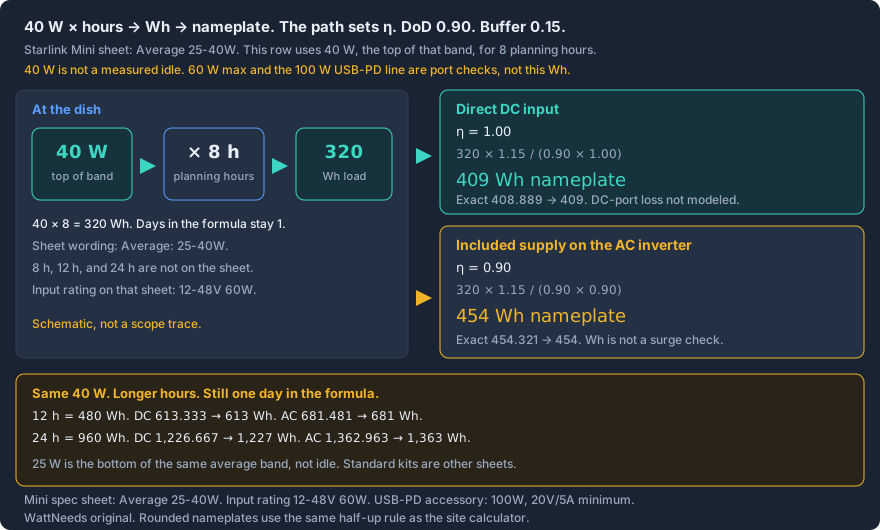
WattNeeds original schematic, not a scope trace and not a lab run. Mini planning row, 40 W × 8 h = 320 Wh: DC exact 408.889 rounds to 409 Wh; AC exact 454.321 rounds to 454 Wh. 12 h is 480 Wh (DC 613 Wh, AC 681 Wh). 24 h is 960 Wh (DC 1,227 Wh, AC 1,363 Wh). Sheet: Starlink Mini specifications.
Three sheets, three averages
Each line below is copied from that kit’s public specification sheet. Keep each average with its own kit. Idle and sleep behavior is not printed as a watt or as a Wh/day figure. Snow melt is printed as a precipitation rate, not as extra watts, so this page does not add a snow-melt term.
On a phone, swipe the tables sideways.
| Kit on the sheet | Average power, as printed | Snow melt, as printed | DC input on that sheet | Path sized here |
|---|---|---|---|---|
| Starlink Mini | Average: 25-40W | Up to 25mm / hour (1 in / hour) | 12-48V 60W | DC η=1.00 and AC η=0.90 |
| Standard kit, older sheet | Average: 50-75 W | Up to 40 mm / hour (1.5 in / hour) | No DC input line | Cited only. Not run through the formula. |
| Standard 4X | Average: 75 - 100 W | Up to 40 mm / hour (1.5 in / hour) | No DC input line | AC η=0.90 at 100 W, the top of this sheet’s band |
Sources, fetched 2026-10-12: Mini specification sheet (power line “Average: 25-40W”, input line “12-48V 60W”). Standard kit specification sheet (power line “Average: 50-75 W”). Standard 4X specification sheet (power line “Average: 75 - 100 W”). The Mini kit lists a DC power cable and a power supply. The Standard kit sheet lists an AC cable. The Standard 4X kit lists an AC power cable and a power supply. This page does not invent a DC input for either Standard sheet.
Mini at 40 W, the top of the average band
The Mini sheet prints one average band: 25-40W. The planning rows in this section use 40 W, the top of that band, so the nameplate covers the high side of the published average. 40 W is not a statement that the dish holds 40 W, and it is not an idle measurement. The hours are a WattNeeds planning pick: 8 h, 12 h, and 24 h online in one day. The sheet does not print those hours.
DC path: the same sheet prints Input Rating 12-48V 60W, and the kit includes a DC power cable. η = 1.00 is the site convention for that direct DC input. The station’s DC-port conversion loss is not in the number. The port still has to sit inside 12–48 V and be able to supply up to the 60 W maximum. That 60 W check is separate from the 40 W average used for watt-hours.
AC path: the kit includes a power supply. Plug that supply into the station’s AC inverter and use η = 0.90. The supply’s own line is “100-240V ~ 1.6A 50 - 60 Hz”. This page does not multiply a voltage by 1.6 A and call the product the dish watt.
| Scenario | Wh at the dish | Days | Path | η | Exact | Rounded |
|---|---|---|---|---|---|---|
| 40 W × 8 h | 320 | 1 | DC input | 1.00 | 408.889 | 409 Wh |
| 40 W × 8 h | 320 | 1 | AC inverter | 0.90 | 454.321 | 454 Wh |
| 40 W × 12 h | 480 | 1 | DC input | 1.00 | 613.333 | 613 Wh |
| 40 W × 12 h | 480 | 1 | AC inverter | 0.90 | 681.481 | 681 Wh |
| 40 W × 24 h | 960 | 1 | DC input | 1.00 | 1,226.667 | 1,227 Wh |
| 40 W × 24 h | 960 | 1 | AC inverter | 0.90 | 1,362.963 | 1,363 Wh |
Rounded values use the calculator’s half-up rule on the full quotient (Math.round). The exact column is that quotient to 3 decimal places. Worked 8 h row: 40 × 8 = 320 Wh. 320 × 1.15 / 0.90 = 408.888…, shown as 408.889, rounds to 409 Wh on the DC convention. 320 × 1.15 / 0.81 = 454.320…, shown as 454.321, rounds to 454 Wh on AC. Twelve hours: 40 × 12 = 480 Wh. 480 × 1.15 / 0.90 = 613.333…, rounds to 613 Wh. 480 × 1.15 / 0.81 = 681.481…, rounds to 681 Wh. All day online: 40 × 24 = 960 Wh. 960 × 1.15 / 0.90 = 1,226.666…, shown as 1,226.667, rounds to 1,227 Wh. 960 × 1.15 / 0.81 = 1,362.962…, shown as 1,362.963, rounds to 1,363 Wh. Twenty-four hours is one day with the dish online the whole day. It is not two days of autonomy.
Mini at 25 W, the bottom of the same band
25 W is the bottom of the printed average, “25-40W”. It is not a measured idle, not a sleep figure, and not a second test. The hours match the 40 W section so the band’s width is visible in watt-hours. 25 × 8 = 200 Wh. 25 × 12 = 300 Wh. 25 × 24 = 600 Wh.
| Scenario | Wh at the dish | Days | Path | η | Exact | Rounded |
|---|---|---|---|---|---|---|
| 25 W × 8 h | 200 | 1 | DC input | 1.00 | 255.556 | 256 Wh |
| 25 W × 8 h | 200 | 1 | AC inverter | 0.90 | 283.951 | 284 Wh |
| 25 W × 12 h | 300 | 1 | DC input | 1.00 | 383.333 | 383 Wh |
| 25 W × 12 h | 300 | 1 | AC inverter | 0.90 | 425.926 | 426 Wh |
| 25 W × 24 h | 600 | 1 | DC input | 1.00 | 766.667 | 767 Wh |
| 25 W × 24 h | 600 | 1 | AC inverter | 0.90 | 851.852 | 852 Wh |
Eight hours at the bottom of the band: 200 × 1.15 / 0.90 = 255.555…, shown as 255.556, rounds to 256 Wh on DC. 200 × 1.15 / 0.81 = 283.950…, shown as 283.951, rounds to 284 Wh on AC. Against the 40 W row for the same 8 hours, the load gap is 320 − 200 = 120 Wh. The rounded nameplates differ by 409 − 256 = 153 Wh on DC and 454 − 284 = 170 Wh on AC. Plan the top of the band when the sheet is the only watt you have. Use 25 W when you want to see the low side of that same printed average.
A maximum is not the average
The Mini input line is a maximum: 12-48V 60W. Holding 60 W for 8 hours is 60 × 8 = 480 Wh. That energy matches 40 W × 12 h, so the nameplates are the 12-hour row already in the table (DC 613 Wh, AC 681 Wh). The match is arithmetic. It does not make 60 W the average. Use 60 W to check the DC port. Use 25–40 W for the watt-hours.
The Mini sheet also prints a USB-PD line: “100W, 20V/5A Minimum (with Starlink USB-C to Barrel Jack Cable Accessory)”. That requirement applies when the USB-C-to-barrel accessory is in the path. The source then has to provide at least 100 W at 20 V / 5 A. Holding 100 W for 8 hours is 800 Wh. That is the accessory-port method, not the 25–40 W average. A station USB-C port that cannot meet 100 W at 20 V / 5 A does not satisfy that line. This page does not size a Mini day as 100 W × hours.
No surge watt is printed on the Mini sheet. Wh math still does not prove the inverter. The AC check is the station’s continuous watts and surge watts against whatever the supply actually draws, on surge traps. The 1.6 A figure on the Mini supply is an input rating across 100–240 V. It is not held for 8 hours on this page.
Standard kits stay on the AC path
The older Standard kit sheet prints Average: 50-75 W. The Standard 4X sheet prints Average: 75 - 100 W. Those are different kits. This page does not average them and does not stretch either band toward the Mini’s 25–40 W. Neither Standard sheet prints a DC input rating. The worked rows below do not invent η = 1.00 for them. Camping and van planning for these two kits uses the included AC supply on the station inverter, η = 0.90, unless a later sheet documents a DC input.
The sized Standard row is the Standard 4X sheet only, at 100 W, the top of “75 - 100 W”. The older sheet’s top, 75 W, is a different kit and is not substituted into these rows. Someone holding the older kit reruns the same formula at 75 W, or at 50 W for the bottom of that older band. The Standard 4X supply line is “100-240V ~ 2.5A 50 - 60 Hz”. This page does not multiply a voltage by 2.5 A. No surge watt is printed for Standard 4X.
| Scenario | Wh at the dish | Days | Path | η | Exact | Rounded |
|---|---|---|---|---|---|---|
| Standard 4X, 100 W × 8 h | 800 | 1 | AC inverter | 0.90 | 1,135.802 | 1,136 Wh |
| Standard 4X, 100 W × 12 h | 1,200 | 1 | AC inverter | 0.90 | 1,703.704 | 1,704 Wh |
100 × 8 = 800 Wh. 800 × 1.15 / 0.81 = 1,135.802…, shown as 1,135.802, rounds to 1,136 Wh. 100 × 12 = 1,200 Wh. 1,200 × 1.15 / 0.81 = 1,703.703…, shown as 1,703.704, rounds to 1,704 Wh. Eight hours at this 100 W upper average is 800 / 320 = 2.5 times the Mini 40 W × 8 h load. The exact AC quotients stay in that ratio. After each row is rounded on its own, 1,136 / 454 = 2.502.
The dish is not the whole day
The 409 Wh DC figure is the Mini slice for 8 hours at 40 W. It is not a van day and not a camping weekend. A CFX3 35 test point alone is 282 Wh/day, which is 360 Wh nameplate on 12 V for one day. The mild parked day on van daily Wh is 635.8 Wh at the loads before any Starlink row (DC nameplate 812 Wh, AC nameplate 903 Wh). Add the dish in the calculator on the path you will actually use. A rainy weekend with no solar credit is sized on rainy-weekend sizing, still with this dish as its own row.
A phone used as a hotspot is a small secondary slice. If the phone is charging anyway, the extra energy is on the order of tens of Wh/day. This page does not print a lab Wh/day for hotspot mode. The van-life phone row is a planning ceiling at the Apple 20 W adapter rating (two phones, 1 h each, 40 Wh). That row is not a hotspot measurement either.
Related: van daily budget · rainy-weekend sizing · camping fridge · surge traps · disclaimer
Wh calculator — enter watts × hours as Wh/day. Mini DC input: set inverter efficiency to 1.00. AC supply: leave η at 0.90. nameplate = (Wh/day × days × 1.15) / (DoD × η).
Where to check pricing
As an Amazon Associate, we earn from qualifying purchases at no extra cost to you. EcoFlow, Jackery, and Bluetti partner programs are not live yet.
See on Amazon Jackery — Coming soon EcoFlow — Coming soon Bluetti — Coming soon