Camping fridge: duty cycle, ambient temperature, real Wh/day
A compressor fridge’s rated watts are what the input is allowed to draw. The day is the average, and the average moves with the air outside the box, the setpoint, the lid, and the shade. Sheets on this page were read 2026-10-30. WattNeeds did not test a fridge.
Rated watts held all day are the wrong product
The compressor runs, then it stops. Holding the nameplate current for 24 hours counts the off time as if the compressor were still on. Dometic’s own line, on the rated-current article and on the CFX3 35 page, is that energy consumption is the average ampere-hours on 12 V at a given ambient and a given internal setpoint. Rated input current is the maximum the unit is rated to draw.
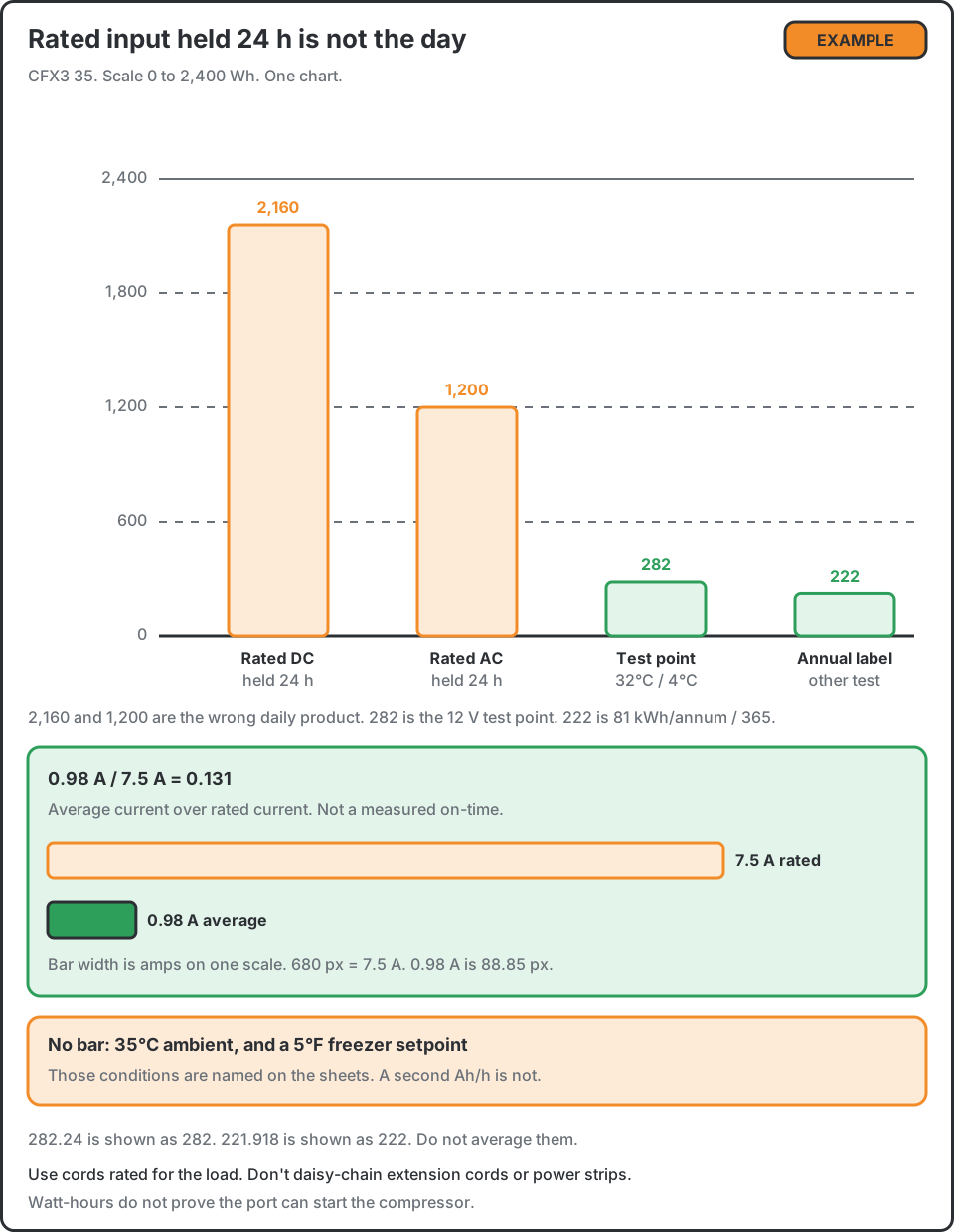
The US CFX3 35 sheet prints both. Energy consumption is 0.98 Ah/h at 12 V, ambient 90°F, internal 39°F. The same product page’s Celsius listing of that cell is ambient 32°C, internal 4°C. Rated DC current is 7.5 A. Rated AC input power is 50 W. Volume is 36 L. One condition. Not a season.
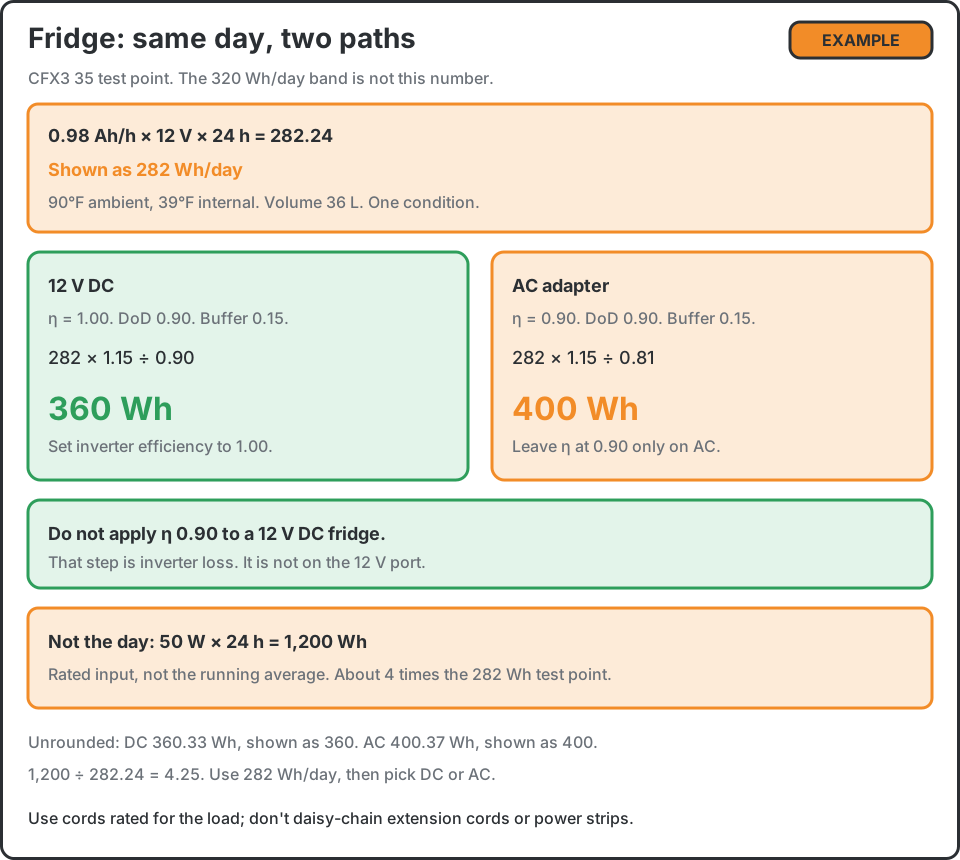
0.98 Ah/h × 12 V × 24 h = 282.24 → 282 Wh/day
0.98 Ah/h × 12 V = 11.76 W average at that test point
7.5 A × 12 V × 24 h = 2,160 Wh (rated DC current held all day)
50 W × 24 h = 1,200 Wh (rated AC input held all day)
2,160 / 282.24 = 7.653. 1,200 / 282.24 = 4.252. Those quotients are how far the rated-input day sits above the test point. They are not a measured duty cycle. The rounded day, 282 / 24 = 11.75 W, is 0.01 W under 11.76 because 282 is 282.24 rounded to the watt-hour. Size from 282, the figure already used on van life and weekend camping. Sizing from the unrounded 282.24 would nameplate one day on 12 V to 361 Wh. This page does not do that.
Average current over rated current is 0.98 / 7.5 = 0.131. Dometic does not say the compressor draws 7.5 A for 13.1% of the hour and zero otherwise. The 7.5 A cell is a maximum. The 0.98 Ah/h cell is an average at one ambient and one setpoint. The ratio is those two printed numbers. It is not an on-time this site measured.
The same US sheet prints rated AC current 0.78 A at 120 V next to rated AC power 50 W. 0.78 × 120 = 93.6, which is not 50. The sheet prints both cells and does not say how 50 W was measured. This page does not replace 50 W with 93.6. The wrong-method day uses the printed 50 W.
What moves the average, in the manual’s own words
The CFX3 series manual (09/2020, document 4445103159) prints an energy-saving list. It does not print a second Ah/h next to any bullet. Quoted as printed:
- Choose a well ventilated location which is protected from direct sunlight.
- Allow warm food to cool down first before placing it in the cooling device to keep cool.
- Do not open the cooling device more often than necessary.
- Do not leave the cooling device open for longer than necessary.
- Defrost the cooler once a layer of ice forms.
- Avoid unnecessarily low temperatures.
The safety section adds a clearance: a minimum of 50 mm ventilation on all four sides, and do not place the cooler in a closed compartment or cover the vents. “Allow warm food to cool down first” is the manual’s pre-cool sentence. It is about the food, not a watt-hour credit for running the box on shore power the night before. No pre-cool Wh is printed. No lid-opening Wh is printed. Shade and the 50 mm gap are operating instructions. They are not a percent this page can multiply.
The same manual’s CFX3 35 column prints climate class N, T, ambient +16°C to +43°C (61°F to 110°F), cooling capacity −22°C to +10°C (−7°F to +50°F), and energy consumption 81 kWh/annum. The standards line says energy consumption is determined by IEC 62552 (2018). The manual does not restate that standard’s ambient and setpoint on the 81 kWh row. 81,000 / 365 = 221.918, which rounds to 222 Wh/day. That is a different test from 0.98 Ah/h. This page does not average 222 and 282.
The product-page FAQ recommends 5°F for freezing and 39°F for refrigeration, and says even small setpoint changes affect energy consumption. The only 12 V Ah/h on the CFX3 35 sheet is the 39°F / 4°C cell. A freezer setpoint has no second Ah/h on that sheet or in this manual.
What other makers print, and what they do not
Each row is a sentence on a sheet read 2026-10-30. A watt rating with no ambient is not a Wh/day. Ice versus a compressor, with the same gadgets, stays on cooler vs fridge.
| Sheet | What it prints | What this page does with it |
|---|---|---|
| CFX3 35, US | 0.98 Ah/h at 90°F / 39°F (32°C / 4°C). Rated DC 7.5 A. Rated AC 50 W. Volume 36 L. | 282 Wh/day. The worked 32°C day. |
| CFX3 manual, 36 L column | 81 kWh/annum. Ambient range +16°C to +43°C. IEC 62552 (2018) named, conditions not restated. | 222 Wh/day. A different test. Not a mild weekend. |
| ICECO VL45 ProD V4.0 manual (host is a retailer CDN; the PDF names ICECO) | Q&A cell: VL45, 0.348 kW·h. Sentence: laboratory testing only; actual consumption depends on conditions. No ambient and no setpoint on that cell. Catalog cell on the same PDF: VL45/74, 0.4348 / 0.416. No VL45 ProD kWh in the Q&A table. | 0.348 kW·h = 348 Wh if that one cell is converted. The catalog cell disagrees. No nameplate. |
| BougeRV CR PRO manual (outlined type; read from the render). Spec table. | CR PRO 30: ECO 36 W, MAX 45 W. Temperature range −22°C to 10°C. No ambient on the watt row. The manual says the table might differ from the nameplate. | 36 × 24 = 864 Wh and 45 × 24 = 1,080 Wh are rated watts held all day. Not a day. |
| Same BougeRV manual, features page | ECO mode “less than 45 W.” “Consumes far less than 1 kWh/day.” Empty-box MAX pull-down: 15 min from 77°F to 32°F, 50 min from 77°F to −4°F. Those are times, not watt-hours. | “Far less than 1 kWh/day” is far less than 1,000 Wh/day. It is not a number to type. It also disagrees with the spec table’s 36 W ECO line. No nameplate. |
| BougeRV CRPRO30 product page | One block prints ECO 45 W, MAX 60 W. Another block on the same page prints ECO 36 W, MAX 45 W. A comparison chart assigns Max 60 W / Eco 45 W to CR-PRO. | Three watt pairs, no ambient, no Wh/day. Not used. |
| Alpicool C20 | Rated power 60 W. DC 5.0 A / 2.5 A on 12/24 V. Cooling range −20°C to 20°C. No Wh/day. No cutoff volts. Three-stage battery protection is named, not numbered. | 5.0 × 12 = 60, and 2.5 × 24 = 60. Those products match the printed watt. 60 × 24 = 1,440 Wh is the rated input held all day. Not a day. |
Hot weather at the printed 32°C point
32°C is 89.6°F. The sheet’s Fahrenheit cell says 90°F. That is the published hot-weather point: ambient 32°C, internal 4°C, 282 Wh/day. 35°C is inside the manual’s +16°C to +43°C range. No Ah/h is printed at 35°C. This page does not add a percent for that 3°C. A parked cabin above 90°F is a different problem, sized on van life as a labeled what-if, not as a lab step.
One day and two days, solar = 0. Steps are load ÷ η, × 1.15, ÷ 0.90. The published nameplate is Math.round of the full quotient.
| Path | Days | η | Exact | Nameplate |
|---|---|---|---|---|
| 12 V | 1 | 1.00 | 360.333 | 360 Wh |
| AC | 1 | 0.90 | 400.370 | 400 Wh |
| 12 V | 2 | 1.00 | 720.667 | 721 Wh |
| AC | 2 | 0.90 | 800.741 | 801 Wh |
282 × 1.15 / 0.90 = 360.333 → 360 Wh
282 × 1.15 / 0.81 = 400.370 → 400 Wh
282 × 2 × 1.15 / 0.90 = 720.667 → 721 Wh
282 × 2 × 1.15 / 0.81 = 800.741 → 801 Wh
From the battery, before buffer and DoD, the AC path takes 282 / 0.90 = 313.333 Wh for the same 282 Wh at the fridge. The 12 V path takes 282 Wh. The difference is 31.333 Wh a day, which is the inverter term this site models. It is not a measured inverter. A 500 Wh label delivers 450 Wh on 12 V: 450 / 282 = 1.596 days if the test point held. On AC it delivers 405 Wh: 405 / 282 = 1.436 days. The buffer is not applied on that check. The buffered one-day plans are 360 Wh and 400 Wh. A 500 Wh label covers both. Two AC days (801 Wh) still fit a 1,000 Wh label. Two 12 V days (721 Wh) do too. Energy is not the miss on a fridge-only test-point weekend. The port amp ceiling, below, can still be the miss.
A mild weekend has no printed Wh/day
Fail as a manufacturer day. Nothing read for this page prints an Ah/h or a Wh/day at an ambient cooler than the 32°C / 4°C point. The annual 222 Wh figure is the IEC label converted, and the manual does not say that test was a mild camp. Using 222 as the weekend would be a different test wearing a weather name.
If the annual label is sized anyway, so it is not confused with 282:
222 × 1.15 / 0.90 = 283.667 → 284 Wh on 12 V
222 × 1.15 / 0.81 = 315.185 → 315 Wh on AC
Do not shop the weekend on 284 Wh. Do not average 222 and 282.
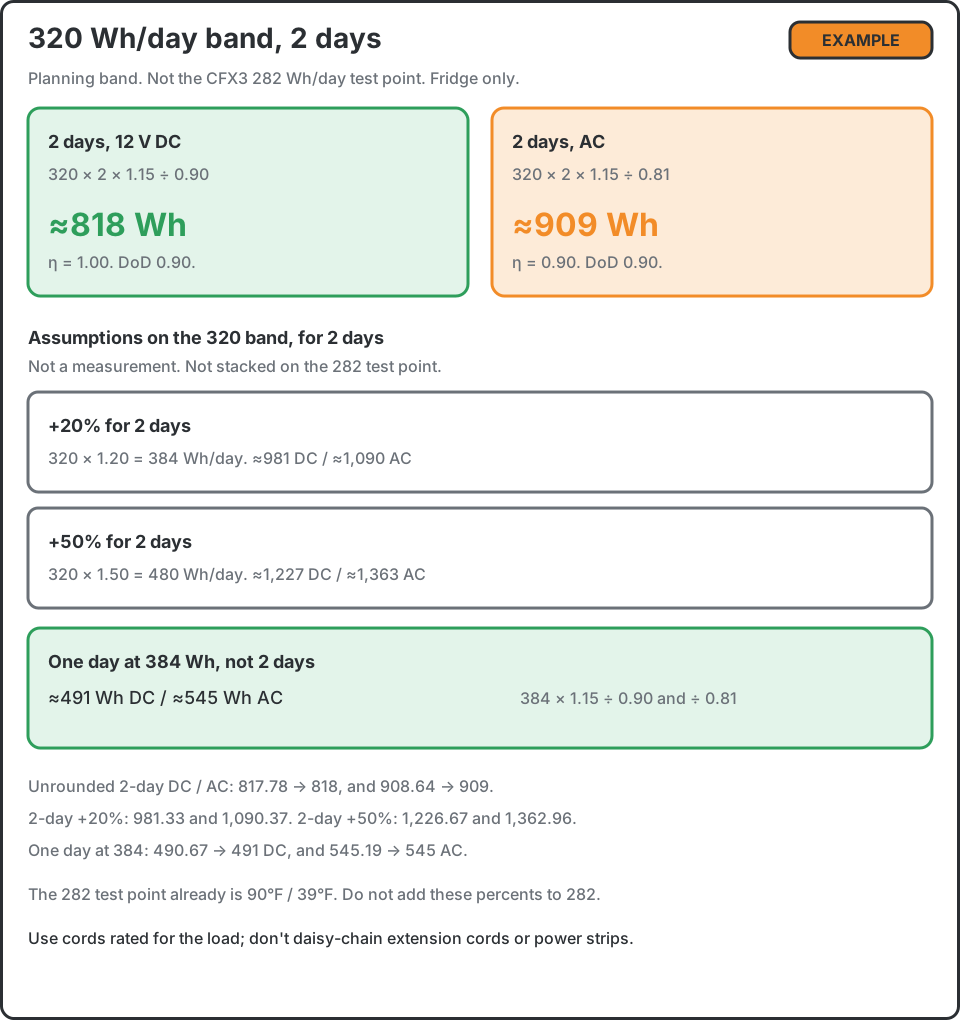
The homepage camping sample is 320 Wh/day. It is a planning band. It is unsourced. It is larger than the 90°F test point, so it is not a mild-weather measurement either. Other pages still use it: weekend camping and cooler vs fridge. The arithmetic, if you type 320:
| Band | What it is | 2-day 12 V | 2-day AC |
|---|---|---|---|
| 320 Wh/day | Homepage sample. Unsourced. | 817.778 → 818 Wh | 908.642 → 909 Wh |
| 384 Wh/day | 320 × 1.20. Assumption. Not a 35°C test. | 981.333 → 981 Wh | 1,090.370 → 1,090 Wh |
| 480 Wh/day | 320 × 1.50. Assumption. Not a freezer test. | 1,226.667 → 1,227 Wh | 1,362.963 → 1,363 Wh |
320 × 2 × 1.15 / 0.90 = 817.778 → 818 Wh
320 × 2 × 1.15 / 0.81 = 908.642 → 909 Wh
One day at 320 is 408.889 → 409 Wh on 12 V and 454.321 → 454 Wh on AC. One day at 384 is 490.667 → 491 Wh on 12 V and 545.185 → 545 Wh on AC. The +20% and +50% rows are headroom on the unsourced band. They are not a Dometic multiplier and not a WattNeeds measurement. They are not the step from 32°C to 35°C, and they are not a freezer factor.
Freezer mode: no Wh/day to size
Fail. Dometic recommends 5°F for freezing and prints the 0.98 Ah/h cell at 39°F internal. The manual’s cooling-capacity row goes to −22°C. Neither line is an energy figure at 5°F. BougeRV’s 50-minute pull-down to −4°F is a time on an empty box in MAX mode. The manual does not say 45 W held for those 50 minutes. This page does not turn that sentence into watt-hours.
Entering 282 for a freezer setpoint uses the refrigeration test point for a colder box. The FAQ says small setpoint changes affect consumption. There is no printed factor to apply. Leave the freezer row blank until a sheet states the ambient, the setpoint, and the Ah/h or Wh/day together.
Fridge, phones, and lights on a small station
The fridge number is the CFX3 test point, 282 Wh. The other two numbers are the site allowances already used on weekend camping: lights 10 W × 5 h = 50 Wh, phones 60 Wh. They are planning figures, not a measured camp. The day at the loads is 282 + 50 + 60 = 392 Wh.
| Path | Days | η | Exact | Nameplate |
|---|---|---|---|---|
| All on 12 V and USB | 1 | 1.00 | 500.889 | 501 Wh |
| All on AC outlets | 1 | 0.90 | 556.543 | 557 Wh |
| All on 12 V and USB | 2 | 1.00 | 1,001.778 | 1,002 Wh |
| All on AC outlets | 2 | 0.90 | 1,113.086 | 1,113 Wh |
392 × 1.15 / 0.90 = 500.889 → 501 Wh
392 × 1.15 / 0.81 = 556.543 → 557 Wh
The AC path takes 392 / 0.90 = 435.556 Wh from the battery before buffer and DoD. The 12 V path takes 392 Wh. That is 43.556 Wh a day of modeled inverter loss on this stack. The exact nameplates differ by 556.543 − 500.889 = 55.654 Wh. The rounded labels differ by 557 − 501 = 56 Wh. Add the exact figures. Do not subtract the rounded labels and call that the gap.
Why the 12 V port wins on this arithmetic: the same 392 Wh never gets divided by 0.90. A 500 Wh label delivers 450 Wh on 12 V and 405 Wh on AC. 450 / 392 = 1.148 days. 405 / 392 = 1.033 days. The runtime check has no buffer. The buffered one-day plan is 501 Wh on 12 V and 557 Wh on AC. A 500 Wh label is short of 501 by 1 Wh. This site’s class ceiling for results up to 512 Wh still contains 501. A 1,000 Wh label covers 501 and 557. It does not cover two days: 1,002 and 1,113 are both above 1,000 and inside the 513–1,152 Wh class. A 2,000 Wh label covers both two-day rows.
The RIVER 2 Max manual (EFR610) prints 512 Wh, not a 500 Wh label. On 12 V, 512 × 0.90 = 460.8 Wh delivered. 460.8 / 392 = 1.176 days. 512 is at least 501, so that sheet covers the one-day 12 V nameplate on energy. It does not cover 1,002. The same manual’s DC output line is 12.6 V, 10 A / 3 A / 3 A, 126 W max. The port diagram names a car-charger outlet and two DC5521 ports. The spec line does not say which amp belongs to which port. EcoFlow's port table puts 126 W on the car outlet and 37 W on each DC5521, so the car outlet is the 10 A leg.
The DELTA 2 manual does separate them: car charger 12.6 V, 10 A, 126 W max; each DC5521 port 12.6 V, 3 A, 38 W max. The manual adds that the car outlet shares power with the DC5521 ports, for 126 W max combined, so a fridge on the car outlet plus anything on the barrel ports still has to stay under 126 W. Printed capacity is 1,024 Wh. CFX3 rated DC current is 7.5 A, and 7.5 × 12 = 90 W while the input is at that rating. 7.5 A is under 10 A and over 3 A. 90 W is under 126 W and over 38 W. The car-charger cell is the one under the rated current. The barrel ports are not. Alpicool’s printed 5.0 A is also under 10 A and over 3 A. BougeRV’s manual does not print an amp, so no port comparison is made for it. None of these comparisons is a compressor start. The CFX3 sheet does not print a start surge.
Low-voltage cutoff
A full nameplate still goes dark if the fridge opens its own battery monitor. The CFX3 manual, figure on page 11, prints 12 V switch-off and restart for Low / Medium / High. Section 7.10 says the cooler switches off when supply voltage falls below the set level and switches back on at the restart voltage. Read from that figure:
| 12 V | Low | Medium | High |
|---|---|---|---|
| Switch off | 10.1 V | 11.2 V | 11.8 V |
| Restart | 11.4 V | 12.2 V | 12.6 V |
The 24 V pair on the same figure is 21.5 / 24.1 / 24.6 V off and 23.0 / 25.3 / 26.2 V on. The note in section 7.10: a starter battery uses Medium or High; a supply battery uses Low. A portable station is a supply battery in that sentence. This page does not retest the figure against a regulated 12.6 V port. High’s restart cell is 12.6 V, the same number DELTA 2 prints as its car-charger voltage. Equal numbers on two sheets are not a running test.
Dometic’s product-page FAQ says the monitor uses voltage while the compressor is running, not the open-circuit voltage, and says not to use splitters, pigtails, or extensions because of voltage drop. That matches the cord line above. Their battery-chemistry note (lead-acid about 50% of rated Ah, NMC about 80%, their LiFePO4 nearly 100%) is their runtime method. It is not this site’s DoD. DoD stays 0.90 on both paths.
The BougeRV manual’s 12 V table, read from the render, is High / Medium / Low cut-out 11.3 / 10.1 / 9.6 V and cut-in 12.5 / 11.4 / 10.9 V. The 24 V row is 24.6 / 22.3 / 21.3 V out and 26.0 / 23.7 / 22.7 V in. The operation page says a power station should use Medium or Low. Factory setting is High. Restart is after 2 minutes once cut-in is reached. ICECO’s VL45 ProD manual prints 12 V cut-off / cut-in as Low 9.6 / 10.9 V, Med 10.4 / 11.7 V, High 11.1 / 12.4 V, and says the supply line has a 15 A fuse in the refrigerator. That fuse is not a station-port rating. A 10 A car-charger cell is still the station’s ceiling. Alpicool names three stages and prints no volts.
A solar top-up does not shrink the nameplate
The calculator has no solar field. Days in the formula are days with no recharge. Harvest, when a panel is actually aimed, is the formula on solar vs battery:
harvest Wh/day = panel W × peak sun hours × 0.86
The 0.86 is that guide’s conversion of the PVWatts Version 5 default loss stack. It is an upper estimate there, not a camp measurement. Dometic’s CFX3 FAQ says to plan on roughly 6 hours of sun and that panel current is usually 4–8 A. This page does not adopt either sentence. A Seattle annual planning hour was checked again 2026-10-30 on the same PVWatts V8 request the solar guide used (47.6062, −122.3321, tilt 30°, azimuth 180°). solrad_annual came back 3.98696432964468, the same full value that guide plans as 3.99 h. Weather file 241108, Washington, 730 m.
100 W × 3.99 h × 0.86 = 343.14 Wh/day at the battery
The 12 V test point asks the battery for 282 Wh, because η=1.00. 343.14 − 282 = 61.14 Wh of surplus on that average day of the weather file. The surplus is not spare battery, and it is not the night. From sunset to sunrise the harvest term is zero. Do not type 61 into the calculator. Keep 282, or 392, in the load. Set days to the dark stretch. A storm or a site under trees is the solar = 0 case, which is the nameplate table above.
Pass / fail
“Energy covers” means the round label, or the printed sheet capacity where one is named, is at least the buffered nameplate. It does not mean the compressor starts, and it does not mean the cutoff stays closed.
| Plan | Result |
|---|---|
| CFX3 test point, 1 day, 12 V, 360 Wh | A 500 Wh label covers the energy. The car-charger 10 A cell is over 7.5 A. A 3 A barrel port is not. Not a start pass. |
| Same day on AC, 400 Wh | Energy covers on a 500 Wh label. The inverter still has to start the compressor. See surge traps. The AC path costs the modeled 31.333 Wh. |
| Same fridge, 2 days, 12 V, 721 Wh | A 500 Wh label is short. A 1,000 Wh label covers the energy. |
| Mild weekend as a manufacturer Wh/day | Fail. No sheet. 222 is the annual label. 320 is the unsourced homepage band and is larger than 282. |
| 35°C, or any freezer setpoint | Fail. No Ah/h. Do not scale 282. Do not scale 320 and call it 35°C or 5°F. |
| 392 Wh stack, 1 day, 12 V, 501 Wh | A 500 Wh label is short by 1 Wh. The class ceiling is 512 Wh. The RIVER 2 Max sheet is 512 Wh, so that sheet covers the energy. Two of its printed DC amps are 3 A. A 3 A leg fails 7.5 A. EcoFlow's port table puts 126 W on the car outlet and 37 W on each DC5521, so the car outlet is the 10 A leg. |
| 392 Wh stack, 1 day, AC, 557 Wh | A 500 Wh label is short. A 1,000 Wh label covers the energy and still pays the inverter term. |
| 392 Wh stack, 2 days, solar = 0 | 1,002 Wh on 12 V and 1,113 Wh on AC. A 1,000 Wh label is short of both. Both sit in the 513–1,152 Wh class. A 2,000 Wh label covers both. |
| ICECO 0.348 kW·h, BougeRV watts, Alpicool 60 W | Fail as a day. Conditions missing, or the cells disagree, or the figure is rated watts. 864, 1,080, and 1,440 Wh are the held-all-day products. Not plans. |
Related: cooler vs fridge (ice vs compressor, same gadgets) · weekend camping (the 392 Wh stack in a full weekend) · van life (the parked day, and the hot-cabin what-if) · solar vs battery (harvest, solar = 0) · surge traps
Wh calculator — enter the fridge as Wh/day and leave watts blank. 12 V port: set inverter efficiency to 1.00. AC adapter: leave η at 0.90. nameplate = (Wh/day × days × 1.15) / (0.90 × η).
Where to check pricing
As an Amazon Associate, we earn from qualifying purchases at no extra cost to you. EcoFlow, Jackery, and Bluetti partner programs are not live yet.
See on Amazon EcoFlow — Coming soon Jackery — Coming soon Bluetti — Coming soon