Van daily Wh: one parked day, two paths
A portable station and the loads you can plug into it. Fridge on its 12 V cable or its AC cord. Fan on the 12 V socket. Router, phones, and laptop on USB-C. Engine off. Solar credit is zero.
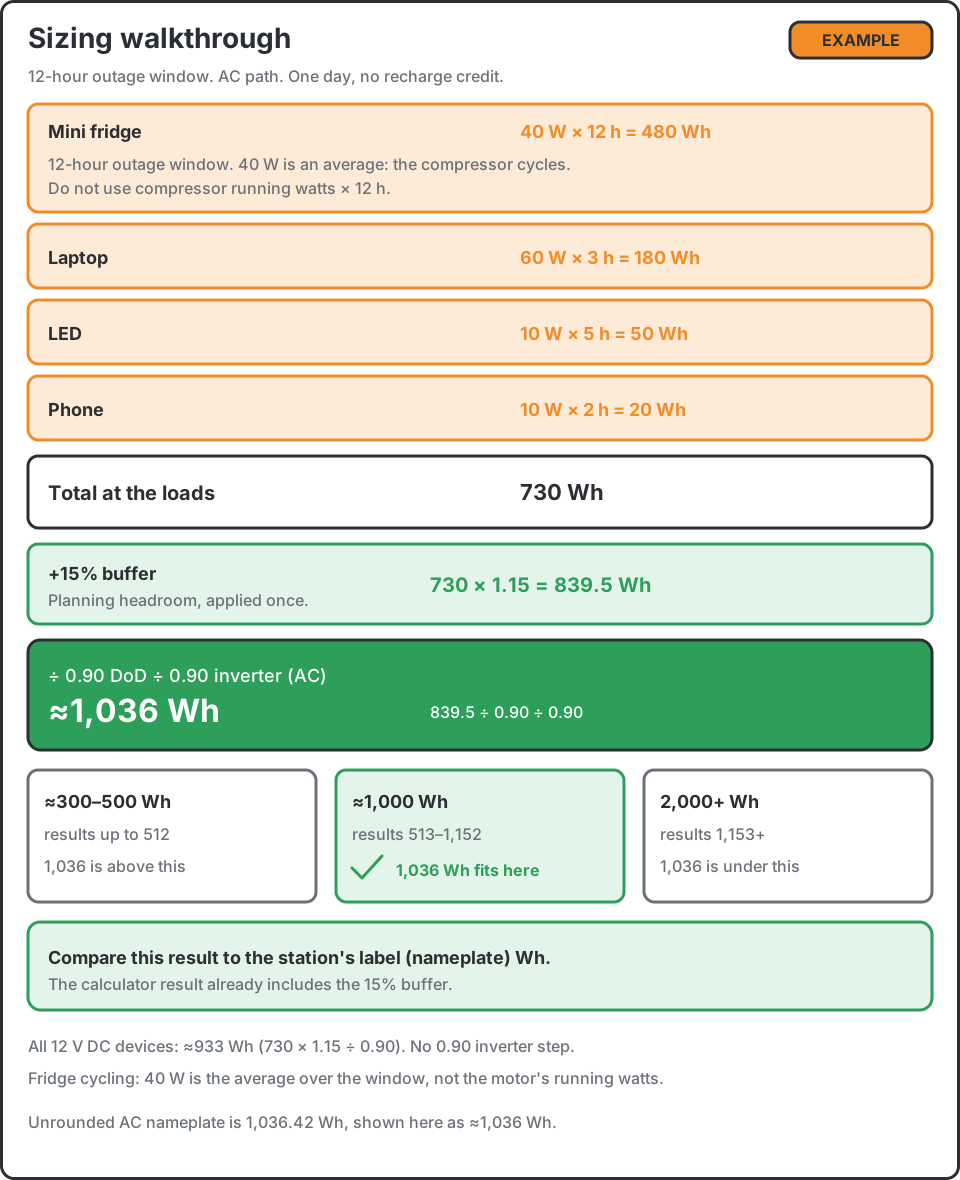
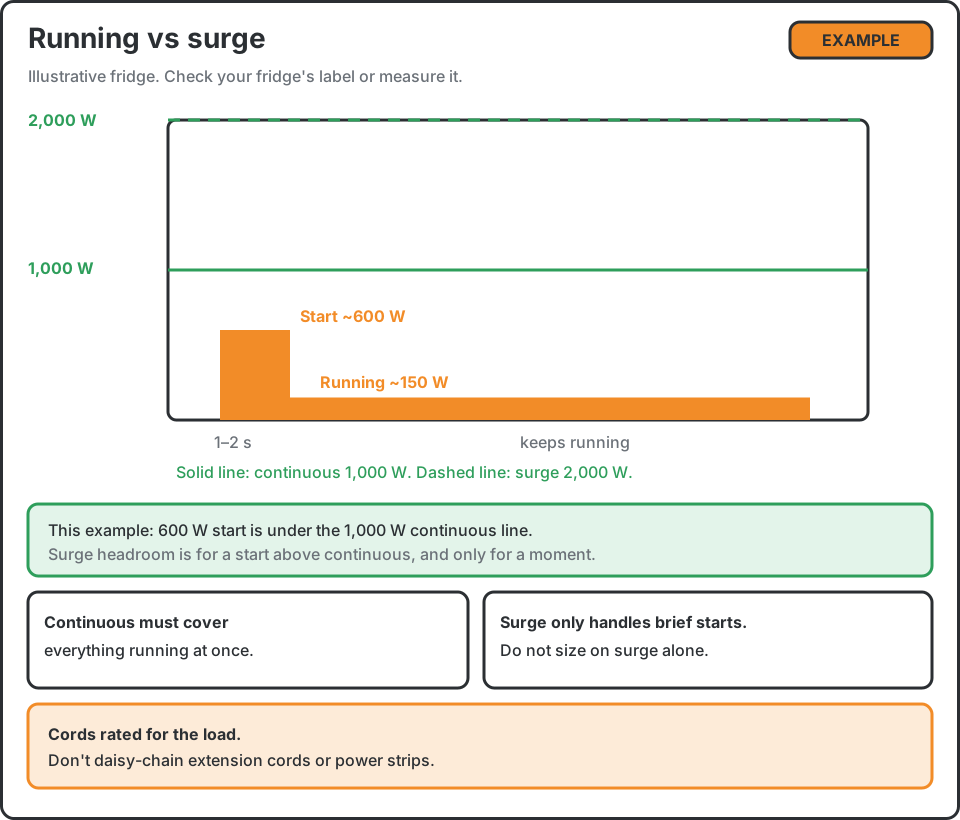
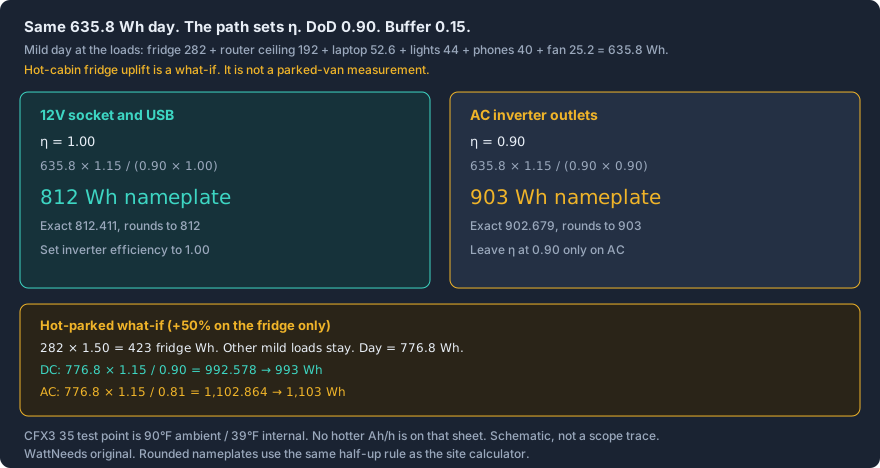
WattNeeds original schematic, not a scope trace and not a lab run. Mild day 635.8 Wh at the loads: DC exact 812.411 rounds to 812 Wh; AC exact 902.679 rounds to 903 Wh. Hot-parked +50% fridge what-if is 776.8 Wh: DC exact 992.578 rounds to 993 Wh; AC exact 1,102.864 rounds to 1,103 Wh. Fridge method lives on camping fridge Wh/day.
Mild parked day
Wh/day is energy at the device. Compressor fridges cycle, so the fridge row uses Dometic’s average amp-hours, then × 12 V × 24 h. The camping fridge guide walks that conversion. 0.98 × 12 × 24 = 282.24, published here as 282 Wh/day, matching that guide. The test point is ambient 90°F, internal 39°F. It is one condition.
On a phone, swipe the tables sideways.
| Load | Basis | Wh/day | What the number is |
|---|---|---|---|
| CFX3 35 on 12 V | 0.98 Ah/h × 12 V × 24 h | 282 | Spec test point. 282.24 rounded to 282. Ambient 90°F, internal 39°F. CFX3 35 spec. |
| One Caframo Sirocco II, high, 6 h | 0.35 A × 12 V = 4.2 W; × 6 h | 25.2 | High-speed 12 V draw from the Sirocco II spec table. 6 h is one of the published timer steps (3, 6, 9, 12). One fan is this scenario’s count. |
| Four 12 V LED pucks, 5 h | 2.2 W × 4 × 5 h | 44 | 2.2 W at 12 V is the Stanpro Slim Puck rating. Four lamps and 5 h are this scenario’s planning pick. The sheet does not publish hours of use. |
| Two phones, 1 h each | 20 W × 2 × 1 h | 40 | Planning pick at the Apple 20 W USB-C adapter rating (iPhone power adapters). Count and hours are this scenario. A phone often draws less than 20 W, so 40 Wh is a ceiling for this pick. |
| MacBook Air 13-inch (M3), one recharge | 52.6 Wh battery | 52.6 | Published battery size (Apple tech specs). One recharge is this scenario. 52.6 Wh is energy stored in the pack. Charger loss is not on that page, so this row is a floor. |
| GL.iNet GL-MT3000, 24 h | 8 W × 24 h | 192 | Ceiling. The Beryl AX spec says power consumption is under 8 W, USB-C 5 V / 3 A. 24 h is this scenario (left on all day). |
| Mild day | 282 + 25.2 + 44 + 40 + 52.6 + 192 | 635.8 | Sum at the devices. No solar. No driving charge. |
Rated DC input on the CFX3 35 sheet is 7.5 A. At 12 V that is 90 W while the input is at that rating. 90 W × 24 h = 2,160 Wh. Rated AC input is 50 W, and 50 × 24 = 1,200 Wh. Both are the wrong daily-energy product. Average power at the 282 Wh test point is 282 / 24 = 11.75 W. Use 282 Wh/day, then pick DC or AC. Start-up watts are a separate check on surge traps. Wh math does not prove the inverter can start the compressor.
Mild day nameplate
Fridge-only 282 Wh for one day is the cross-check with camping fridge: DC 360 Wh, AC 400 Wh. The van day adds the other plugs.
| Scenario | Wh/day | Days | Path | η | Exact | Rounded |
|---|---|---|---|---|---|---|
| CFX3 test point only | 282 | 1 | 12 V | 1.00 | 360.333 | 360 Wh |
| CFX3 test point only | 282 | 1 | AC | 0.90 | 400.370 | 400 Wh |
| Mild parked day | 635.8 | 1 | 12 V / USB | 1.00 | 812.411 | 812 Wh |
| Mild parked day | 635.8 | 1 | AC | 0.90 | 902.679 | 903 Wh |
| Mild parked day, no recharge | 635.8 | 2 | 12 V / USB | 1.00 | 1,624.822 | 1,625 Wh |
| Mild parked day, no recharge | 635.8 | 2 | AC | 0.90 | 1,805.358 | 1,805 Wh |
Rounded values use the calculator’s half-up rule on the full quotient (Math.round). Example: 635.8 × 1.15 / 0.90 = 812.411… → 812. The same day on AC is 635.8 × 1.15 / 0.81 = 902.679… → 903. Two days with no recharge is exactly twice the one-day quotient.
Mixed stack, one day
Fridge on the AC cord. The rest of the mild day on 12 V and USB. That rest is 25.2 + 44 + 40 + 52.6 + 192 = 353.8 Wh/day. One day. Each part uses nameplateWh = (whPerDay × days × 1.15) / (0.90 × η). Add the two nameplates.
| Part | Wh/day | Days | Path | η | Exact | Math.round |
|---|---|---|---|---|---|---|
| CFX3 35 on AC | 282 | 1 | AC | 0.90 | 400.370 | 400 Wh |
| Rest of the mild day on DC | 353.8 | 1 | 12 V / USB | 1.00 | 452.078 | 452 Wh |
| Sum | 635.8 | 1 | AC fridge + DC rest | split | 852.448 | 852 Wh |
Fridge: 282 × 1.15 / (0.90 × 0.90) = 400.370370…, Math.round 400 Wh. Rest: 353.8 × 1.15 / (0.90 × 1.00) = 452.077777…, shown as 452.078, Math.round 452 Wh. Sum of those quotients: 852.448148…, shown as 852.448, Math.round 852 Wh. Sum of the rounded parts: 400 + 452 = 852 Wh. 852 sits between the all-DC 812 Wh and the all-AC 903 Wh for the same 635.8 Wh day.
Hot parked van
The compressor’s job is the temperature gap between cabin air and the food. A hotter cabin is a harder gap, so the compressor runs a larger share of each hour. Dometic’s own line is that the Ah/h figure is the average draw at a given ambient and a given internal setpoint (rated current vs energy consumption). The published pair is 90°F outside the box and 39°F inside it. The CFX3 series manual lists climate class N, T and an ambient range of +16°C to +43°C (61°F to 110°F) on the 36 L model, and the energy-saving section says to keep the cooler out of direct sun, limit lid openings, and avoid an unnecessarily cold setpoint. That is why duty cycle moves. The manual does not print a second Ah/h for a hotter cabin.
A closed vehicle in the sun leaves outdoor air temperature quickly. The National Weather Service page on vehicle heat, describing a heating study, says interior air rose about 19°F in 10 minutes and about 34°F in 30 minutes, and that the interior can run more than 50°F above the air outside. Those figures are for the enclosed vehicles in that study. They are a reason the cabin can leave the 90°F fridge test. They are not a van test and not a fridge duty-cycle percent.
No citable hot-cabin Ah/h or duty-cycle percent was found on the CFX3 35 spec, the series manual, or the Dometic draw article. The +20% and +50% rows are planning what-ifs. Camping fridge uses that same percent band as a labeled assumption on its homepage 320 Wh/day planning band. Here the percents sit on the 282 Wh test point, because a parked cabin can be hotter than 90°F. They are still assumptions. 282 × 1.20 = 338.4. 282 × 1.50 = 423. The other loads stay at the mild-day figures unless a row says otherwise.
The series manual also lists 81 kWh/annum on the 36 L model (the CFX3 35 column: gross volume 36 L, 12 V rated current 7.5 A). 81,000 / 365 = 221.918 Wh/day, which rounds to 222 Wh/day. That annual figure is a different test. It is not the 282 test point, and it is not a hot-parked measurement. This page does not average 222 and 282. Sizing uses 282.
If cabin air is above the manual’s 110°F ambient limit, the cooler is outside the published operating range. Shade it and move air. This page does not invent Wh/day past that limit. Other gear on this list also publishes ceilings a sun-baked cabin can pass: GL-MT3000 operating temperature up to 40°C (104°F), MacBook Air 50°F to 95°F, Stanpro puck −4°F to 104°F.
| Day | Fridge Wh | Fan Wh | Lights | Phones | Laptop | Router | Total |
|---|---|---|---|---|---|---|---|
| Mild parked day | 282 | 25.2 | 44 | 40 | 52.6 | 192 | 635.8 |
| +20% fridge what-if | 338.4 | 25.2 | 44 | 40 | 52.6 | 192 | 692.2 |
| +50% fridge what-if | 423 | 25.2 | 44 | 40 | 52.6 | 192 | 776.8 |
| +50% fridge, and two fans at 12 h | 423 | 100.8 | 44 | 40 | 52.6 | 192 | 852.4 |
The last fan cell is a separate planning pick on top of the +50% fridge what-if: two Sirocco II fans on high, each for the 12-hour timer step. 2 × 4.2 W × 12 h = 100.8 Wh. The 0.35 A and the 12-hour step are on the Caframo page. The count of two fans is this scenario’s pick. It is not a measured hot day.
| Scenario | Wh/day | Days | Path | η | Exact | Rounded |
|---|---|---|---|---|---|---|
| +20% fridge what-if | 692.2 | 1 | 12 V / USB | 1.00 | 884.478 | 884 Wh |
| +20% fridge what-if | 692.2 | 1 | AC | 0.90 | 982.753 | 983 Wh |
| +50% fridge what-if | 776.8 | 1 | 12 V / USB | 1.00 | 992.578 | 993 Wh |
| +50% fridge what-if | 776.8 | 1 | AC | 0.90 | 1,102.864 | 1,103 Wh |
| +50% fridge what-if, no recharge | 776.8 | 2 | 12 V / USB | 1.00 | 1,985.156 | 1,985 Wh |
| +50% fridge what-if, no recharge | 776.8 | 2 | AC | 0.90 | 2,205.728 | 2,206 Wh |
| +50% fridge and two fans at 12 h | 852.4 | 1 | 12 V / USB | 1.00 | 1,089.178 | 1,089 Wh |
| +50% fridge and two fans at 12 h | 852.4 | 1 | AC | 0.90 | 1,210.198 | 1,210 Wh |
| +50% fridge and two fans at 12 h, no recharge | 852.4 | 2 | 12 V / USB | 1.00 | 2,178.356 | 2,178 Wh |
| +50% fridge and two fans at 12 h, no recharge | 852.4 | 2 | AC | 0.90 | 2,420.395 | 2,420 Wh |
Worked +50% check: 776.8 × 1.15 / 0.90 = 992.577…, shown as 992.578, rounds to 993 Wh on DC. 776.8 × 1.15 / 0.81 = 1,102.864…, rounds to 1,103 Wh on AC.
Driving charge stays out of the budget
EcoFlow lists an alternator charger with charging-mode output up to 800 W. The same page says that power depends on the vehicle alternator. This budget uses none of that credit. Connecting the charger is an install. A qualified installer does the cables, fusing, and alternator check. A 12 V socket already on the van can feed the station’s DC input while the engine runs; how many watts that socket actually delivers is the vehicle’s limit, not a number this page invents. Check the socket’s fuse rating in the vehicle manual; do not upsize the fuse.
Related: camping fridge Wh/day · diesel heater electrical draw · Starlink / hotspot · surge traps
Wh calculator — enter the day as Wh/day. 12 V and USB: set inverter efficiency to 1.00. AC outlets: leave η at 0.90. nameplate = (Wh/day × days × 1.15) / (DoD × η).
Where to check pricing
As an Amazon Associate, we earn from qualifying purchases at no extra cost to you. EcoFlow, Jackery, and Bluetti partner programs are not live yet.
See on Amazon EcoFlow — Coming soon Bluetti — Coming soon Jackery — Coming soon