Diesel heater Wh: the battery runs the fan
Fuel makes the heat. The 12 V house battery, or a portable station’s 12 V port, runs the glow plug, the fuel pump, the combustion fan, and the controller. Plan that electrical sum. The diesel or gasoline energy stays off the watt-hour calculator.
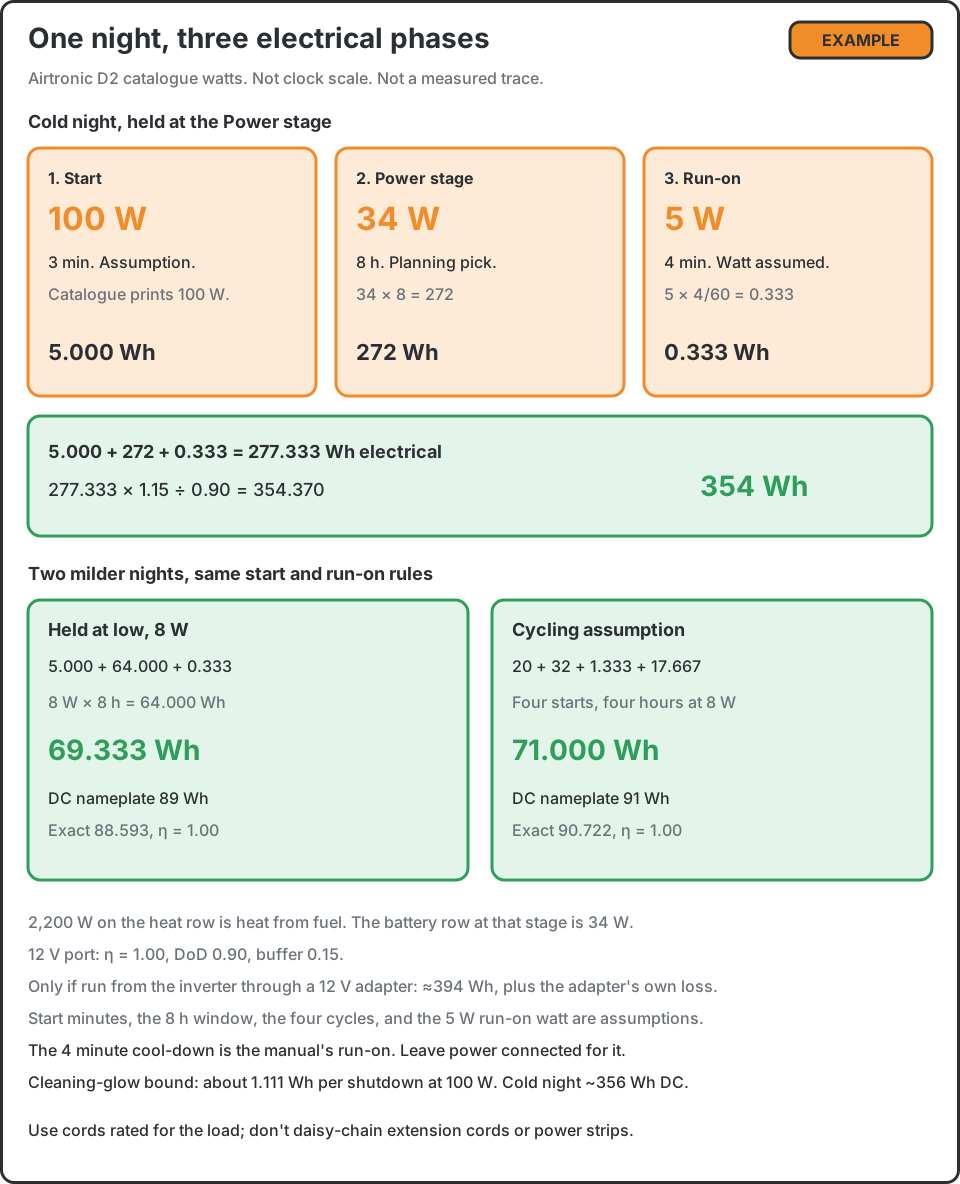
Fuel makes the heat
An air parking heater burns diesel or gasoline and blows the warmed air inside. The battery does not supply the heat. At the Airtronic D2 power stage the 2017 product information prints 2,200 W of heat and 34 W electrical. 2,200 / 34 = 64.706. Eight hours at that heat rating is 2,200 × 8 = 17,600 Wh of heat. The electrical product for those same 8 hours is 34 × 8 = 272 Wh. Fuel use at that stage is printed as 0.28 L/h, so 8 hours is 2.24 L. This page does not turn liters into watt-hours. At the low stage the same sheet prints 850 W of heat and 8 W electrical (850 / 8 = 106.25).
The sheets also print a usual heater tolerance of ±10% where no limit is given, at rated voltage and about 20°C. The rows below use the printed watts. They do not widen the rows by 10%.
Published electrical watts
Two manufacturers, two 2 kW-class air heaters. Where their documents disagree by a watt, both printings are in the table. The night arithmetic uses one column only: the Eberspächer 2017 product information.
On a phone, swipe the tables sideways.
| Stage | 2017 product information | Technical description | US brochure | Used in the nights |
|---|---|---|---|---|
| Off | 5 W | 4 W | not printed | 5 W |
| Low / Small | 8 W | 8 W | 8 W | 8 W |
| Medium | 12 W | 12 W | 12 W | cited only |
| High / Large | 22 W | 23 W | 22 W | cited only |
| Power | 34 W | 34 W | 34 W | 34 W |
| Start | 100 W | ≤100 W | not printed | 100 W ceiling |
| 12 V lower limit | 10.2 V | approx. 10.5 V, 20 s trigger | not in that table | cited, not averaged |
Heat on the 2017 sheet, same order as the watts: a dash at off, then 850 / 1,200 / 1,800 / 2,200 W. Fuel: a dash, then 0.10 / 0.15 / 0.23 / 0.28 L/h. The technical description’s Airtronic (D2) block is the same heater order number and prints heat 2,200 / 1,800 / 1,200 / 850 W across Power / Large / Medium / Small, with a dash at Off. Sources, fetched 2026-10-16: Eberspächer product information (2017), Airtronic D2 12 V row. Airtronic technical description (distributor copy of the Eberspächer manual; the manual’s own footer points at eberspaecher.com). Eberspächer special-vehicles brochure, Airtronic D2 columns. A later Airtronic 2 / D2L is a different sheet. It is not this table.
Webasto’s Air Top 2000 STC prints a control-range band, not four stages. The documents below do not print a separate start watt. None of the night totals borrow a start watt for this heater.
| Webasto Air Top 2000 STC | What that page prints | Start watt |
|---|---|---|
| US product page (diesel) | Heat 0.9–2.0 kW. Power consumption 1.25–2.45 A (14–29 W). Operating voltage 10.5–16 V or 21–32 V. | not printed |
| Installation instructions 9043156A | Diesel heat 0.9–2.0 kW, rated power 15–30 W at 12 V and 13–28 W at 24 V. Petrol (STC B) heat 1.0–2.0 kW, rated power 15–30 W at 12 V. Diesel operating voltage 10.5–16 V / 20.5–31 V. Data at +20°C, 0 m, rated voltage. | not printed |
| Range Plus flyer | Diesel heat 0.9–2.0 kW, fuel 0.12–0.24 L/h, nominal voltage 12 V, rated power 15–30 W. | not printed |
On the US product page, 1.25 A × 12 V = 15 W and 2.45 A × 12 V = 29.4 W. The parenthetical “14–29 Watts” does not match those amps at 12 V. The watt-hour rows use the printed watts, 14 W and 29 W. The installation-instructions band, 15–30 W, is a second printing. This page does not average 14 with 15 or 29 with 30. The 9043156A PDF linked above is a distributor copy; the ident number and the Webasto Thermo & Comfort SE footer are on the document.
Phases, and what each document actually times
The technical description separates the electrical life of the Airtronic into a start, standard operation, and a cool-down. Switch-on turns on the glow plug and starts the fan at low speed. For the Airtronic (the D2 block, before the Airtronic M paragraph), fuel supply starts after about 65 seconds, and the glow plug switches off 60 seconds after the flame sensor has detected the flame. The “another 120 seconds to the POWER stage” sentence is under Starting Airtronic M. It is not applied to the D2 nights.
Switch-off stops the fuel. The fan runs on for about 4 minutes. During that run-on the glow plug is on for about 40 seconds “to clean.” If no fuel was supplied, or the heater was already in the OFF stage, it stops without after-running. When the set temperature is still exceeded at the smallest stage, the heater goes to OFF, the fan runs on about 4 minutes, then the fan stays at minimum speed (circulation) or switches off (fresh air) until the next start.
The catalogue prints 100 W at start and does not print how long that 100 W lasts. The technical description prints ≤100 W at start and does not print a watt for the 40-second cleaning glow. The phase sums below leave that interval out. A bound holds the 100 W start ceiling for those 40 seconds: 100 × 40/3600 = 10/9 Wh, about 1.111 Wh per shutdown. One shutdown on the cold night raises the 12 V nameplate from 354 Wh to about 356 Wh. Four shutdowns on the cycling night raise it from 91 Wh to about 96 Wh. The mild night held at low has one shutdown too, and that bound is about 90 Wh. The exact rows are with the nameplates. The bound is not a measured glow watt.
Webasto installation instructions 9043156A say the fan continues after switch-off at the control element, and to leave the heater connected until the after-running period has elapsed. They shorten continued running to 40 seconds in the ADR hazardous-goods case. They do not print the normal after-run length in the technical-data chapter, and they do not print a start watt. The 40-second ADR line is not the van cool-down used below.
Three nights
Every night is sequential: a start, then time at a catalogue stage, then one run-on, except the cycling night, which repeats that pattern. Assumptions, labeled once:
- Start: the 100 W catalogue figure is held for 3 minutes (0.05 h). 100 × 0.05 = 5.000 Wh. Three minutes is a planning pick. It is longer than 65 s + 60 s = 125 s, which is the described glow window only if the flame is detected as fuel starts. It is not a measured start.
- Run-on watt: 5 W, the catalogue Off figure, for the technical description’s about 4 minutes. 5 × 4/60 = 1/3 Wh, shown as 0.333 Wh. The manual does not print the run-on watt. The technical description’s Off column is 4 W and is not used in the sum.
- Hours and cycle count are planning picks. The sheets do not print an overnight duty cycle.
- Cleaning glow: about 40 seconds during the run-on. No printed watt, so the phase sums leave it out. A bound at the 100 W start ceiling is about 1.111 Wh per shutdown.
Mild night, held at low
One start, then the low stage for 8 hours, then one run-on. 8 × 8 = 64.000 Wh. Sum: 5.000 + 64.000 + 0.333 = 69.333 Wh.
Mild night, cycling
Assumption over 8 hours of clock time: four cycles. Each cycle is 3 minutes at 100 W, 60 minutes at 8 W, and 4 minutes at 5 W. That is 67 minutes. Four cycles are 268 minutes. The other 480 − 268 = 212 minutes sit at the Off watt, 5 W.
- Starts: 4 × 5.000 = 20 Wh
- Low: 4 × 8 W × 1 h = 32 Wh
- Run-ons: 4 × 5 W × 4/60 h = 4/3 Wh, shown as 1.333 Wh
- Off remainder: 5 W × 212/60 h = 53/3 Wh, shown as 17.667 Wh
20 + 32 + 1.333 + 17.667 = 71.000 Wh. Under this particular pick, four starts cost more electrical energy than the hours spent at 5 W instead of 8 W. The sheet does not say cycling is always the smaller night. Change the on-time and the sum changes.
Cold night, held at power
One start, then the power stage for 8 hours, then one run-on. 34 × 8 = 272 Wh. Sum: 5.000 + 272 + 0.333 = 277.333 Wh.
If the 3-minute start sits inside the 8 hours instead of before them, subtract 3 minutes of the stage row and keep the 5.000 Wh start row. The mild night drops by 8 × 0.05 = 0.400 Wh, to 68.933 Wh. The cold night drops by 34 × 0.05 = 1.700 Wh, to 275.633 Wh. Those two totals are not given nameplates below.
Nameplates
12 V path, days = 1, η = 1.00, DoD = 0.90, buffer = 0.15. Exact is the full quotient to 3 decimal places. Rounded is Math.round of that full quotient, the same rule as roundWh in js/calculator.js.
| Scenario | Wh | Days | Path | η | Exact | Rounded |
|---|---|---|---|---|---|---|
| Mild, low held | 69.333 | 1 | 12 V | 1.00 | 88.593 | 89 Wh |
| Mild, cycling assumption | 71.000 | 1 | 12 V | 1.00 | 90.722 | 91 Wh |
| Cold, power held | 277.333 | 1 | 12 V | 1.00 | 354.370 | 354 Wh |
Worked cold row: 277.333… × 1.15 / 0.90 = 354.370…, shown as 354.370, rounds to 354 Wh. Mild held: 69.333… × 1.15 / 0.90 = 88.592…, shown as 88.593, rounds to 89 Wh. Cycling: 71 × 1.15 / 0.90 = 90.722…, shown as 90.722, rounds to 91 Wh.
Those three rows leave the cleaning glow out. The 100 W bound adds about 1.111 Wh per shutdown. 69.333… + 1.111… = 70.444 Wh. 71 + 4 × 1.111… = 71 + 4.444… = 75.444 Wh. 277.333… + 1.111… = 278.444 Wh.
| Night with the 100 W bound | Shutdowns | Wh | Path | η | Exact | Rounded |
|---|---|---|---|---|---|---|
| Mild, low held | 1 | 70.444 | 12 V | 1.00 | 90.012 | about 90 Wh |
| Mild, cycling assumption | 4 | 75.444 | 12 V | 1.00 | 96.401 | about 96 Wh |
| Cold, power held | 1 | 278.444 | 12 V | 1.00 | 355.790 | about 356 Wh |
70.444… × 1.15 / 0.90 = 90.012…, rounds to about 90 Wh. 75.444… × 1.15 / 0.90 = 96.401…, rounds to about 96 Wh. 278.444… × 1.15 / 0.90 = 355.790…, rounds to about 356 Wh.
A 12 V heater on an inverter, then a 12 V adapter
The heater wants 12 V DC. The station’s 12 V port is that path: set η to 1.00. Putting the same heater on the AC inverter, then through a separate 12 V adapter, pays the inverter factor and still has the adapter’s loss, which the calculator does not model.
| Same electrical Wh | Wh | Path | η | Exact | Rounded |
|---|---|---|---|---|---|
| Cold night | 277.333 | 12 V port | 1.00 | 354.370 | 354 Wh |
| Cold night | 277.333 | AC inverter | 0.90 | 393.745 | 394 Wh |
| Mild, low held | 69.333 | AC inverter | 0.90 | 98.436 | 98 Wh |
| Webasto top of 15–30 W, 8 h, no start row | 240 | 12 V port | 1.00 | 306.667 | 307 Wh |
| Webasto top of 15–30 W, 8 h, no start row | 240 | AC inverter | 0.90 | 340.741 | 341 Wh |
Cold night on AC: 277.333… × 1.15 / 0.81 = 393.744…, shown as 393.745, rounds to 394 Wh. The full quotients differ by 39.374… Wh. After each row is rounded on its own, 394 − 354 = 40 Wh. That 40 Wh is the rounded inverter gap. A 12 V adapter after the inverter is a further conversion, absent from the 394 Wh. The phase drawing states the same limit: only if the night in the bars is run from the inverter through a 12 V adapter, ≈394 Wh, plus the adapter’s own loss.
The 394 Wh and the 98 Wh leave the cleaning glow with no watt. With the 100 W bound the cold night is 278.444… Wh, and 278.444… × 1.15 / 0.81 = 395.322…, rounds to 395 Wh. The mild held night with that one shutdown is 70.444… × 1.15 / 0.81 = 100.013…, shown as 100.014, rounds to 100 Wh. Both are still the inverter factor only. The adapter’s own loss is extra. The cycling night with four shutdowns is 75.444… × 1.15 / 0.81 = 107.112…, rounds to 107 Wh on the inverter, before that adapter loss.
The old one-line example on this page was 30 W × 8 h = 240 Wh, then 240 × 1.15 / 0.81 ≈ 341 Wh. 30 W is the top of the 15–30 W installation-instructions band, held for 8 hours with no start row, because that manual does not print one. On the 12 V port the same 240 Wh is 240 × 1.15 / 0.90 = 306.666…, shown as 306.667, rounds to 307 Wh. 341 Wh is the inverter denominator. It is the wrong path for a heater that already speaks 12 V.
The rest of that Webasto band, still with no start row, 12 V, days = 1:
| Held for 8 h | Wh | Sheet | Exact | Rounded |
|---|---|---|---|---|
| 14 W × 8 h | 112 | US page, bottom of 14–29 W | 143.111 | 143 Wh |
| 29 W × 8 h | 232 | US page, top of 14–29 W | 296.444 | 296 Wh |
| 15 W × 8 h | 120 | 9043156A and Range Plus, bottom of 15–30 W | 153.333 | 153 Wh |
| 30 W × 8 h | 240 | 9043156A and Range Plus, top of 15–30 W | 306.667 | 307 Wh |
112 × 1.15 / 0.90 = 143.111…, rounds to 143 Wh. 232 × 1.15 / 0.90 = 296.444…, rounds to 296 Wh. 120 × 1.15 / 0.90 = 153.333…, rounds to 153 Wh. These rows are the printed band held flat for 8 hours. They are not an Airtronic night, and they are not a start.
The port, the cutoff, and the cool-down
At 12.0 V, the catalogue start figure is 100 / 12 = 8.333 A. Power stage 34 / 12 = 2.833 A. Low stage 8 / 12 = 0.667 A. Off 5 / 12 = 0.417 A. Those are the printed watts divided by 12.0 V. They are not a measured current, and the sheets do not print the start current at 10.2 V or 10.5 V. A 12 V port whose amp rating is under 8.333 A does not cover the 100 W ceiling at 12.0 V. The Webasto running top, 30 W / 12 V = 2.500 A, is the control-range top. It is not a start current. The fuse is the one in the heater’s installation instructions. Many station car sockets are rated 10 A; a cold glow plug can briefly exceed its rated watts; Webasto 9043156A specifies a 20 A fuse on the 12 V supply. Check the port rating and the heater manual’s supply requirement.
The Airtronic D2 12 V product information prints a lower voltage limit of 10.2 V. The technical description prints undervoltage protection at about 10.5 V (24 V heaters: about 21 V), trigger time 20 seconds, and overvoltage at about 16 V. Webasto’s US page prints a 12 V operating range starting at 10.5 V. The installation instructions print 10.5–16 V for the 12 V models. A station or battery monitor that opens the port above the heater’s cutoff can abort a start or stop the heater mid-cycle. Watt-hours do not prove the port voltage stays inside that window while the glow plug is on. Losing power mid-burn skips the after-run, which the manuals warn can damage the heater. Keep the port cutoff well above the heater’s 10.2–10.5 V limit.
Leave the heater powered through its own cool-down. Webasto’s instructions say to switch off at the control element and to wait until the after-running period has elapsed before disconnecting power. Switching off without that after-run can damage the heater. Eberspächer’s technical description has the fan run on about 4 minutes, with the glow plug on about 40 seconds during that run-on. Pulling the 12 V plug, or opening a master switch in that window, ends the sequence the manual describes. Follow the control element and the manual.
Use cords rated for the load; don’t daisy-chain extension cords or power strips.
Exhaust and carbon monoxide stay with the installation instructions and a qualified installer. Webasto’s installation instructions warn of poisoning and suffocation from exhaust, require the exhaust to be routed outside, and say not to run the heater in a closed room that has no exhaust extraction, including a programmed start in a closed garage. This page does not route a pipe, place a skin fitting, or site a CO alarm. Use a CO alarm the way the alarm manufacturer instructs. No concentration threshold is stated here.
A different 2 kW air heater, including a gasoline Airtronic B4 (the US brochure prints 40 W at its power stage), uses the watts on its own data plate. Those watts are not in the totals above.
Heater plus a 12 V fridge
The fridge figure is the CFX3 35 test point from camping fridge: 0.98 Ah/h × 12 V × 24 h = 282.24, published as 282 Wh/day, ambient 90°F, internal 39°F. That test point is a hot day. A winter night can use less fridge energy than 282 Wh. This page does not invent a winter fridge watt-hour. Adding 282 Wh to a cold heater night is the site’s fridge day plus the heater, and it is conservative relative to that hot test.
| Combined day | Wh at the loads | Path | Exact | Rounded |
|---|---|---|---|---|
| Cycling heater + fridge | 71 + 282 = 353 | 12 V | 451.056 | 451 Wh |
| Mild held + fridge | 69.333 + 282 = 351.333 | 12 V | 448.926 | 449 Wh |
| Cold heater + fridge | 277.333 + 282 = 559.333 | 12 V | 714.704 | 715 Wh |
| Cycling heater + mild van day | 71 + 635.8 = 706.8 | 12 V | 903.133 | 903 Wh |
| Cold heater + mild van day | 277.333 + 635.8 = 913.133 | 12 V | 1,166.781 | 1,167 Wh |
353 × 1.15 / 0.90 = 451.055…, shown as 451.056, rounds to 451 Wh. 351.333… × 1.15 / 0.90 = 448.925…, shown as 448.926, rounds to 449 Wh. 559.333… × 1.15 / 0.90 = 714.703…, shown as 714.704, rounds to 715 Wh. The mild parked van day is already 635.8 Wh, and that sum includes this same 282 Wh fridge. The other plugs are 635.8 − 282 = 353.8 Wh. Add the heater to 635.8 once. Adding the 812 Wh mild-day nameplate on top of the 451 Wh or 715 Wh row counts the fridge twice. Cycling heater plus the whole mild day: 706.8 × 1.15 / 0.90 = 903.133…, rounds to 903 Wh. Cold heater plus that day: 913.133… × 1.15 / 0.90 = 1,166.781…, rounds to 1,167 Wh.
Those combined rows use the night sums that leave the cleaning glow unmeasured. Adding the 100 W bound, about 1.111 Wh per shutdown, changes the load Wh and the 12 V nameplate.
| Combined day, with the bound | Wh at the loads | Path | Exact | Rounded |
|---|---|---|---|---|
| Cycling heater + fridge | 75.444 + 282 = 357.444 | 12 V | 456.735 | about 457 Wh |
| Mild held + fridge | 70.444 + 282 = 352.444 | 12 V | 450.346 | about 450 Wh |
| Cold heater + fridge | 278.444 + 282 = 560.444 | 12 V | 716.123 | about 716 Wh |
| Cycling heater + mild van day | 75.444 + 635.8 = 711.244 | 12 V | 908.812 | about 909 Wh |
| Cold heater + mild van day | 278.444 + 635.8 = 914.244 | 12 V | 1,168.201 | about 1,168 Wh |
357.444 × 1.15 / 0.90 = 456.734…, shown as 456.735, rounds to about 457 Wh. 352.444… × 1.15 / 0.90 = 450.345…, shown as 450.346, rounds to about 450 Wh. 560.444… × 1.15 / 0.90 = 716.123…, rounds to about 716 Wh. 711.244… × 1.15 / 0.90 = 908.812…, rounds to about 909 Wh. 914.244… × 1.15 / 0.90 = 1,168.201…, rounds to about 1,168 Wh. The van day still includes the fridge once.
Related: van daily Wh budget · camping fridge · surge traps · disclaimer
References
- Eberspächer, product information (2017). Airtronic D2 12 V: off / low / medium / high / power electrical watts 5 / 8 / 12 / 22 / 34, start 100 W, heat up to 2,200 W, lower voltage limit 10.2 V.
- Eberspächer, Airtronic / Airtronic M technical description (distributor PDF). Operation 34 / 23 / 12 / 8 / 4 W, start ≤100 W, undervoltage about 10.5 V with a 20 s trigger, fuel at about 65 s, glow plug off 60 s after flame detection, fan run-on about 4 minutes, cleaning glow about 40 s.
- Eberspächer, special-vehicles brochure. Airtronic D2: 8 / 12 / 22 / 34 W.
- Webasto, Air Top 2000 STC product page. Diesel: 0.9–2.0 kW, 14–29 W, also printed as 1.25–2.45 A, 12 V operating range from 10.5 V.
- Webasto, Air Top 2000 STC installation instructions, ident. 9043156A (distributor PDF). Rated power 15–30 W (12 V), operating voltage, after-run warning, ADR 40 s case.
- Webasto, Range Plus flyer. Air Top 2000 STC diesel: 15–30 W, 0.9–2.0 kW.
- Dometic CFX3 35. Fridge cross-check only. The 282 Wh/day conversion is the one on camping fridge.
Wh calculator — enter the night’s electrical sum as Wh/day. 12 V port: set inverter efficiency to 1.00. nameplate = (Wh/day × days × 1.15) / (0.90 × η).
Where to check pricing
As an Amazon Associate, we earn from qualifying purchases at no extra cost to you. EcoFlow, Jackery, and Bluetti partner programs are not live yet.
See on Amazon Bluetti — Coming soon EcoFlow — Coming soon Jackery — Coming soon