Weekend camping: what size power station?
Three planning days for car camping. Solar credit is zero. The nameplate is a size to shop against. It does not prove the inverter can start or hold the load.
Calculator order
Same relation as js/calculator.js. Round the full quotient once, half-up, the way Math.round does. Do not round the middle steps and then keep going.
- Watt-hours at the load = given Wh/day, or watts × hours.
- Battery watt-hours = load ÷ η.
- With buffer = battery watt-hours × 1.15.
- Nameplate = that result ÷ 0.90 DoD.
DoD=0.90 is a planning fraction of the label. It is not a BMS guarantee. The 15% buffer is headroom, not a measured loss. A day with no recharge is the calculator’s case. Panel harvest, when you actually have it, is solar vs battery. A dark weekend stays on this page.
EcoFlow’s device-setup article uses watts × hours = Wh (their example is 1,200 W × 0.5 h = 600 Wh). EcoFlow’s camping guide then adds a 20–30% buffer and says the inverter uses energy, so DC gear avoids that loss. WattNeeds does not adopt 20–30%. The buffer knob stays 0.15. AC stays η=0.90. 12 V and USB stay η=1.00.
Light weekend day
No laptop. Lights and phones are the site allowances already used on the 570 Wh stack: 10 W × 5 h = 50 Wh, and 60 Wh of phone charging. Those are planning figures, not a measured camp. The fridge figure is the CFX3 35 test point, not the 320 Wh/day band.
The sheet lists 0.98 Ah/h at 12 V, ambient 90°F, internal 39°F, volume 36 L, rated AC input 50 W. 0.98 × 12 × 24 = 282.24, published as 282 Wh/day on camping fridge. Dometic’s runtime method is usable battery Ah ÷ that Ah/h (CFX3 draw article). Their lead-acid note uses 50% of rated Ah. That is not this site’s 0.90 DoD. 50 W × 24 h = 1,200 Wh is the rated AC input held all day, not this test point.
| Stack | Wh/day | What it is |
|---|---|---|
| Cooler only: lights 50 + phones 60 | 110 | Ice. The station does not run a compressor. Not the cooler-vs-fridge gadget row, which adds a 140 Wh laptop and totals 250 Wh/day. |
| Small fridge: CFX3 282 + those 110 | 392 | 282 is the cited test point. 320 is a different planning band and is not used here. |
All-AC-outlet case only (CFX3 on its AC adapter, phones and lights on wall bricks). On the 12 V and USB ports, use η = 1.00. Step columns are each full step shown to three decimals, not a chain of already-rounded multiplies. Exact is the full nameplate to three decimals. The published nameplate is Math.round of that full quotient.
These four rows are that all-AC-outlet case, solar = 0.
| Stack | Days | Steps (load ÷ 0.90, × 1.15, ÷ 0.90) | Exact | Nameplate |
|---|---|---|---|---|
| 110 Wh/day | 1 | 122.222 → 140.556 → nameplate | 156.173 | 156 Wh |
| 110 Wh/day | 2 | 244.444 → 281.111 → nameplate | 312.346 | 312 Wh |
| 392 Wh/day | 1 | 435.556 → 500.889 → nameplate | 556.543 | 557 Wh |
| 392 Wh/day | 2 | 871.111 → 1,001.778 → nameplate | 1,113.086 | 1,113 Wh |
392 × 1 × 1.15 / (0.90 × 0.90) = 556.543 → 557 Wh
392 × 2 × 1.15 / 0.81 = 1,113.086 → 1,113 Wh
12 V and USB rows use η=1.00 on the whole stack, including the 50 Wh of lights. Solar = 0. Steps are load ÷ 1.00, × 1.15, ÷ 0.90.
| Stack | Days | Steps (load ÷ 1.00, × 1.15, ÷ 0.90) | Exact | Nameplate |
|---|---|---|---|---|
| 110 Wh/day | 1 | 110.000 → 126.500 → nameplate | 140.556 | 141 Wh |
| 110 Wh/day | 2 | 220.000 → 253.000 → nameplate | 281.111 | 281 Wh |
| 392 Wh/day | 1 | 392.000 → 450.800 → nameplate | 500.889 | 501 Wh |
| 392 Wh/day | 2 | 784.000 → 901.600 → nameplate | 1,001.778 | 1,002 Wh |
110 × 1 × 1.15 / (0.90 × 1.00) = 140.556 → 141 Wh
110 × 2 × 1.15 / 0.90 = 281.111 → 281 Wh
392 × 1 × 1.15 / (0.90 × 1.00) = 500.889 → 501 Wh
392 × 2 × 1.15 / 0.90 = 1,001.778 → 1,002 Wh
Optional split: fridge and phones on 12 V/USB, 50 Wh of lights on AC. On 392 Wh/day that is 282 + 60 = 342 Wh at η=1.00 and 50 Wh at η=0.90. On 110 Wh/day that is 60 Wh at η=1.00 and 50 Wh at η=0.90. Add the full pass quotients, then round once. Solar = 0.
| Stack | Days | 12 V/USB exact | AC exact | Exact sum | Nameplate |
|---|---|---|---|---|---|
| 392 Wh/day | 1 | 437.000 | 70.988 | 507.988 | 508 Wh |
| 392 Wh/day | 2 | 874.000 | 141.975 | 1,015.975 | 1,016 Wh |
| 110 Wh/day | 1 | 76.667 | 70.988 | 147.654 | 148 Wh |
| 110 Wh/day | 2 | 153.333 | 141.975 | 295.309 | 295 Wh |
392 × 1 day split: 342 × 1.15 / 0.90 + 50 × 1.15 / 0.81 = 437.000 + 70.988 = 507.988 → 508 Wh
392 × 2 day split: 684 × 1.15 / 0.90 + 100 × 1.15 / 0.81 = 874.000 + 141.975 = 1,015.975 → 1,016 Wh
On the 110 Wh split, do not add the three-decimal pass displays. One day: 76.667 + 70.988 = 147.655, and the full quotients 76.666… + 70.987654… = 147.654, which rounds to 148 Wh. Two days: 153.333 + 141.975 = 295.308, and the full sum is 295.309, which rounds to 295 Wh. A 500 Wh label covers 148 Wh and 295 Wh. 508 Wh is short by 8 Wh of a 500 Wh label; the class ceiling is 512 Wh. 1,016 Wh is short of a 1,000 Wh label.
A 500 Wh label delivers 500 × 0.81 = 405 Wh on AC. That is 405 / 110 = 3.682 days of the cooler-only load and 405 / 392 = 1.033 days of the 392 Wh load. A 500 Wh label delivers 450 Wh on 12 V: 450 / 110 = 4.091 days at 110 Wh/day and 450 / 392 = 1.148 days at 392 Wh/day. The runtime check does not apply the buffer. The buffered 1-day AC plan for 392 Wh is 557 Wh, which is above a 500 Wh label and above this site’s ~300–500 Wh class ceiling (results up to 512 Wh). On 12 V that day is 501 Wh, short by 1 Wh of a 500 Wh label; the class ceiling is 512 Wh. 141 Wh and 281 Wh are covered by a 500 Wh label. Two cooler-only AC days (312 Wh) sit in that class. Two AC days at 392 Wh (1,113 Wh) do not. 1,002 Wh is short of a 1,000 Wh label.
The small-compressor planning band on camping fridge is about 200–350 Wh/day before lights and phones. Ends plus the same 110 Wh: 310 Wh/day is 440.123 → 440 Wh for 1 day on AC and 396.111 → 396 Wh on 12 V; 460 Wh/day is 653.086 → 653 Wh on AC and 587.778 → 588 Wh on 12 V. Those ends are the band, not a second manufacturer point. Ice versus a compressor, with the laptop left in, stays on cooler vs fridge.
Loaded camping day (570 Wh)
Homepage camping sample, same stack as rainy weekend. 320 Wh/day is not the CFX3 282 test point. Laptop, lights, and phones are planning allowances: 70 W × 2 h, 10 W × 5 h, and 60 Wh. This section runs every row through one AC pass.
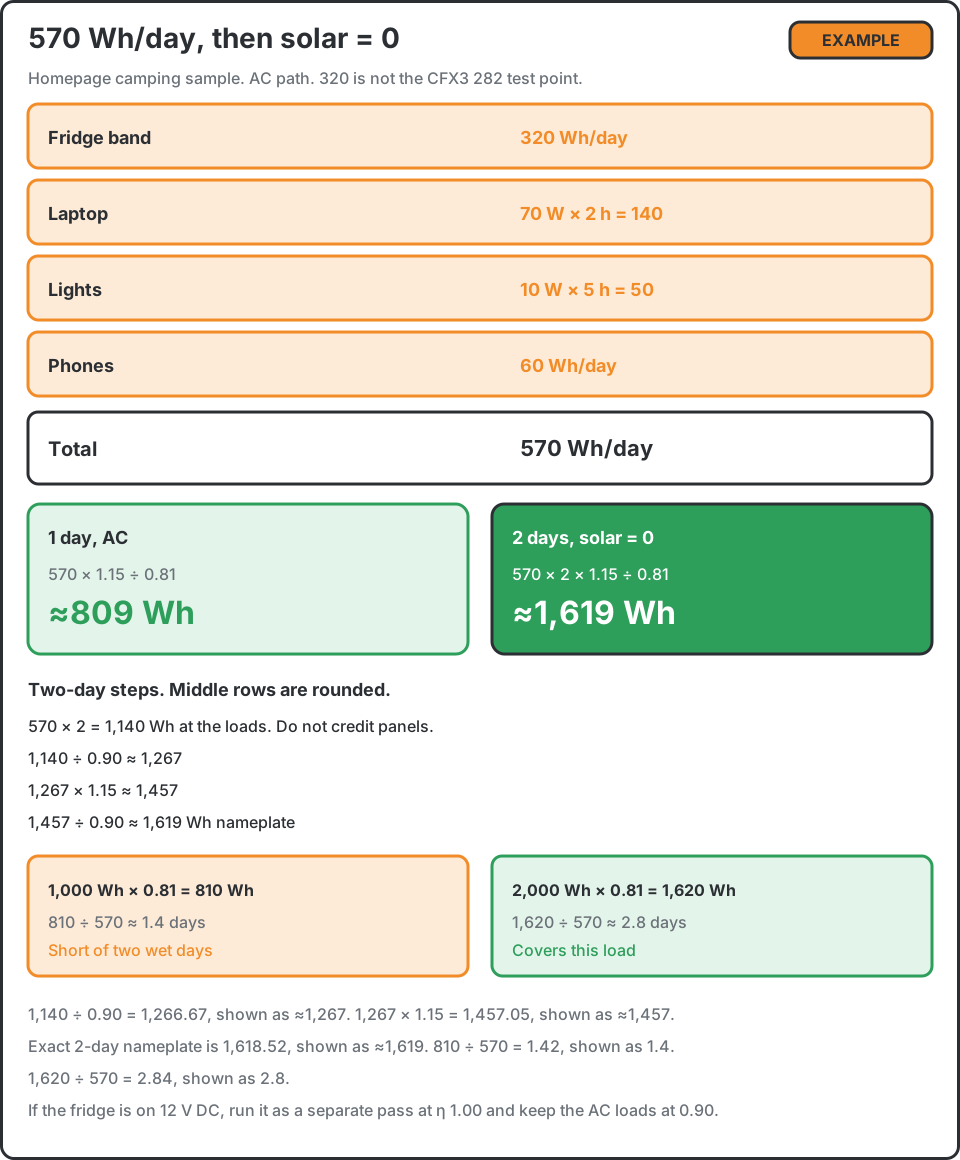
| Device | Count | Wh/day |
|---|---|---|
| Camp fridge (avg) | 320 Wh/day planning band (not CFX3 282) | 320 |
| Laptop | 70 W × 2 h | 140 |
| LED lights | 10 W × 5 h | 50 |
| Phones | USB allowance | 60 |
| Total | 570 |
One day, AC, solar = 0:
- 570 / 0.90 = 633.333 Wh from the battery
- 633.333 × 1.15 = 728.333 Wh with buffer
- 728.333 / 0.90 = 809.259 → 809 Wh nameplate
nameplate = 570 × 1 × 1.15 / (0.90 × 0.90) = 809.259 → 809 Wh
Two days, solar = 0. Unrounded middles, then the exact nameplate:
- 570 × 2 = 1,140 Wh at the loads
- 1,140 / 0.90 = 1,266.667 Wh from the battery
- 1,266.667 × 1.15 = 1,456.667 Wh with buffer
- 1,456.667 / 0.90 = 1,618.519 → 1,619 Wh nameplate
nameplate = 570 × 2 × 1.15 / 0.81 = 1,618.519 → 1,619 Wh
The rainy-weekend drawing rounds those middles the other way: 1,266.667 shown as about 1,267, then 1,267 × 1.15 = 1,457.05 shown as about 1,457, then 1,457 / 0.90 = 1,618.889, which still rounds to 1,619. Size from 1,618.519. Both displays agree on 1,619 Wh.
Mixed path: 12 V fridge, AC laptop and lights
Same 570 Wh at the loads. The fridge stays on 12 V (η=1.00). Phones stay on USB (η=1.00): a wall brick plugged into an AC outlet would belong on the AC pass instead. Laptop and the 50 Wh of lights are on the inverter (η=0.90). Run two passes. Add the exact nameplates, then round once. The formula is linear in load Wh, and DoD and buffer are shared, so the sum is the planning nameplate for one pack. It is not a second battery.
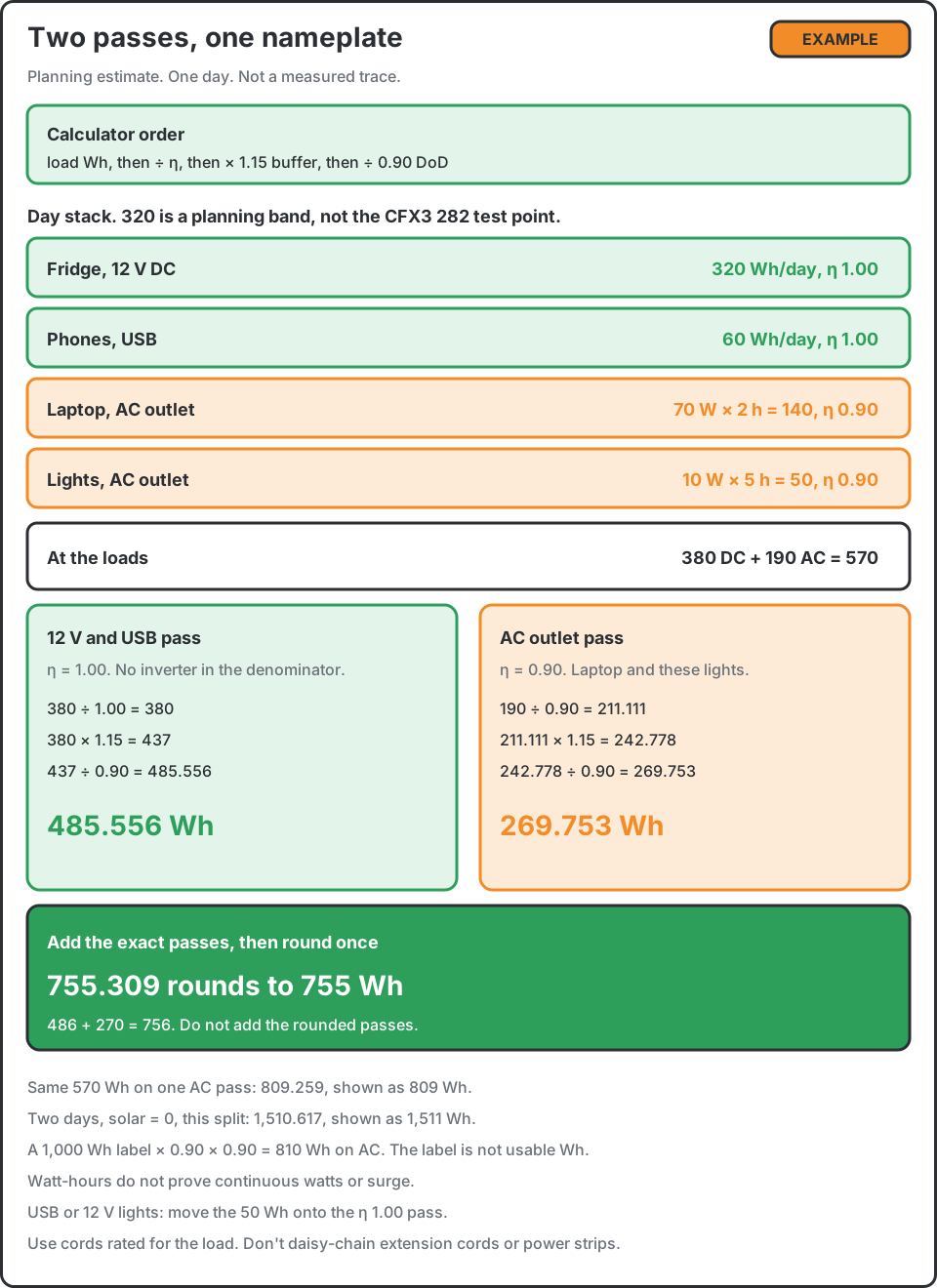
| Pass | Wh/day | η | 1-day exact | 1-day rounded | 2-day exact | 2-day rounded |
|---|---|---|---|---|---|---|
| Fridge 320 + phones 60 | 380 | 1.00 | 485.556 | 486 Wh | 971.111 | 971 Wh |
| Laptop 140 + lights 50 | 190 | 0.90 | 269.753 | 270 Wh | 539.506 | 540 Wh |
| Sum of exact, then round once | 570 | 755.309 | 755 Wh | 1,510.617 | 1,511 Wh |
One day, DC pass: 380 / 1.00 = 380; 380 × 1.15 = 437; 437 / 0.90 = 485.556. AC pass: 190 / 0.90 = 211.111; 211.111 × 1.15 = 242.778; 242.778 / 0.90 = 269.753. Sum 755.309 rounds to 755 Wh. The rounded passes add to 486 + 270 = 756. That extra watt-hour is rounding error. Two days: 971.111 + 539.506 = 1,510.617 → 1,511 Wh. On that row, 971 + 540 happens to equal 1,511. Still add the exact figures first.
Same arithmetic from the battery side, which is the split already used on solar vs battery: 320 + 60 + (140 + 50) / 0.90 = 591.111 Wh from the battery before buffer and DoD. Then 591.111 × 1.15 / 0.90 = 755.309.
One AC pass on all 570 Wh is the 809 Wh row above. One DC pass on all 570 Wh (only if the laptop and the lights are also 12 V or USB) is 570 × 1.15 / 0.90 = 728.333 → 728 Wh for one day, and 1,456.667 → 1,457 Wh for two days. The mixed plan sits between them: 755 Wh and 1,511 Wh.
EcoFlow’s camping guide treats lights and USB gear as already DC. If these lights are USB or 12 V, move the 50 Wh onto η=1.00. The 1-day passes are then 430 Wh at η=1.00 (exact 549.444, rounds to 549) and 140 Wh at η=0.90 (exact 198.765, rounds to 199). Exact sum 748.210 rounds to 748 Wh. That is the moved row, not a second measurement.
500, 1,000, and 2,000 Wh labels
A label is nameplate Wh. Usable energy at these defaults is smaller. On AC, delivered Wh = nameplate × 0.90 × 0.90. On 12 V or USB, delivered Wh = nameplate × 0.90. The buffer is not applied again on the way down. Days below are delivered Wh ÷ load Wh. They are the runtime check, not a station test.
| Label | AC delivered | 12 V delivered | Days at 110 Wh, AC | Days at 392 Wh, AC | Days at 570 Wh, AC | Days, mixed battery draw 591.111 |
|---|---|---|---|---|---|---|
| 500 Wh | 405 | 450 | 3.682 | 1.033 | 0.711 | 0.761 |
| 1,000 Wh | 810 | 900 | 7.364 | 2.066 | 1.421 | 1.523 |
| 2,000 Wh | 1,620 | 1,800 | 14.727 | 4.133 | 2.842 | 3.045 |
The 570 Wh drawing prints 1.4 and 2.8 days. Those are 810 / 570 = 1.421 and 1,620 / 570 = 2.842 at one decimal. Mixed days use 12 V delivered ÷ 591.111, because part of that day never sees the inverter. Do not divide 810 by 570 for the mixed plan.
Shop the buffered nameplate, not the round class name. Class spans on this site: results up to 512 Wh, then 513–1,152 Wh, then 1,153 Wh and up.
| Buffered plan | Nameplate | 500 Wh label | 1,000 Wh label | 2,000 Wh label |
|---|---|---|---|---|
| Cooler only, 1 day, 12 V | 141 Wh | Covers | Covers | Covers |
| Cooler only, 2 days, 12 V | 281 Wh | Covers | Covers | Covers |
| Cooler only, 2 days, AC | 312 Wh | Covers | Covers | Covers |
| CFX3 stack 392 Wh, 1 day, 12 V | 501 Wh | Short by 1 Wh; class ceiling 512 | Covers | Covers |
| CFX3 stack 392 Wh, 1 day, AC | 557 Wh | Short | Covers | Covers |
| CFX3 stack 392 Wh, 2 days, 12 V | 1,002 Wh | Short | Short of a 1,000 Wh label | Covers |
| CFX3 stack 392 Wh, 2 days, AC | 1,113 Wh | Short | Short (1,000 is under 1,113; the class ceiling is 1,152) | Covers |
| Loaded 570 Wh, 1 day, AC | 809 Wh | Short | Covers | Covers |
| Loaded 570 Wh, 2 days, solar = 0, AC | 1,619 Wh | Short | Short | Covers |
| Mixed 570 Wh split, 1 day | 755 Wh | Short | Covers | Covers |
| Mixed 570 Wh split, 2 days, solar = 0 | 1,511 Wh | Short | Short | Covers |
A 1,000 Wh label is not 1,000 usable Wh. On AC it is 810 Wh. On 12 V it is 900 Wh. A 1,000 Wh label covers one all-AC loaded day (809 Wh) and one mixed day (755 Wh). It does not cover two loaded days with solar at zero, on either the all-AC plan (1,619 Wh) or the mixed plan (1,511 Wh). Two AC days of the 392 Wh fridge stack need 1,113 Wh, which is inside the ~1000 Wh class and above a 1,000 Wh label. Two 12 V days of that stack need 1,002 Wh, which is short of a 1,000 Wh label and inside the same class (ceiling 1,152 Wh).
None of those rows prove the compressor will start, or that a kettle will run. Continuous watts have to cover what is on together. Surge only covers a brief start. Use cords rated for the load. Don't daisy-chain extension cords or power strips. Do not backfeed a breaker panel.
Related: camping fridge (282 vs 320, DC η=1.00) · cooler vs fridge (250 Wh gadgets vs the 570 Wh day) · rainy weekend (the 1,619 Wh case) · solar vs battery (the 591.111 Wh mixed battery draw) · surge traps
Wh calculator — one η per pass. 12 V and USB: set inverter efficiency to 1.00. AC outlets: leave η at 0.90. nameplate = (Wh/day × days × 1.15) / (0.90 × η).
Where to check pricing
As an Amazon Associate, we earn from qualifying purchases at no extra cost to you. EcoFlow, Jackery, and Bluetti partner programs are not live yet.
See on Amazon EcoFlow — Coming soon Jackery — Coming soon Bluetti — Coming soon