Solar harvest vs the battery you still need
Daily harvest is panel watts times peak sun hours times a loss factor. The battery still covers the night and any day that factor is zero. Camping, a parked van, or a home-outage cord stack. Three loads already on this site.
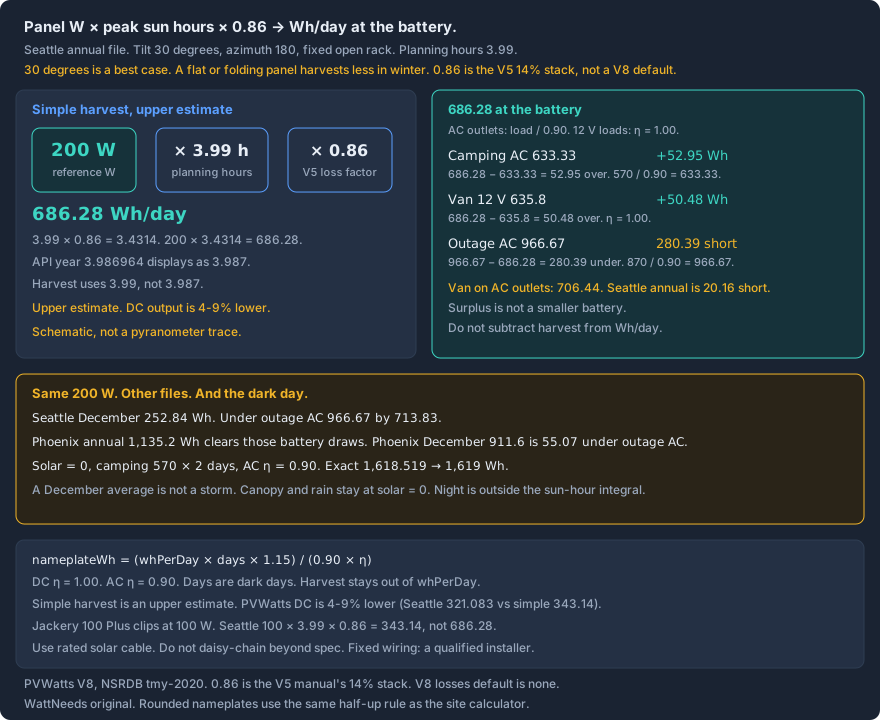
WattNeeds original schematic, not a pyranometer trace and not a lab run. Seattle annual planning row, 200 × 3.99 × 0.86 = 686.28 Wh/day at the battery. AC-outlet loads need load / 0.90 from the battery. 12 V loads use η = 1.00. Against those battery draws: 686.28 − 633.33 = 52.95 over camping on the AC path, 686.28 − 635.8 = 50.48 over the 12 V van day, and 966.67 − 686.28 = 280.39 short of the AC outage day. Same 200 W in the Seattle December file: 200 × 1.47 × 0.86 = 252.84 Wh/day, which is 713.83 Wh under the outage battery draw. Phoenix annual file: 200 × 6.60 × 0.86 = 1,135.2 Wh/day. Two dark camping days stay on the AC nameplate 1,619 Wh. Hours: PVWatts v8, Seattle request.
The harvest product
Panel watts on this page are the nameplate at the reference condition in the PVWatts Version 5 manual: reference irradiance 1,000 W/m² and reference cell temperature 25°C (Equation 8). One kWh/m² is one hour at that 1,000 W/m². A 27 May 2020 NREL briefing calls the unit kWh/m² a sun-hour (Jimenez, Tribal Energy Webinar Series, “the unit kWh/m² is sometime called a sun-hour”). This page calls the daily count peak sun hours.
PVWatts reports that daily count as solar radiation in kWh/m²/day. The field is solrad_annual for the year and solrad_monthly for each month (PVWatts V8 API). The figure is plane-of-array for the tilt and azimuth in the request. It is not power at 2 a.m. The same API call returns DC array output separately. Sun hours do not change when the loss input changes. Checked 2026-10-14 on all three requests below: losses 14 and losses 10 returned the same solrad_annual. AC annual kWh and the first DC month changed.
harvest Wh/day = panel W × peak sun hours × 0.86
The 0.86 is the manual’s own conversion of its default system loss: “1 − 14/100 = 0.86.” Table 6 prints the pieces that make up that 14%: soiling 2%, shading 3%, snow 0%, mismatch 2%, wiring 2%, connections 0.5%, light-induced degradation 1.5%, nameplate rating 1%, age 0%, availability 3%. The manual says the total is not the sum of those percents. Equation 9 multiplies the surviving fractions. The manual then rounds the result to 14% and uses 0.86. This page uses that 0.86. It does not substitute the unrounded product. PVWatts V8 has no built-in loss default. The V8 parameter table lists losses as required, default none (PVWatts V8 API). The 0.86 is the Version 5 default stack, not a V8 built-in.
What 0.86 is not:
- Not aim. Aim is already inside the sun-hour figure, for the geometry below. Tilt 30° aimed south is a best case for these fixed-rack requests. A panel flat on the ground, or a folding panel opened flatter than 30°, harvests less in winter than the December rows. Facing east is a different request too.
- Not dirt as a separate knob. Dirt is the soiling line, 2%, inside the 14%. This page keeps that default. It does not invent a dirtier percent.
- Not nearby shade. The 3% shading line is the manual’s far-horizon default. The manual says to raise it for trees and structures close to the array. A camp under canopy is not a 3% trim. Use solar = 0, on rainy-weekend sizing.
- Not cell temperature. Equation 8 multiplies by (1 + γ(Tcell − 25°C)). Table 3 prints γ = −0.47%/°C for the Standard module type. The 0.86 factor does not contain that term. An illustration, not a measured cell: a cell 25°C above the 25°C reference gives 1 + (−0.0047 × 25) = 0.8825. That cut is not applied to the harvest rows. This page does not have a cell temperature for the scenarios.
- Not the grid inverter. The manual keeps inverter efficiency out of the system loss. Its default nominal efficiency is 0.96, and 0.86 × 0.96 = 0.825 is the manual’s step back toward the old DC-to-AC derate. This page stops at 0.86. A station’s DC solar input is not that grid inverter.
- Not the station’s watt cap or its MPPT. No efficiency for the station’s solar-input converter is cited here, so none is applied. Caps are in the last section.
The 3% availability line is a grid-tied uptime assumption inside the published stack. A folding panel does not have that same outage model. The 0.86 is still the manual’s conversion of the whole default stack, not a camping measurement.
Three request points, one aim
Each row is a PVWatts V8 call on 2026-10-14, API version 8.5.0. Geometry, the same for all three: fixed open rack (array_type=0), tilt 30°, azimuth 180° (south in this hemisphere), standard module (module_type=0). Weather file: NSRDB PSM V3 GOES tmy-2020 3.2.0, the 2020 TMY the API docs name. The request coordinates are a city-center pick. The climate point is the nearest station. Distance is the API field, in meters. A later NSRDB update can move the hours. June is solrad_monthly index 5. December is index 11. January is index 0.
On a phone, swipe the tables sideways.
| Request | Station | Annual API | Planning h | June API | Planning h | December API | Planning h |
|---|---|---|---|---|---|---|---|
| 33.4484, −112.074 | Arizona, file 78206, 1,305 m | 6.598 | 6.60 | 7.607 | 7.61 | 5.304 | 5.30 |
| 39.7392, −104.9903 | Colorado, file 484137, 1,351 m | 5.768 | 5.77 | 6.835 | 6.84 | 4.203 | 4.20 |
| 47.6062, −122.3321 | Washington, file 241108, 730 m | 3.987 | 3.99 | 5.695 | 5.70 | 1.466 | 1.47 |
The API column is the returned value, half-up to 3 decimal places, for display. Planning hours are the same full value, half-up to 2 decimal places. Harvest multiplies the planning hours, not the 3-decimal display. Denver in December is the case that shows the difference: the full value 4.202809… displays as 4.203 and plans as 4.20. Seattle’s year displays as 3.987 and plans as 3.99. The briefing’s “~ 4.5 kWh/m²” for a horizontal surface in Colorado is not this table. These hours are plane-of-array at 30° tilt. That 30° south aim is a best case. A flat panel, or a folding panel laid flatter than 30°, harvests less in winter than these December rows. This page does not invent a flat-panel hour.
Phoenix, Denver, and Seattle in the harvest table are these three request points, in that order. The API city field on each response was empty. The state field is Arizona, Colorado, and Washington.
Calls, losses left at 14 only because the parameter is required. Sun hours did not use that loss. Phoenix request. Denver request. Seattle request.
100 W and 200 W against three loads
100 W and 200 W are planning nameplates at the reference condition above. They are not a product test. The simple harvest rows below are an upper estimate. The PVWatts DC cross-check later on this page is about 4–9% lower (514 / 472 / 321 Wh/day against 568 / 496 / 343). The three loads are already on the site:
- 570 Wh/day camping. Homepage sample used on rainy-weekend sizing and weekend camping: fridge planning band 320, laptop 140, lights 50, phones 60. The 320 band is not the CFX3 282 Wh/day test point. That split stays on camping fridge.
- 635.8 Wh/day van. Mild parked day on van daily Wh. Sum at the devices. No solar in that guide.
- 870 Wh/day outage essentials. Light essentials on home outage: router 480, lamps 240, phones and laptops 150. No fridge. The fridge stack on that page is 2,059 Wh/day and is not re-sized here.
| Place and month | Planning h | 100 W upper estimate | 200 W upper estimate |
|---|---|---|---|
| Phoenix annual | 6.60 | 567.6 | 1,135.2 |
| Phoenix June | 7.61 | 654.46 | 1,308.92 |
| Phoenix December | 5.30 | 455.8 | 911.6 |
| Denver annual | 5.77 | 496.22 | 992.44 |
| Denver June | 6.84 | 588.24 | 1,176.48 |
| Denver December | 4.20 | 361.2 | 722.4 |
| Seattle annual | 3.99 | 343.14 | 686.28 |
| Seattle June | 5.70 | 490.2 | 980.4 |
| Seattle December | 1.47 | 126.42 | 252.84 |
Worked Seattle annual row, the diagram: 3.99 × 0.86 = 3.4314. 200 × 3.4314 = 686.28 Wh/day. 100 × 3.4314 = 343.14. Phoenix annual: 6.60 × 0.86 = 5.676, and 200 × 5.676 = 1,135.2. Seattle December: 1.47 × 0.86 = 1.2642, and 200 × 1.2642 = 252.84. Denver annual: 5.77 × 0.86 = 4.9622, and 200 × 4.9622 = 992.44.
Harvest arrives at the battery; AC-outlet loads need load / 0.90 from the battery; 12 V loads use η = 1.00.
The next table is 200 W harvest minus the watt-hours the battery must supply. A positive remainder is surplus on that average day of the weather file. It is not spare battery, and it is not a promise for a storm. Outage 870 is AC-only, so the battery supplies 870 / 0.90 = 966.67 Wh. Camping 570 on the AC path, the rainy-weekend nameplate path, is 570 / 0.90 = 633.33 Wh. The van mild day as itemized is 12 V and USB, so η = 1.00 and the battery supplies 635.8 Wh. The same van day on AC outlets is 635.8 / 0.90 = 706.44 Wh.
| 200 W harvest | Minus camping AC 633.33 | Minus van 12 V 635.8 | Minus van AC 706.44 | Minus outage AC 966.67 |
|---|---|---|---|---|
| Phoenix annual 1,135.2 | +501.87 | +499.4 | +428.76 | +168.53 |
| Denver annual 992.44 | +359.11 | +356.64 | +286.00 | +25.77 |
| Seattle annual 686.28 | +52.95 | +50.48 | −20.16 | −280.39 |
| Phoenix December 911.6 | +278.27 | +275.8 | +205.16 | −55.07 |
| Denver December 722.4 | +89.07 | +86.6 | +15.96 | −244.27 |
| Seattle December 252.84 | −380.49 | −382.96 | −453.60 | −713.83 |
Phoenix December against the outage battery draw flips. 911.6 − 870 was +41.6 at the outlet. 911.6 − 966.67 = −55.07 at the battery. Seattle annual camping on the AC path is 686.28 − 633.33 = +52.95. Seattle annual on van AC outlets is 686.28 − 706.44 = −20.16.
Two other battery draws, not columns in that table. Camping with the fridge and the phones on η = 1.00, and the laptop plus lights on AC: 320 + 60 + (140 + 50) / 0.90 = 591.11 Wh. A 12 V fridge does not take the inverter factor. The whole camping day on 12 V stays at 570 Wh from the battery. Against the six harvests that remainder is +565.2, +422.44, +116.28, +341.6, +152.4, and −317.16. Van with the fridge on the AC cord and the rest on 12 V and USB: 282 / 0.90 + 353.8 = 667.13 Wh. Seattle annual at 200 W is 686.28 − 591.11 = +95.17 on that camping split, and 686.28 − 667.13 = +19.15 on that van mix.
Panel watts that make the simple harvest equal the battery watt-hours, at those planning hours: W = (load / η) / (hours × 0.86). The break-even divides the unrounded quotient, not the 2-decimal battery figure. Camping on the AC path at the Phoenix annual hours: (570 / 0.90) / 5.676 = 111.581 W. The 100 W row at that site is 567.6, which is 633.33 − 567.6 = 65.73 Wh under that AC-path battery draw. The same camping day on 12 V is 570 / 5.676 = 100.423 W, and 570 − 567.6 = 2.4 Wh under. Camping on the AC path at the Seattle December hours: (570 / 0.90) / 1.2642 = 500.976 W. On 12 V that December figure stays 570 / 1.2642 = 450.878 W. Same camping day, different path, different month, different panel. Outage on the AC path at the Seattle annual hours: (870 / 0.90) / 3.4314 = 281.712 W. Dividing the rounded 966.67 by 3.4314 instead lands on 281.713. This page uses 281.712, from the unrounded battery quotient. June is the high month in these three files. Seattle June at 200 W is 980.4, which is 980.4 − 966.67 = 13.73 Wh over the outage battery draw. The same 200 W panel is short of that battery draw in December by 713.83 Wh. Size the dark month you will actually be there.
PVWatts DC output is a lower cross-check
The same three calls, with system_capacity=0.1 (a 100 W nameplate) and losses set to 14, return monthly DC array kWh. That DC figure is the model’s array output after its thermal model and after the 14% loss input. It is before the AC inverter. Sum the twelve months, multiply by 1,000, divide by 365. That is an average day of this TMY file, not a forecast.
| 100 W request | Sum of dc_monthly (kWh) | Wh/day from that sum | Simple row, upper estimate, 100 W × planning h × 0.86 |
|---|---|---|---|
| Phoenix | 187.713 | 514.282 | 567.6 |
| Denver | 172.332 | 472.144 | 496.22 |
| Seattle | 117.195 | 321.083 | 343.14 |
The kWh column is the full sum, half-up to 3 decimal places. The Wh/day column divides the unrounded sum by 365, then half-up to 3 decimal places. Phoenix full sum 187.712857 kWh → 187.712857 × 1,000 / 365 = 514.2818…, shown as 514.282. The simple row is an upper estimate. It sits above the DC row at all three sites (Phoenix 567.6 − 514.282 = 53.318 Wh/day). Rounded to the whole watt-hour, DC output is 514 / 472 / 321 against simple 568 / 496 / 343, about 4–9% lower. The gap is the rest of the PVWatts hourly model, including cell temperature and cover effects. This page does not split that gap into a percent for heat. The load comparison uses the simple row, because that product shows the hours and the 0.86, and it labels that row as the upper estimate. Do not average the two rows. The manual’s open-rack thermal model assumes an installed nominal operating cell temperature of 45°C. That 45°C is an input to the heat model, not the cell temperature of these scenarios.
Battery nameplate, solar = 0
Buy the battery for the dark stretch. The calculator does not take a solar credit. Days in the formula are days with no recharge. Rounded nameplates use Math.round on the full quotient. The exact column is that quotient to 3 decimal places, half-up.
| Load | Days | Path | η | Exact | Rounded |
|---|---|---|---|---|---|
| Camping 570 | 1 | DC | 1.00 | 728.333 | 728 Wh |
| Camping 570 | 1 | AC | 0.90 | 809.259 | 809 Wh |
| Camping 570 | 2 | DC | 1.00 | 1,456.667 | 1,457 Wh |
| Camping 570 | 2 | AC | 0.90 | 1,618.519 | 1,619 Wh |
| Van 635.8 | 1 | DC | 1.00 | 812.411 | 812 Wh |
| Van 635.8 | 1 | AC | 0.90 | 902.679 | 903 Wh |
| Van 635.8 | 2 | DC | 1.00 | 1,624.822 | 1,625 Wh |
| Van 635.8 | 2 | AC | 0.90 | 1,805.358 | 1,805 Wh |
| Outage 870 | 1 | AC | 0.90 | 1,235.185 | 1,235 Wh |
| Outage 870 | 2 | AC | 0.90 | 2,470.370 | 2,470 Wh |
Camping, one AC day: 570 × 1.15 / 0.81 = 809.259…, shown as 809.259, rounds to 809 Wh. Two AC days: 570 × 2 × 1.15 / 0.81 = 1,618.518…, shown as 1,618.519, rounds to 1,619 Wh. That 1,619 Wh is the rainy-weekend result. One DC day: 570 × 1.15 / 0.90 = 728.333…, rounds to 728 Wh. Two DC days: 1,456.666…, shown as 1,456.667, rounds to 1,457 Wh. The rainy-weekend page treats 570 as an AC-path mix because the laptop and lights go through the inverter. A 12 V fridge in that mix does not get η = 0.90 on its own watt-hours. Set η = 1.00 for a DC-only pass.
The van rows match van daily Wh: 635.8 × 1.15 / 0.90 = 812.411… → 812 Wh on DC, and 635.8 × 1.15 / 0.81 = 902.679… → 903 Wh on AC. Two days is twice the one-day quotient. The outage rows match the rounded nameplates on home outage. Those loads are AC plugs. Leave η at 0.90. 870 × 1.15 / 0.81 = 1,235.185…, shown as 1,235.185, rounds to 1,235 Wh. Two days: 2,470.370…, rounds to 2,470 Wh. That page prints the same quotients to 2 decimal places (1,235.19 and 2,470.37). The whole-Wh results are the same.
Delivered energy on the way down is nameplate × DoD × η, with no second use of the 1.15 buffer. AC delivered fraction is 0.90 × 0.90 = 0.81. DC delivered fraction is 0.90 × 1.00 = 0.90. Days covered = delivered / load.
| Nameplate | Path | Delivered | Days at 570 | Days at 635.8 | Days at 870 |
|---|---|---|---|---|---|
| 1,000 Wh | AC | 810 | 1.421 | 1.274 | 0.931 |
| 2,000 Wh | AC | 1,620 | 2.842 | 2.548 | 1.862 |
| 1,000 Wh | DC | 900 | 1.579 | 1.416 | — |
| 2,000 Wh | DC | 1,800 | 3.158 | 2.831 | — |
Days are the quotient to 3 decimal places, half-up. 810 / 570 = 1.42105… → 1.421. 1,620 / 570 = 2.84210… → 2.842. The rainy-weekend page prints those two as 1.4 and 2.8 at one decimal. 810 / 870 = 0.93103… → 0.931, short of one outage day. The outage stack is AC-only, so the DC rows are blank. A 1,000 Wh nameplate on AC covers 1.421 camping days and does not cover one 870 Wh outage day. None of these day counts include a solar credit.
Night, clouds, and which part to buy
Sun hours are an integral over the day. From sunset to sunrise the harvest term is zero, whatever the daily total was. A fridge that cycles overnight draws from the pack. Subtracting 686.28 from 635.8 and then sizing a one-day nameplate on the 50.48 Wh remainder would describe a battery that only covers the surplus on the 12 V van day, not the night. The calculator will accept that small Wh/day if you type it. Do not type it. Keep the full load in whPerDay. Set days to the dark stretch you must survive.
A rainy weekend is the solar = 0 case, not the December average. Seattle December at 200 W is still 252.84 Wh on the simple model. A storm or a dense canopy can be zero. Two camping days at zero are the 1,619 Wh AC nameplate above, whether or not the Phoenix annual camping-AC cell shows +501.87 Wh of surplus.
Add panel watts when the simple harvest is short of the battery draw on the days you expect sun, and the station will accept the added watts and volts. Seattle December, camping on the AC path, 200 W panel: short 380.49 Wh/day from the battery. Closing that gap on the simple model takes 500.976 W of panel at those hours, still before the input cap and still before a storm. Add battery when the failure is a dark day. Extra panel on the Phoenix annual row, where 200 W already clears the battery draws in the table, does not buy the second rainy day. The 1,619 Wh AC nameplate does. A surplus also disappears if the pack is already full. The simple remainder assumes the battery had room.
The station’s solar input is a cap, not a panel watt
The harvest table assumes the station accepts the panel’s watts and its voltage. Read the manual for the unit in hand. Two public manuals, checked 2026-10-14, show how far apart those limits sit. They are examples. They are not a class rule and not a ranking.
The EcoFlow DELTA 2 user manual whose AC input line is 100–120 V prints “Solar Charging 11-60V 15A Max, 500W Max.” The solar section says to keep the panel’s output voltage within 60 V “to avoid product damages.” The 200 W rows on this page are under that 500 W line. They still have to sit inside 11–60 V and 15 A. A panel nameplate above 500 W does not raise the watt term above 500 W for this input. This page does not multiply 500 × peak sun hours. The 500 W figure is a maximum, not an operating point the manual promises to hold.
The English block of the Jackery Explorer 100 Plus user manual (model JE-100A) prints “USB-C1/C2 Input (Solar Input): 100W Max, 18-27.2V 5A.” A 200 W panel is above that watt line. The watt term for this input cannot be 200 W. Clipped harvest on this input is 100 W × peak sun hours × 0.86, the 100 W column above. Seattle annual is 343.14 Wh/day, not the unclipped 200 W figure 686.28. The voltage window is also narrower than the DELTA 2 line: a panel inside 11–60 V can still be outside 18–27.2 V. The 100 W harvest column above is a panel nameplate. This manual’s solar-input maximum is also 100 W. Those are different facts that share a number.
Do not multiply the voltage ceiling by the amp ceiling and call it the solar watts. On the DELTA 2 line, 60 × 15 = 900 W, and the manual’s watt max is 500 W. On the 100 Plus line, 27.2 × 5 = 136 W, and the manual’s watt max is 100 W. The corner product is not the charge rate.
Open-circuit voltage is the panel voltage with no load. It is the high end of what the panel can present, and it belongs against the station’s maximum input voltage. Series connection adds those voltages. This page does not give a series or parallel procedure. Use rated solar cable. Do not daisy-chain beyond the cable or connector spec. Use a qualified installer for fixed wiring. The temperature coefficient of open-circuit voltage is on the panel sheet. It is not the −0.47%/°C power coefficient from PVWatts Table 3. This page does not compute a cold-morning voltage, because it does not have that panel sheet.
Related: rainy-weekend sizing · weekend camping · van daily budget · home outage essentials · camping fridge · surge traps · disclaimer
Wh calculator — enter the load as Wh/day and leave the solar harvest out of that field. DC pass: set inverter efficiency to 1.00. AC pass: leave η at 0.90. nameplate = (Wh/day × days × 1.15) / (DoD × η). Days are the dark days, not the sunny average.
Where to check pricing
As an Amazon Associate, we earn from qualifying purchases at no extra cost to you. EcoFlow, Jackery, and Bluetti partner programs are not live yet.
See on Amazon EcoFlow — Coming soon Jackery — Coming soon Bluetti — Coming soon