Home outage essentials: sticker Wh, then nameplate
Two AC stacks on extension cords: light essentials, and the same stack plus one full-size fridge. Not HVAC. Not a transfer switch. Not a panel backfeed.
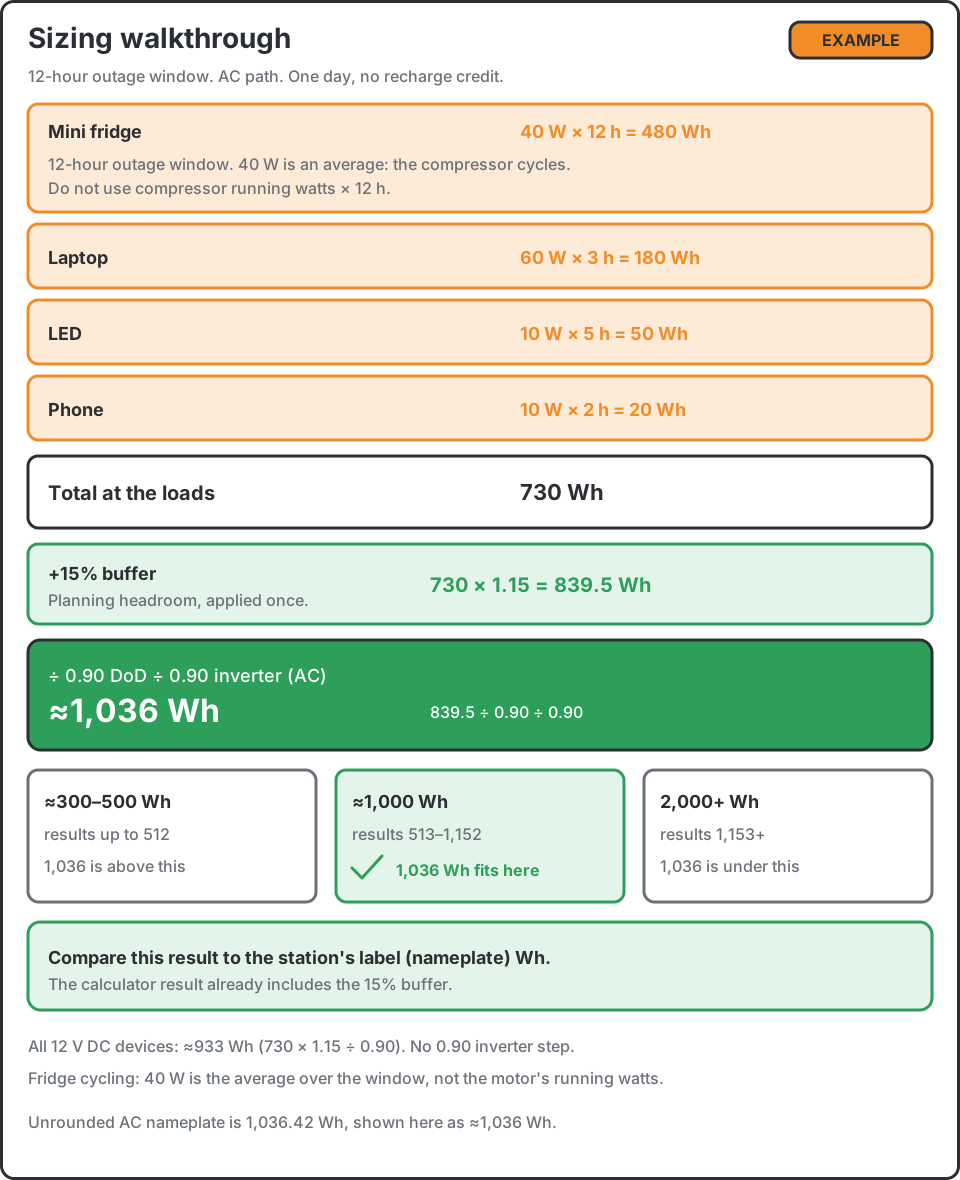
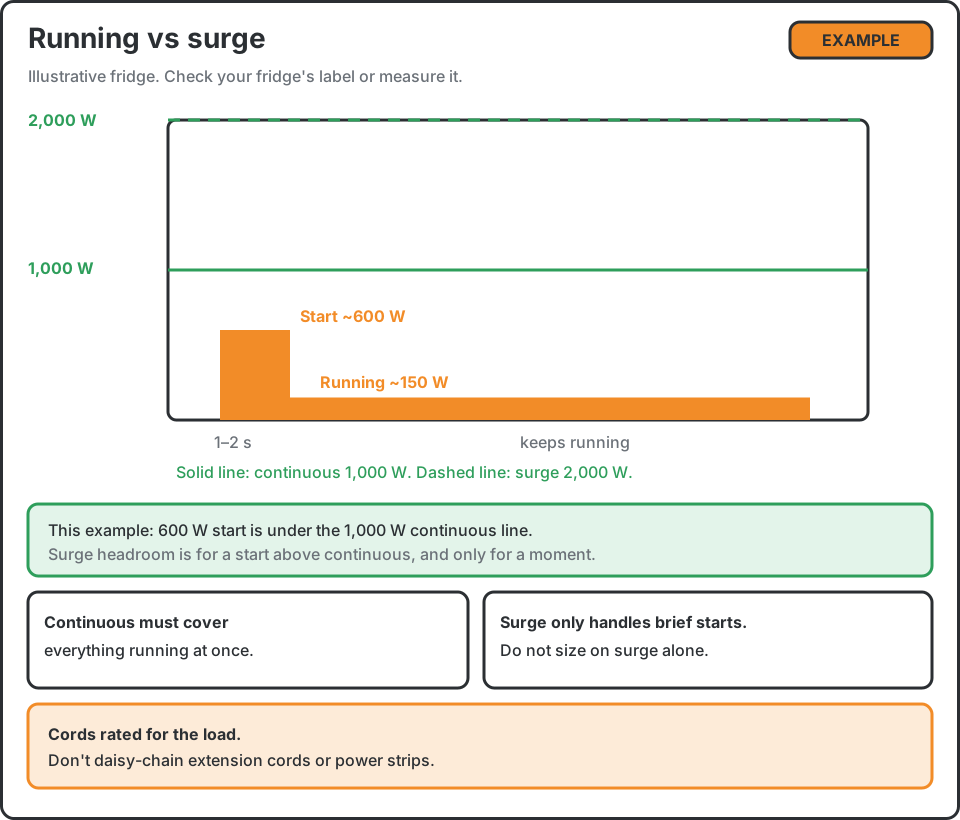
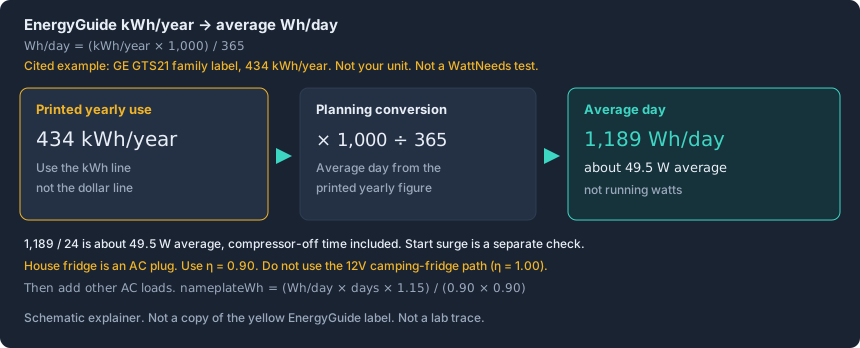
WattNeeds original. Schematic, not a yellow-label copy and not a lab trace. Cited example: 434 kWh/year → 1,189 Wh/day. House fridge stays on AC η=0.90. FTC EnergyGuide · 16 CFR 305.14 · GE label PDF.
EnergyGuide kWh/year → Wh/day
Refrigerators sold in the US carry a yellow EnergyGuide. The FTC requires that label, and the energy figure comes from the Department of Energy test. 16 CFR § 305.14 says the label must contain the model’s estimated annual energy consumption. The DOE refrigerator test reports that use in kWh/yr (10 CFR 430 Appendix A).
Read the estimated yearly electricity use in kWh. Ignore the dollar line for sizing. The dollars use a national average rate, and that rate changes. The kWh line is the energy figure.
Wh/day = (kWh/year × 1,000) / 365
Dividing by 365 (not 365.25) turns the printed yearly kWh into an average day. That is planning math on the sticker. It is not a second lab test, and it is not a promise for tomorrow’s outage. A shut door can land under it. A hot kitchen can land over it. The label already says your cost depends on your rates and your use. If your sticker is not the example below, use your number.
Cited example: one public label
Public GE Appliances EnergyGuide PDF for models GTS21FGK, GTS21FTK, GTS21FMK, and GTS21FSK (20.8 cu ft, automatic defrost, top-mounted freezer, no through-the-door ice): 434 kWh estimated yearly electricity use. That is the figure printed on that label. It is not a WattNeeds measurement, and it is not a claim that those models are still the one in your kitchen.
434 × 1,000 / 365 = 1,189.04… → 1,189 Wh/day
1,189 / 24 ≈ 49.5 W average
49.5 W is the sticker-day average, including hours the compressor is off. It is not running watts and not the start surge. EcoFlow’s home backup runtime article describes a typical modern refrigerator as hundreds of watts while the compressor runs, cycling through the day, with a brief startup surge. This page does not adopt their separate “around 200 W average” illustration as a measurement. 200 W × 24 h would be 4,800 Wh/day, which is not this label. Nameplate Wh does not prove the inverter can start the compressor. Check continuous watts and surge on Surge traps.
A 12V camping compressor is a different energy path. That method, including η=1.00 on the 12V port, stays on camping fridge. Ice versus running a compressor at all stays on cooler vs fridge.
Scenario A — light essentials, no fridge
AC plugs only. The router row is a planning pick at the top of a cited common band. The lamp row is a planning pick inside a cited band, with hours chosen here. Phones and laptops are an allowance.
| Load | Planning figure | Wh/day | What it is |
|---|---|---|---|
| Router | 20 W × 24 h | 480 | Top of EcoFlow’s “commonly ~5–20 W” router band. A separate modem is extra watts × 24. Their snapshot used 30 W for modem and router together. |
| LED lamps | 40 W × 6 h | 240 | 40 W sits inside their “perhaps 20 to 60 watts” for a few LED sets. Six hours is this page’s evening, not a measured duty cycle. |
| Phones / laptops | allowance | 150 | Planning allowance inside the old 100–200 Wh band. Not a sticker. |
| Total | 870 | No fridge. |
AC nameplate uses η=0.90, DoD=0.90, buffer=0.15. Denominator is 0.81.
| Scenario A | Formula | Exact | Nameplate |
|---|---|---|---|
| 1 day | 870 × 1.15 / (0.90 × 0.90) | 1,235.19 | 1,235 Wh |
| 2 days | 870 × 2 × 1.15 / (0.90 × 0.90) | 2,470.37 | 2,470 Wh |
One day without the fridge (~1,235 Wh nameplate) is the light-essentials case on home backup under ~2 kWh. Two days (~2,470 Wh) steps past that tier.
Scenario B — essentials plus this full-size fridge
Same 870 Wh/day, plus 1,189 Wh/day from the 434 kWh label. The house fridge plugs into AC. Leave η at 0.90.
870 + 1,189 = 2,059 Wh/day
| Scenario B | Wh/day in | Days | Formula | Nameplate |
|---|---|---|---|---|
| Fridge only | 1,189 | 1 | 1,189 × 1.15 / 0.81 | 1,688 Wh |
| Fridge only | 1,189 | 2 | 1,189 × 2 × 1.15 / 0.81 | 3,376 Wh |
| Essentials + fridge | 2,059 | 1 | 2,059 × 1.15 / 0.81 | 2,923 Wh |
| Essentials + fridge | 2,059 | 2 | 2,059 × 2 × 1.15 / 0.81 | 5,847 Wh |
The formula is linear: 1,688 + 1,235 = 2,923. One cited fridge day plus light essentials is about 2,923 Wh nameplate. That is above the under-~2 kWh compare tier. Two days is about 5,847 Wh nameplate. A ~1,000 Wh station is not a one-day plan for this fridge stack.
Swap 1,189 for your own sticker day before you buy. 434 kWh/year is one public label, not a class average.
What stays off this page
EcoFlow’s runtime article tells readers to skip central air, clothes dryers, and always-on electric water heat, and it contrasts a portable station (cords to loads, and it can go camping) with a fixed battery tied to the panel. This page stays on the cord side. Window-AC energy is already on Surge traps (Frigidaire FHWC054TE1, 450 W cooling held 8 hours, is 3,600 Wh at the load). It is not resized here.
Their capacity step is watts × hours, then a +25–30% lump, with a note that pure-sine inverters are often quoted around 90–95% and that you may not want to empty the pack. WattNeeds does not use that lump. Site defaults stay buffer 0.15, DoD 0.90, and AC η 0.90: multiply daily Wh by 1.15 / 0.81.
Related: camping fridge (12V Wh/day, η=1.00) · cooler vs fridge · Surge traps · home backup under ~2 kWh
Wh calculator — enter the fridge as Wh/day from your sticker (kWh/year × 1,000 / 365). Leave η at 0.90 for AC plugs. nameplate = (Wh/day × days × 1.15) / (0.90 × 0.90).
Where to check pricing
As an Amazon Associate, we earn from qualifying purchases at no extra cost to you. EcoFlow, Jackery, and Bluetti partner programs are not live yet.
See on Amazon EcoFlow — Coming soon Jackery — Coming soon Bluetti — Coming soon