1,000 Wh vs 2,000 Wh
Four planning cases for a round 1,000 Wh label and a round 2,000 Wh label. Watt-hours say how long the load can run. Inverter watts say whether it runs at all. Sheets on this page were read 2026-10-26.
What the round labels deliver
Same order as js/calculator.js. Round the full quotient once, half-up, the way Math.round does. Do not round the middle steps and then keep going. DoD=0.90 is a planning fraction of the label. It is not a BMS guarantee. The 15% buffer is headroom, not a measured loss. The runtime check does not apply the buffer again on the way down.
| Label | 12 V / USB delivered | AC delivered |
|---|---|---|
| 1,000 Wh | 1,000 × 0.90 = 900 Wh | 1,000 × 0.81 = 810 Wh |
| 2,000 Wh | 2,000 × 0.90 = 1,800 Wh | 2,000 × 0.81 = 1,620 Wh |
Those four products are exact. A 2,000 Wh label is not 2,000 usable Wh. Class spans on this site, from the sizing walkthrough: results up to 512 Wh, then 513–1,152 Wh, then 1,153 Wh and up. Shop the buffered nameplate against the printed label, not the round class name. A plan of 1,476 Wh is past the ~1,000 Wh class ceiling of 1,152 Wh, and it still sits under a 2,000 Wh label. A plan past 2,000 Wh is past that label even though the large class has no ceiling. The step down from here, where a 500 Wh label still covers a day, is 500 vs 1,000 Wh.
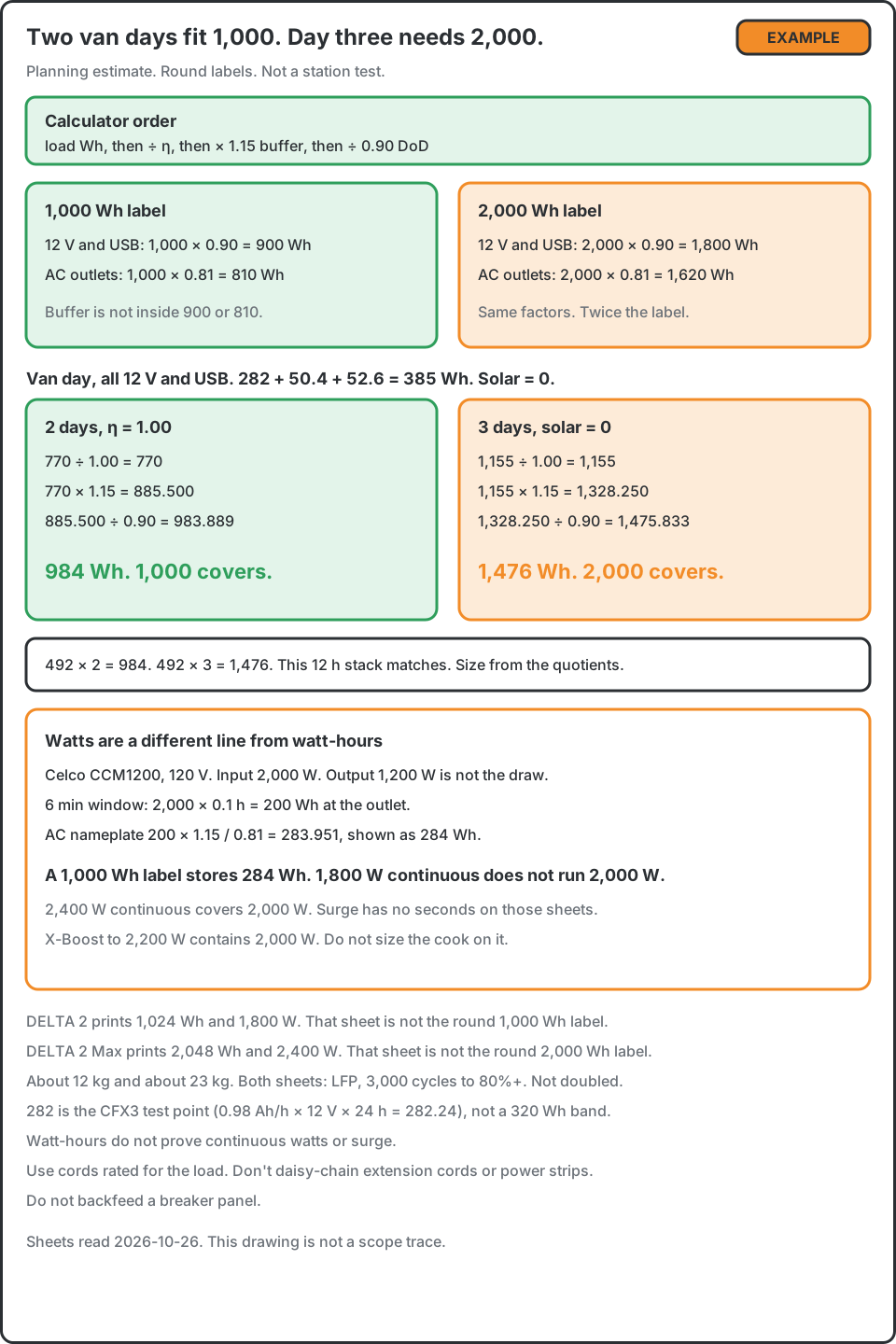
Van weekend: 12 V fridge, one fan, one laptop
Engine off. Solar = 0. One day, two days, and a third day with no recharge. The fridge figure is the CFX3 35 test point, the same 282 Wh/day used on camping fridge and van daily Wh. The sheet lists 0.98 Ah/h at 12 V DC, ambient 90°F, internal 39°F. 0.98 × 12 × 24 = 282.24, published as 282 Wh/day. Rated DC current 7.5 A is 90 W, and rated AC power 50 W held all day is 1,200 Wh. Neither is this test point. Average power at the test point is 282 / 24 = 11.75 W.
| Load | Basis | Wh/day | Path |
|---|---|---|---|
| CFX3 35 | 0.98 Ah/h × 12 V × 24 h, published as 282. On the 12 V cable. | 282 | 12 V, η=1.00 |
| One Caframo Sirocco II, high | 0.35 A is the 12 V high column. 0.35 × 12 = 4.2 W. The sheet’s timer steps are 3, 6, 9, and 12 h. This day uses the long step, 12 h: 4.2 × 12 = 50.4 Wh. The 6 h step is the second table. | 50.4 | 12 V, η=1.00 |
| MacBook Air 13-inch (M3), one recharge | 52.6 Wh battery. One recharge is this day. 52.6 Wh is energy stored in the pack. Charger loss is not on that page, so this row is a floor. The included 30 W USB-C adapter is a watts rating, not 30 W × hours. | 52.6 | USB-C, η=1.00 |
| Van day, 12 h fan | 282 + 50.4 + 52.6 | 385 | One DC pass |
Phones, pucks, and the router are off this stack. They are on the mild parked day (635.8 Wh) on van daily Wh. All three rows here are 12 V or USB, solar = 0. Steps are load ÷ 1.00, × 1.15, ÷ 0.90.
| Days | Steps | Exact | Nameplate |
|---|---|---|---|
| 1 | 385.000 → 442.750 → nameplate | 491.944 | 492 Wh |
| 2 | 770.000 → 885.500 → nameplate | 983.889 | 984 Wh |
| 3 | 1,155.000 → 1,328.250 → nameplate | 1,475.833 | 1,476 Wh |
385 × 1 × 1.15 / 0.90 = 491.944 → 492 Wh
385 × 2 × 1.15 / 0.90 = 983.889 → 984 Wh
385 × 3 × 1.15 / 0.90 = 1,475.833 → 1,476 Wh
On this 12 h stack, doubling and tripling the rounded day land on the same integers: 492 × 2 = 984, and 492 × 3 = 1,476. That match is this stack. It is not a rule. Size from the full quotient. The 6 h fan below does not match.
A 1,000 Wh label delivers 900 Wh on 12 V. 900 / 385 = 2.338 days. Hours at that day’s average are (900 / 385) × 24 = 56.104. Do not multiply the rounded day: 2.338 × 24 = 56.112. A 2,000 Wh label delivers 1,800 Wh: 1,800 / 385 = 4.675 days, and (1,800 / 385) × 24 = 112.208 hours. 4.675 × 24 = 112.200. The buffered plan is the shopping number. 984 Wh is under a 1,000 Wh label. 1,476 Wh is over it, over the ~1,000 Wh class ceiling of 1,152 Wh, and under a 2,000 Wh label. Two of these days fit 1,000 Wh. The third day with no recharge is where 2,000 Wh is the floor.
The 6 h timer is the same fan at the same 4.2 W, for a published shorter step: 4.2 × 6 = 25.2 Wh. The day is 282 + 25.2 + 52.6 = 359.8 Wh.
| Days, 6 h fan | Steps | Exact | Nameplate |
|---|---|---|---|
| 1 | 359.800 → 413.770 → nameplate | 459.744 | 460 Wh |
| 2 | 719.600 → 827.540 → nameplate | 919.489 | 919 Wh |
| 3 | 1,079.400 → 1,241.310 → nameplate | 1,379.233 | 1,379 Wh |
359.8 × 1.15 / 0.90 = 459.744 → 460 Wh
719.6 × 1.15 / 0.90 = 919.489 → 919 Wh
1,079.4 × 1.15 / 0.90 = 1,379.233 → 1,379 Wh
Do not double the rounded day. 460 × 2 = 920. The two-day quotient is 919.489, which rounds to 919 Wh. Do not triple it either. 460 × 3 = 1,380. The three-day quotient rounds to 1,379 Wh. Runtime on 12 V: 900 / 359.8 = 2.501 days, and (900 / 359.8) × 24 = 60.033 hours at that day’s average. 1,800 / 359.8 = 5.003 days, and (1,800 / 359.8) × 24 = 120.067 hours. Do not multiply the rounded days: 2.501 × 24 = 60.024, and 5.003 × 24 = 120.072. Same shopping decision as the 12 h fan. Two days fit a 1,000 Wh label. Three days need 2,000 Wh.
In JavaScript, 0.35 * 12 lands on 4.199999999999999, and 4.2 * 12 lands on 50.400000000000006. This page uses 4.2 W and 50.4 Wh, the same published products as the van page. 282 + 50.4 + 52.6 is 385 in that same JavaScript.
Plugging the 30 W adapter into an AC outlet puts the 52.6 Wh recharge on η=0.90. It is still a floor. The fridge and the 12 h fan stay on 12 V (332.4 Wh, η=1.00). Add the full quotients, then round once.
| Days | 52.6 Wh on AC, to 3 decimals | 332.4 Wh on 12 V, to 3 decimals | Full sum, to 3 decimals | Nameplate |
|---|---|---|---|---|
| 1 | 74.679 | 424.733 | 499.412 | 499 Wh |
| 2 | 149.358 | 849.467 | 998.825 | 999 Wh |
| 3 | 224.037 | 1,274.200 | 1,498.237 | 1,498 Wh |
2 days: 52.6 × 2 × 1.15 / 0.81 + 332.4 × 2 × 1.15 / 0.90 = 998.825 → 999 Wh
The one-day displays add to 74.679 + 424.733 = 499.412, which matches the full sum and rounds to 499 Wh. The rounded passes are 75 + 425 = 500. Two days: the displays add to 149.358 + 849.467 = 998.825, which matches the full sum’s three-decimal figure and rounds to 999 Wh. The rounded passes are 149 + 849 = 998. Shop 999. A 1,000 Wh label covers it. Three days round to 1,498 Wh, and the rounded passes 224 + 1,274 also add to 1,498. That plan is over a 1,000 Wh label and under a 2,000 Wh label. Moving the laptop onto AC does not change the decision: two days fit 1,000 Wh, three days need 2,000 Wh.
The rainy weekend stack is a different day: 570 Wh at the loads, all on AC, with the 320 Wh/day fridge planning band rather than this 282 Wh test point. That page prints about 809 Wh for one day and 1,619 Wh for two days. A 1,000 Wh label covers one of those AC days and misses two. A 2,000 Wh label covers 1,619 Wh. Runtime on that all-AC path, buffer off: 810 / 570 = 1.421 days, and 1,620 / 570 = 2.842 days. Those quotients are why an older one-decimal line said about 1.4 and about 2.8. They are not the 385 Wh van day above. Two van days on 12 V still fit a 1,000 Wh label. Two of those 570 Wh AC days do not.
Outage night: CPAP, a router, two lamps
One night and two nights. No house fridge. Solar = 0. The heavy CPAP row is the one already sized on CPAP: ResMed battery guide 198103/7, AirSense 10 at the printed 10 cm H2O row, ClimateLineAir at 30°C with humidifier setting 8, 4.92 A at 12 V. 4.92 × 12 × 8 = 472.32 Wh for that 8-hour table. It is one printed row so the arithmetic can be checked. It is not a recommended setting. This page does not change a pressure. The DC path is ResMed’s converter, η=1.00. The station’s own DC-port loss is still not modeled.
| Load | Basis | Wh | Path |
|---|---|---|---|
| AirSense 10, heavy 10 cm row | 4.92 A × 12 V × 8 h = 472.32 Wh. Eight hours is the battery guide’s period, not 24 h. | 472.32 | DC converter, η=1.00 |
| GL.iNet GL-MT3000 | Power consumption is printed as <8 W. Power input is Type-C, 5 V / 3 A. 5 × 3 = 15 W is the port rating, not the night. Ceiling: 8 W × 12 h. Twelve hours is this window. | 96 | USB, η=1.00 |
| Two GE Basic A19 lamps | The GE page prints wattage 8.5 W at 120 V. 8.5 W × 2 × 6 h. Six hours is this night. The “60 Watt replacement” line is the old bulb, not the draw. | 102 | AC, η=0.90 |
| Night | DC and USB 472.32 + 96 = 568.32. AC lamps 102. | 670.32 | Two passes |
DC and USB pass: 568.32 × 1.15 / 0.90 = 726.187, which rounds to 726 Wh alone. AC pass: 102 × 1.15 / 0.81 = 144.815, which rounds to 145 Wh alone. Add the exact passes. The full sum is 871.001481…, shown as 871.001, which rounds to 871 Wh. The three-decimal displays add to 726.187 + 144.815 = 871.002, one thousandth over that 871.001. The rounded passes are 726 + 145 = 871. Two nights: 1,742.003 → 1,742 Wh. The displays add to 1,452.373 + 289.630 = 1,742.003. Doubling the rounded night also gives 871 × 2 = 1,742. That match is these two nights. The one-night displays already disagree by a thousandth, so size from the full sum.
1 night: 568.32 × 1.15 / 0.90 + 102 × 1.15 / 0.81 = 871.001 → 871 Wh
2 nights: 1,742.003 → 1,742 Wh
In JavaScript, 472.32 + 96 lands on 568.3199999999999. The pass above uses the literal 568.32. 568.32 * 1.15 / 0.90 is 726.1866666666666, and the three-decimal half-up of that is 726.187.
Battery draw per night, before buffer and DoD: 568.32 + 102 / 0.90 = 681.653 Wh. A 1,000 Wh label covers (1,000 × 0.90) / 681.653 = 1.320 nights. A 2,000 Wh label covers 2.641 nights. Those are nights of this stack, not hours of a 24-hour average. The therapy row is 8 h, the lamps are 6 h, and the router ceiling is 12 h. The buffered 871 Wh plan fits a 1,000 Wh label. The buffered 1,742 Wh plan does not. It is over the 1,152 Wh class ceiling and under a 2,000 Wh label. Two of these nights, solar at zero, are where 2,000 Wh is the floor.
Moving the CPAP onto an AC supply, and leaving the router on USB, changes the path. ResMed’s battery guide recommends DC converters over inverters. Where it allows an inverter, it asks for a pure sine wave unit rated 300 W continuous and 500 W peak, and that inverter list does not name AirSense 10 with HumidAir. The AC rows are the site formula. They are not an approval. The AirSense 10 user guide prints peak power consumption 104 W (108 VA) and typical 53 W (57 VA). 104 W is under an 1,800 W continuous line and under a 2,400 W continuous line. That comparison is not why the label changes, and it is not a therapy approval. The second night’s watt-hours are why.
AC loads on that path: 472.32 + 102 = 574.32 Wh. USB stays 96 Wh. One night’s full sum is 938.059 → 938 Wh. The displays add to 815.393 + 122.667 = 938.060, one thousandth over. Two nights: 1,876.119 → 1,876 Wh. The displays add to 1,630.785 + 245.333 = 1,876.118, one thousandth under. Battery draw: 96 + 574.32 / 0.90 = 734.133 Wh. A 1,000 Wh label covers 900 / 734.133 = 1.226 nights. A 2,000 Wh label covers 2.452 nights. Same decision as the DC-converter path: one night fits 1,000 Wh, two nights need 2,000 Wh.
One fridge sticker day, then that day plus the CPAP night
The house fridge is the public GE EnergyGuide already used on home outage: models GTS21FGK, GTS21FTK, GTS21FMK, and GTS21FSK, 434 kWh estimated yearly electricity use. 434 × 1,000 / 365 = 1,189.041, published as 1,189 Wh/day. 1,189 / 24 ≈ 49.5 W average. That average includes hours the compressor is off. It is not running watts and not a start surge. The dollars on the label are not used.
| Fridge only, AC η=0.90 | Formula | Exact | Nameplate |
|---|---|---|---|
| 1 day | 1,189 × 1.15 / 0.81 | 1,688.086 | 1,688 Wh |
| 2 days | 1,189 × 2 × 1.15 / 0.81 | 3,376.173 | 3,376 Wh |
1,189 × 1.15 / 0.81 = 1,688.086 → 1,688 Wh
2,378 × 1.15 / 0.81 = 3,376.173 → 3,376 Wh
A 1,000 Wh label delivers 810 Wh on AC. 810 / 1,189 = 0.681 day. Hours at the sticker-day average are (810 / 1,189) × 24 = 16.350. Do not multiply the rounded day: 0.681 × 24 = 16.344. A 2,000 Wh label delivers 1,620 Wh: 1,620 / 1,189 = 1.362 days, and (1,620 / 1,189) × 24 = 32.700 hours. 1.362 × 24 = 32.688. The runtime of 1.362 days is not two sticker days. The buffer is off on the way down. The buffered one-day plan is 1,688 Wh. A 1,000 Wh label is short of it by 688 Wh. A 2,000 Wh label covers it. Two sticker days are 3,376 Wh. Both round labels are short. One cited fridge day is where 2,000 Wh earns the watt-hours. A second fridge day is past both labels.
Adding the heavy CPAP night, the two lamps, and a router left on for the calendar day is a different sum. The router ceiling moves from 12 h to 24 h because this row is a day, not the night window above: 8 W × 24 h = 192 Wh, still a ceiling under the printed <8 W. CPAP stays 472.32 Wh for 8 h, not × 3. Lamps stay 102 Wh. Fridge stays 1,189 Wh on AC.
| Part of one calendar day | Wh | Path | Pass, to 3 decimals | Rounds alone to |
|---|---|---|---|---|
| Fridge 1,189 + lamps 102 | 1,291 | AC, η=0.90 | 1,832.901 | 1,833 Wh |
| CPAP 472.32 + router 192 | 664.32 | DC and USB, η=1.00 | 848.853 | 849 Wh |
| Full sum | 1,955.32 | Two passes | 2,681.755 | 2,682 Wh |
1,291 × 1.15 / 0.81 + 664.32 × 1.15 / 0.90 = 2,681.755 → 2,682 Wh
The displays add to 1,832.901 + 848.853 = 2,681.754, one thousandth under the full sum’s 2,681.755. The rounded passes are 1,833 + 849 = 2,682. In JavaScript, 472.32 + 192 lands on 664.3199999999999. The pass uses the literal 664.32. A 1,000 Wh label and a 2,000 Wh label are both short of 2,682 Wh. Battery draw before buffer and DoD: 664.32 + 1,291 / 0.90 = 2,098.764 Wh. A 1,000 Wh label covers 900 / 2,098.764 = 0.429 day. A 2,000 Wh label covers 0.858 day. Neither runtime is a full day of this stack. A 2,000 Wh label that covers the fridge sticker alone does not cover the fridge plus this CPAP night.
The GTS21 owner’s manual (49-60761, 01-17 GEA) requires a 115 V AC, 60 Hz, 15- or 20-amp grounded supply, and its shock warning says not to use an extension cord. The manual does not print compressor running watts, and it does not print a start surge or a locked-rotor amp. This page does not multiply 15 A or 20 A by 115 V and call the product the fridge. The care section’s replacement bulbs, 5 W LED or 40 W incandescent maximum, are not the day. No surge multiple is invented here. No scope trace. The DELTA 2 surge cell is 2,700 W, and the DELTA 2 Max surge cell is 4,800 W. Neither cell prints seconds. Those lines are not a measured compressor start. A 2,000 Wh label that covers 1,688 Wh of sticker energy does not prove the compressor starts. Read the fridge rating plate. If the station cannot sit at the fridge, that is an electrician and a transfer switch or inlet, not a backfeed into the panel. This page does not repeat the manual’s grounding steps.
A 2,000 W input for six minutes
Stored energy can pass while the inverter’s continuous line fails. Surge is a brief start. A magnetron cook lasts minutes. The peak line is not those minutes. No surge multiple is invented here. No scope trace.
The Celco manual for CCM1200, CCM1800, and CCM2100 prints three columns. This row is only the CCM1200 column: rated voltage 120 V ~ 60 Hz, rated input power 2,000 W, rated output power 1,200 W, oven capacity 0.6 cu ft. 1,200 W is cooking output. The wall draw on that column is 2,000 W. The sheet does not print a power factor, so this page does not invent one. The CCM1800 and CCM2100 columns are 208/230 V, with inputs of 3,000 W and 3,200 W. They are not this 120 V example, and both of those inputs are over the 2,400 W line below. Six minutes is this page’s window, not a cook time printed on the sheet. This is a commercial countertop oven. It is here because the input sits between two continuous ratings. It is not a campsite cook.
2,000 W × (6/60) h = 200 Wh
200 × 1.15 / 0.81 = 283.951 → 284 Wh
A 1,000 Wh label delivers 810 Wh on AC, which is 810 / 200 = 4.050 of those windows. A 2,000 Wh label delivers 1,620 Wh, 8.100 windows. Both labels store one cook. Neither number turns the oven on.
On the sheets in the next section, 2,000 W is over the DELTA 2 continuous 1,800 W. It is under that manual’s X-Boost number of 2,200 W. The cook is still minutes. This page does not call 2,000 W a pass on X-Boost. DELTA 2 Max’s continuous 2,400 W covers 2,000 W for this oven alone. The 4,800 W surge cell is not what covers a six-minute cook. The 1,050 W Comfee input on 500 vs 1,000 Wh is under both of these continuous lines, so that smaller oven is not why these two sheets differ.
Use cords rated for the load. Don't daisy-chain extension cords or power strips. Do not backfeed a breaker panel. The oven plugs into the station, not into a house circuit through the panel. This page does not repeat the Celco grounding steps.
Charge input, weight, and the cycle line
Two manuals, read 2026-10-26, show why a ~1,000 Wh class and a ~2,000 Wh class are not “twice the everything.” The round 1,000 and 2,000 labels above are the energy comparison. These sheets are the watts, the input ceilings, the mass, and the cycle line. They are not a ranking. The same two sheets are already on EcoFlow vs Jackery vs Bluetti.
| Line | DELTA 2 manual | DELTA 2 Max manual |
|---|---|---|
| Printed capacity | 1,024 Wh, 51.2 V. Not a 1,000 Wh label. | 2,048 Wh. Not a 2,000 Wh label. |
| Cell chemistry / cycle life | LFP, 3,000 cycles to 80%+ capacity. | LFP, 3,000 cycles to 80%+ capacity. |
| AC output | Pure sine, 1,800 W total (surge 2,700 W), 120 V. The surge cell prints no seconds. | Pure sine, 2,400 W total (surge 4,800 W), 120 V. The surge cell prints no seconds. |
| X-Boost | 2,200 W on the spec line. Enabled when output exceeds rated power. Not for appliances with voltage protection. More suitable for heating devices; the manual says to test. X-Boost works by lowering output voltage below 120 V. Our sizing rule: voltage-reduction lift modes are for resistive heating loads only. Reduced voltage can stall or overheat motor and compressor loads. Not a surge rating. Do not size on it. | 3,400 W on the spec line. Same family of limits: off in bypass, not for every appliance, more suitable for heating devices, test them. X-Boost works by lowering output voltage below 120 V. Our sizing rule: voltage-reduction lift modes are for resistive heating loads only. Reduced voltage can stall or overheat motor and compressor loads. Not a surge rating. Do not size on it. |
| AC charge | X-Stream 1,200 W max, 10 A, 100–120 V. The AC charging section also prints “≈1.2 hrs Full Charge.” | X-Stream 1,800 W max, 15 A, 100–120 V. The spec table does not print a full-charge time on that line. |
| Solar input | 11–60 V, 15 A, 500 W max. Keep panel voltage inside that range. 500 W is a ceiling, not a day’s harvest. | 11–60 V, 15 A. One port 500 W. Two ports 1,000 W. A ceiling, not a harvest. This page does not repeat a series-wiring figure. |
| Car charge input | 12 V / 24 V battery, default 8 A. The spec line does not print a watt. This page does not invent one. | 12 V / 24 V battery, default 8 A. No watt on that line either. |
| 12 V output | 12.6 V, 10 A, 126 W max, shared with the DC5521 ports. The CFX3 average at the test point is 11.75 W. Rated 7.5 A is 90 W. 90 W is under 126 W. That is a rating comparison, not a compressor start. | 12.6 V, 10 A, 126 W max. Same 90 W comparison. Same limit: not a start proof. |
| Weight, as printed | Approximately 12 kg (27 lb). | Approximately 23 kg (50 lb). |
Charge math is a ceiling check, not a charge curve. The 0.90 factor on this site is the AC output path. It is not charge efficiency, and it is not in the divisions below.
1,024 / 1,200 = 0.853 h
1.2 × 1,200 = 1,440 Wh
0.853 h is the 1,024 Wh label divided by the 1,200 W maximum, as if that maximum held for the whole fill and every watt-hour stuck. The manual’s printed “≈1.2 hrs Full Charge” is a different number. 1,440 Wh is not the 1,024 Wh label. The manual also says the AC charging speed can be adjusted in the app, so 1.2 h is not pinned to 1,200 W by this page. This page does not adopt 0.853 h or 1.2 h as a calculated recharge. Do not turn 1,200 W × 1 h into a 1,200 Wh battery.
1,024 / 500 = 2.048 h
2,048 / 1,800 = 1.138 h
2,048 / 500 = 4.096 h
2,048 / 1,000 = 2.048 h
Those four quotients are the same kind of ceiling check. 2.048 h is 1,024 Wh at a 500 W solar ceiling, or 2,048 Wh at a 1,000 W two-port ceiling. 4.096 h is 2,048 Wh at one 500 W port. 1.138 h is 2,048 Wh divided by the 1,800 W AC maximum. A text extraction of the DELTA 2 Max manual on 2026-10-26 did not find a full-charge hours sentence next to that 1,800 W line. 1,800 × 1 h = 1,800 Wh, which is not 2,048 Wh. Harvest from a real sky stays on solar vs battery. Panel voltage stays inside 11–60 V. This page does not give a stringing procedure.
The DELTA 2 manual prints approximately 12 kg (27 lb). The DELTA 2 Max manual prints approximately 23 kg (50 lb). Both lines say approximately, so this page does not subtract them and does not divide watt-hours by kilograms. The pounds are the manuals’ figures, not a conversion performed here. On these two sheets the heavier carry is the Max. A walk from the car is a reason to keep a 1,000 Wh label when the buffered plan already fits it. A parked van or a house outage cares about the watt-hours and the inverter line more than about that carry. Neither weight is a test this site ran.
Both sheets print LFP and 3,000 cycles to 80%+ capacity. The cycle count does not double when the watt-hours do. This page does not turn 3,000 cycles into years, and it does not multiply 3,000 by the label and call the product lifetime energy. DoD=0.90 is a planning fraction. It is not that cycle test. The chemistry primer is LiFePO4 vs NMC. An NCM extra battery, where a sheet prints one, is a different pack. Day counts on this page stay on the base labels.
Delivered energy on the printed labels, same factors, rounded once: 1,024 × 0.90 = 921.6 → 922 Wh on 12 V, and 1,024 × 0.81 = 829.44 → 829 Wh on AC. 2,048 × 0.90 = 1,843.2 → 1,843 Wh on 12 V, and 2,048 × 0.81 = 1,658.88 → 1,659 Wh on AC. The 829 Wh and 1,659 Wh figures are the same products already on the comparison page. Do not shop 829 Wh as if it were the round label’s 810 Wh, or 1,659 Wh as if it were 1,620 Wh. On the 385 Wh van day, divide the unrounded products: 921.6 / 385 = 2.394 days, and 1,843.2 / 385 = 4.788 days. Do not divide the rounded 922 Wh.
Where 1,000 Wh is enough
“Covers” means the round label is at least the buffered nameplate. The oven row stores the energy and still has to pass the watts check above. The rainy-weekend rows are that page’s printed nameplates, not a new stack.
| Buffered plan | Nameplate | 1,000 Wh label | 2,000 Wh label |
|---|---|---|---|
| Van, 385 Wh, 12 h fan, 1 day, 12 V | 492 Wh | Covers | Covers |
| Van, 385 Wh, 2 days, 12 V, solar = 0 | 984 Wh | Covers | Covers |
| Van, 385 Wh, 3 days, 12 V, solar = 0 | 1,476 Wh | Short. Past the 1,152 Wh class ceiling. 2,000 Wh is the floor. | Covers |
| Van, 6 h fan, 2 days, 12 V | 919 Wh | Covers | Covers |
| Van, 6 h fan, 3 days, 12 V | 1,379 Wh | Short | Covers |
| Van, laptop on AC, 12 h fan, 2 days | 999 Wh | Covers. Shop 999, not the rounded passes’ 998. | Covers |
| Van, laptop on AC, 12 h fan, 3 days | 1,498 Wh | Short | Covers |
| Rainy weekend, 570 Wh, 1 day, all AC | about 809 Wh | Covers | Covers |
| Rainy weekend, 570 Wh, 2 days, all AC | 1,619 Wh | Short | Covers |
| CPAP night, DC converter, 1 night | 871 Wh | Covers | Covers |
| CPAP night, DC converter, 2 nights | 1,742 Wh | Short. 2,000 Wh is the floor. | Covers |
| CPAP on AC, 1 night / 2 nights | 938 / 1,876 Wh | Covers / short | Covers / covers |
| Fridge sticker, 1 day, AC | 1,688 Wh | Short by 688 Wh | Covers |
| Fridge sticker, 2 days, AC | 3,376 Wh | Short | Short |
| Fridge day plus CPAP night, lamps, 24 h router | 2,682 Wh | Short | Short by 682 Wh |
| One 6 min CCM1200 window | 284 Wh | Energy covers. 2,000 W does not run on an 1,800 W continuous line. | Energy covers. Watts depend on that station’s continuous line, not on the 2,000 Wh label. A 2,400 W line covers 2,000 W. |
A 1,024 Wh sheet covers the two-day van plan (984 Wh) and the one CPAP night (871 Wh), and it covers the laptop-on-AC two-day plan (999 Wh). It does not cover three van days (1,476 Wh), two CPAP nights (1,742 Wh), or one fridge sticker day (1,688 Wh). A 2,048 Wh sheet covers those three. It does not cover two fridge sticker days (3,376 Wh) or the fridge-plus-CPAP day (2,682 Wh). 2,682 − 2,048 = 634. The printed 2,048 Wh label is short of that plan by 634 Wh.
1,000 Wh is enough for two of these 12 V van days, for one of these CPAP nights, and for one AC day of the 570 Wh camping stack. 2,000 Wh is the floor for a third van day, for two of these CPAP nights, for one fridge sticker day, and for two AC days of that 570 Wh stack. It is not enough for the fridge sticker plus the CPAP night, and it is not enough for two fridge sticker days. A 2,000 W oven input is a watts problem. Buying the next watt-hour class does not fix an 1,800 W inverter, and a 2,000 Wh label is not itself a 2,400 W inverter.
Related: 500 vs 1,000 Wh · van daily Wh · home outage · CPAP · surge traps · rainy weekend · solar vs battery · ~1,000 Wh class · ~2,000 Wh class · LiFePO4 vs NMC
Wh calculator — one η per pass. 12 V and USB: set inverter efficiency to 1.00. AC outlets: leave η at 0.90. nameplate = (Wh/day × days × 1.15) / (0.90 × η).
Where to check pricing
As an Amazon Associate, we earn from qualifying purchases at no extra cost to you. EcoFlow, Jackery, and Bluetti partner programs are not live yet.
See on Amazon EcoFlow — Coming soon Bluetti — Coming soon Jackery — Coming soon