CPAP night on a power station
One therapy night is watts times hours asleep, not a power-brick rating times 24. Heated humidification and a heated tube are most of the watt-hours on the ResMed table below. A portable station for camping, a home outage, or a van. Solar credit is zero.
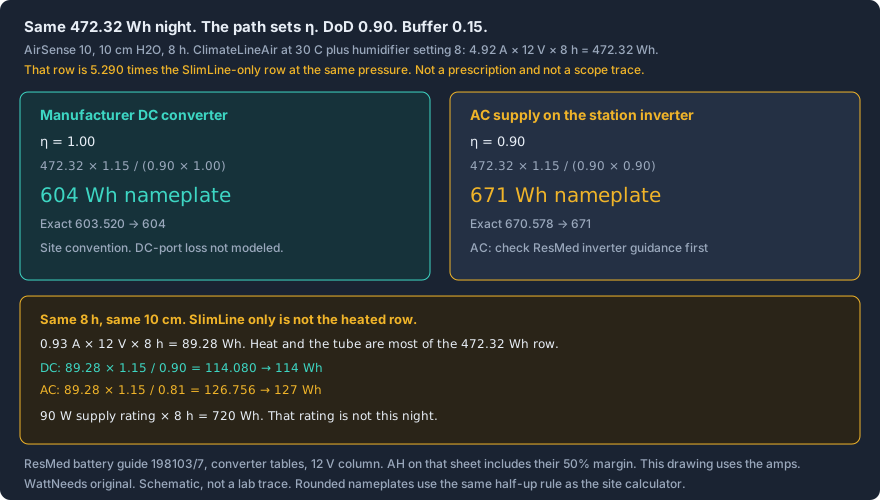
WattNeeds original schematic, not a scope trace and not a lab run. Heavy row 472.32 Wh: DC exact 603.520 rounds to 604 Wh; AC exact 670.578 rounds to 671 Wh. SlimLine-only row 89.28 Wh: DC exact 114.080 rounds to 114 Wh; AC exact 126.756 rounds to 127 Wh. The 90 W figure is the supply rating, held for 8 h (720 Wh), not this row. Source tables: ResMed battery guide 198103/7.
One printed AirSense 10 pressure
ResMed’s battery guide (198103/7, 2018-08) prints current at 12 V DC for an 8-hour period, and only with their DC-to-DC converter. The worked pressure here is the 10 cm H2O row. The sheet labels that column IPAP. It is one printed row so the arithmetic can be checked. It is not a recommended setting. Use the row for the prescribed pressure, or the next higher printed pressure. This page does not change a pressure.
The four rows below are the AirSense 10 CPAP, Elite, AutoSet, and AutoSet for Her block on the converter tables. Watt-hours at the 12 V source are amps × 12 V × 8 h. The guide’s amp-hour column is a different number: battery sizes “include a 50% safety margin.” Check: 0.93 × 8 × 1.5 = 11.16, and the sheet prints 12 AH. WattNeeds uses the 0.93 A column, not 12 AH. Do not stack their 50% on top of the 0.15 buffer.
On a phone, swipe the tables sideways.
| Row label on the sheet, at 10 cm H2O | Amps at 12 V | Watts (A × 12) | Wh for 8 h | Versus SlimLine only |
|---|---|---|---|---|
| SlimLine tubing. No humidifier on this row label. | 0.93 | 11.16 | 89.28 | 1.000 |
| ClimateLineAir at 30°C. The row label does not include a humidifier. | 1.52 | 18.24 | 145.92 | 1.52 / 0.93 = 1.634 |
| SlimLine tubing, humidifier setting 8. | 3.66 | 43.92 | 351.36 | 3.66 / 0.93 = 3.935 |
| ClimateLineAir at 30°C, humidifier setting 8. | 4.92 | 59.04 | 472.32 | 4.92 / 0.93 = 5.290 |
At this one pressure, the heated-tube-plus-humidifier row is 5.290 times the SlimLine-only row. The gap is 472.32 − 89.28 = 383.04 Wh. The humidifier-at-8 row on non-heated tubing (351.36 Wh) is a larger step up from SlimLine only than the heated tube alone (145.92 Wh). The Air10 DC/DC converter guide says the same thing in words: an Air10 device with the HumidAir humidifier attached uses considerably more power than the device alone, and the humidifier drains a battery faster. That sentence is not a watt. The table is the watt.
The sheet also prints humidifier setting 4, and ClimateLineAir with humidifier at Auto, on the same page. Those rows are not sized here. Settings 4, 8, 30°C, and Auto are the labels ResMed printed. They are not instructions to change a machine.
The user guide lists a side cover for use without the humidifier tub. Whether to run without heated humidification is a question for the manual and for the clinician or the equipment supplier. This page does not recommend it.
| Scenario | Wh/night | Nights | Path | η | Exact | Rounded |
|---|---|---|---|---|---|---|
| SlimLine only, 10 cm | 89.28 | 1 | DC converter | 1.00 | 114.080 | 114 Wh |
| SlimLine only, 10 cm | 89.28 | 1 | AC inverter | 0.90 | 126.756 | 127 Wh |
| SlimLine only, no recharge | 89.28 | 2 | DC converter | 1.00 | 228.160 | 228 Wh |
| SlimLine only, no recharge | 89.28 | 2 | AC inverter | 0.90 | 253.511 | 254 Wh |
| ClimateLineAir 30°C, no humidifier on the label | 145.92 | 1 | DC converter | 1.00 | 186.453 | 186 Wh |
| ClimateLineAir 30°C, no humidifier on the label | 145.92 | 1 | AC inverter | 0.90 | 207.170 | 207 Wh |
| SlimLine, humidifier setting 8 | 351.36 | 1 | DC converter | 1.00 | 448.960 | 449 Wh |
| SlimLine, humidifier setting 8 | 351.36 | 1 | AC inverter | 0.90 | 498.844 | 499 Wh |
| ClimateLineAir 30°C + humidifier 8 | 472.32 | 1 | DC converter | 1.00 | 603.520 | 604 Wh |
| ClimateLineAir 30°C + humidifier 8 | 472.32 | 1 | AC inverter | 0.90 | 670.578 | 671 Wh |
| Same heavy row, no recharge | 472.32 | 2 | DC converter | 1.00 | 1,207.040 | 1,207 Wh |
| Same heavy row, no recharge | 472.32 | 2 | AC inverter | 0.90 | 1,341.156 | 1,341 Wh |
Rounded values use the calculator’s half-up rule on the full quotient (Math.round). The exact column is that quotient to 3 decimal places. Worked heavy night: 472.32 × 1.15 / 0.90 = 603.520, rounds to 604 Wh on the DC convention. 472.32 × 1.15 / 0.81 = 670.577…, shown as 670.578, rounds to 671 Wh on AC. Two nights with no recharge is exactly twice the one-night quotient. Two nights means two 8-hour therapy periods, not 48 hours of blower time.
The amps are already the 12 V draw with ResMed’s converter, so the DC column does not add a second inverter. The AC column runs that same Wh through η = 0.90. That is the site formula for a station inverter in front of an AC supply. It is not a second ResMed measurement of AC input watts. The user-guide typical below is the separate AC figure.
A runtime check uses deliveredUsableWh = nameplate × 0.90 × η, then divides by Wh per night. On the heavy 472.32 Wh night, a 500 Wh nameplate delivers 500 × 0.90 = 450 Wh on the DC convention, which is 450 / 472.32 = 0.953 of that night. The same 450 Wh is 450 / 89.28 = 5.040 SlimLine-only nights. A 1,000 Wh nameplate delivers 900 Wh on DC (900 / 472.32 = 1.905 heavy nights) and 810 Wh on AC (810 / 472.32 = 1.715 heavy nights). Neither is the 2-night nameplate in the table (1,207 Wh DC, 1,341 Wh AC). These checks are the formula. They are not a station test.
A supply rating is not the night
The AirSense 10 user guide prints a 90 W power supply, DC output 24 V 3.75 A (24 × 3.75 = 90 W), typical power consumption 53 W (57 VA), and peak power consumption 104 W (108 VA). The guide does not print pressure, leak, humidity, or tubing next to “typical.” 53 W is not the battery-guide 10 cm row, and it is not a dry-night figure. This page does not average 53 W with 59.04 W.
Sizing the night as 90 W × 8 h = 720 Wh treats the supply rating as if it were the overnight average. 720 / 472.32 = 1.524 times the heavy 10 cm row, and 720 / 89.28 = 8.065 times the SlimLine-only row. Holding 90 W for 24 h is 2,160 Wh, which is not a night. The VA figure is not the watt either: 53 W is the number this section multiplies, not 57 VA.
53 W × 8 h = 424 Wh for one night at the published typical. That 424 Wh sits between the humidifier-at-8 row (351.36 Wh) and the heavy heated row (472.32 Wh). It does not replace either row. Peak 104 W is a watts check, not an 8-hour energy figure. 104 W is above the 90 W supply rating in the same table. This page does not resolve that gap. Wh math does not prove a station inverter can supply the peak. Check continuous watts on surge traps.
Before using the AC path, read ResMed’s inverter section in the same battery guide. ResMed recommends DC-to-DC converters over inverters. Where it allows an inverter, it recommends a certified pure sine wave inverter rated 300 W continuous and 500 W peak/surge. Its inverter steps list S9, VPAP III, AutoSet CS2, VPAP Adapt, and Stellar with named humidifiers, not AirSense 10, and it warns that other ResMed heated humidifiers must not be used with inverters. The AC rows on this page are the site formula, not a statement that an AirSense 10 with HumidAir is approved on a station’s AC outlet. Ask ResMed or the equipment supplier first.
| Figure | Wh if held 8 h | What it is | 1 night, DC η=1.00 | 1 night, AC η=0.90 |
|---|---|---|---|---|
| User-guide typical, 53 W | 424 | Published typical watts. Conditions not printed beside the line. | 541.778 → 542 Wh | 601.975 → 602 Wh |
| 90 W supply rating | 720 | Brick rating held for 8 h. Not the typical and not the 10 cm row. | 920.000 → 920 Wh | 1,022.222 → 1,022 Wh |
Two nights at the 53 W typical, no recharge: DC exact 1,083.556 rounds to 1,084 Wh; AC exact 1,203.951 rounds to 1,204 Wh. The 90 W rows are the overstated method. They are not the recommended night.
The Air10 converter guide (model 370003) prints its own typical power consumption 51 W and peak 106 W, input 12 V / 24 V at 13 A / 6.5 A, output 24 V at 3.75 A. 51 × 8 = 408 Wh. That typical is not the user-guide 53 W, and this page does not average them. The input-current rating held for 8 hours is 13 A × 12 V × 8 h = 1,248 Wh, which is 1,248 / 408 = 3.059 times the converter’s own typical watt held for 8 hours. 13 A is the input rating. The heavy 10 cm row averages 4.92 A at 12 V. Check the station’s DC-port continuous rating against the converter’s printed input. This page does not divide the 106 W peak by 12 into a required port amp.
ResMed also published a 2015 sheet, document 1018673/1, Power consumption of Air10 devices. The column is titled “Power Consumed (Watt Hour).” AirSense 10 AutoSet running rows on that sheet are 7, 22, and 34 under stated settings, measured with a Yokogawa WT110. The sheet does not print the length of the run. This page does not multiply 7, 22, or 34 by 8 hours.
AirSense 11: one typical, no split
The AirSense 11 user guide prints a 65 W power supply, DC output 24 V 2.71 A (24 × 2.71 = 65.04 W, which the guide calls 65 W), typical power consumption 56.1 W (111.5 VA), and peak power consumption 73.2 W (137.6 VA). The guide does not print pressure, humidity, or tubing next to “typical.” The 2018 battery guide does not list AirSense 11, so there is no manufacturer amp split here for blower versus humidifier versus heated tube. This page does not scale the AirSense 10 ratios onto the AirSense 11.
56.1 W × 8 h = 448.8 Wh at that typical. The 111.5 VA figure is not used (111.5 × 8 would treat VA as watts). 65 W × 8 h = 520 Wh is the supply rating held for the night, not the typical. Peak 73.2 W is above the 65 W supply rating in the same table. Wh sizing uses 56.1 W. The watts check uses the peak line. Applying η = 1.00 to this AC-published typical is the site convention for a manufacturer DC converter. It is not a measured 12 V amp. The user guide lists an Air11 DC/DC converter as an accessory. The Air11 converter guide (model 390002) says it is for an Air11 device, input 12 V / 24 V at 10 A / 5 A, output 24 V at 3.75 A. It does not print a typical watt. 10 A × 12 V is an input rating, not the 56.1 W night.
| Scenario | Wh/night | Nights | Path | η | Exact | Rounded |
|---|---|---|---|---|---|---|
| Typical 56.1 W × 8 h | 448.8 | 1 | DC convention | 1.00 | 573.467 | 573 Wh |
| Typical 56.1 W × 8 h | 448.8 | 1 | AC inverter | 0.90 | 637.185 | 637 Wh |
| Typical, no recharge | 448.8 | 2 | DC convention | 1.00 | 1,146.933 | 1,147 Wh |
| Typical, no recharge | 448.8 | 2 | AC inverter | 0.90 | 1,274.370 | 1,274 Wh |
| 65 W rating held 8 h (not the typical) | 520 | 1 | DC convention | 1.00 | 664.444 | 664 Wh |
| 65 W rating held 8 h (not the typical) | 520 | 1 | AC inverter | 0.90 | 738.272 | 738 Wh |
DreamStation 2: an 80 W rating, and two what-ifs
The DreamStation 2 manual does not print a typical overnight watt. It prints two electrical lines. One is “AC Power Consumption: 100–240 VAC, 50/60 Hz, 2.0-1.0 A.” That pairs a current range with a voltage range. This page does not multiply a voltage by that current and call the product the device watt. The other line is on the Check Power fault: an 80 W power supply is required to support humidification. 80 W is a supply rating, not an average draw. Holding it for 8 hours is 80 × 8 = 640 Wh. That is the brick method for this machine.
No citable DreamStation 2 average watt, and no citable humidifier-off watt, was found in that manual. The AirSense 10 amp table is not applied here. Two planning what-ifs, labeled as such: half of 80 W (40 W) and a quarter of 80 W (20 W). They are round fractions of the only watt on the humidification-supply line, so the nameplate gap is visible. They are not a Philips measurement and not a duty cycle. 40 × 8 = 320 Wh. 20 × 8 = 160 Wh.
| Scenario | Wh/night | Nights | Path | η | Exact | Rounded |
|---|---|---|---|---|---|---|
| 80 W rating held 8 h (not an average) | 640 | 1 | DC convention | 1.00 | 817.778 | 818 Wh |
| 80 W rating held 8 h (not an average) | 640 | 1 | AC inverter | 0.90 | 908.642 | 909 Wh |
| 80 W rating, no recharge | 640 | 2 | DC convention | 1.00 | 1,635.556 | 1,636 Wh |
| 80 W rating, no recharge | 640 | 2 | AC inverter | 0.90 | 1,817.284 | 1,817 Wh |
| What-if, 40 W (half the rating) | 320 | 1 | DC convention | 1.00 | 408.889 | 409 Wh |
| What-if, 40 W (half the rating) | 320 | 1 | AC inverter | 0.90 | 454.321 | 454 Wh |
| What-if, 40 W, no recharge | 320 | 2 | DC convention | 1.00 | 817.778 | 818 Wh |
| What-if, 40 W, no recharge | 320 | 2 | AC inverter | 0.90 | 908.642 | 909 Wh |
| What-if, 20 W (quarter of the rating) | 160 | 1 | DC convention | 1.00 | 204.444 | 204 Wh |
| What-if, 20 W (quarter of the rating) | 160 | 1 | AC inverter | 0.90 | 227.160 | 227 Wh |
| What-if, 20 W, no recharge | 160 | 2 | DC convention | 1.00 | 408.889 | 409 Wh |
| What-if, 20 W, no recharge | 160 | 2 | AC inverter | 0.90 | 454.321 | 454 Wh |
Linearity check: the 40 W what-if for two nights matches the 80 W rating for one night (DC 818 Wh, AC 909 Wh). That only shows the formula scales. It does not make 40 W a measured draw. DC η = 1.00 on these rows is the site convention for a manufacturer DC cord. Philips did not print a 12 V amp for this table.
Cords, the DC port, and a backup that is not the utility list
AirSense 10 DC path: the Air10 converter guide (model 370003) is specifically for AirSense 10, AirCurve 10, and Lumis. Only connect it to a 12 V or 24 V DC supply. Do not modify it. The guide says the power cord is not replaceable, and there are no user-serviceable parts inside. It describes a vehicle 12 V or 24 V outlet. It does not name a portable power station. If a station port is that kind of outlet, the limits are still the converter input rating and the station’s own port rating. Ask the equipment supplier. Do not cut the cord.
AirSense 11 DC path: the Air11 converter guide (model 390002) is for an Air11 device. Only use it on 12 V or 24 V. Do not modify it. Do not plug the cord into a USB port. The guide says the cord is not replaceable. The Air10 converter is a different model. Do not interchange them.
DreamStation 2 DC path: the manual says a Philips Respironics DC power cord can run the device in a stationary recreational vehicle, boat, or motor home, and that their DC battery adapter cable, with that cord, allows a 12 V free-standing battery. Only use a Philips Respironics DC power cord and battery adapter cable. Use of any other system may damage the device. The manual does not name a portable power station. Ask the supplier which cord fits this device on that station. When DC power is taken from a vehicle battery, the manual says not to use the device while the engine is running. The ResMed battery guide has the matching vehicle-battery warning: do not start the engine while the ResMed device is powered from that battery. A portable station is not that vehicle battery. The cord rule still stands.
Both converter guides say the converter is not for aircraft use. Both say a 12 V or 24 V positive-ground vehicle system can damage the converter. If the source is a vehicle, the vehicle manual is where ground is confirmed. This page does not repeat clip-lead or fuse-replacement steps from those guides.
For a home outage, SDG&E’s Medical Baseline page lists Continuous Positive Airway Pressure (CPAP) among qualifying devices. A physician certifies the application. The same page says SDG&E cannot guarantee that the power will always be on, that they attempt to notify customers before a state-directed outage, and that you should arrange a backup power supply. If you are in a life-threatening situation and you require medical equipment for life support, that page says to call 911. Enrollment is their program, not a WattNeeds determination, and it is not a second battery. Camping and van use are outside that utility account. People who depend on the device still need a tested second path: another charged station, the manufacturer DC converter or cord, already tried for a full night at home while mains power is still available, or a place that still has power. This site did not run that night.
Related: disclaimer · 500 vs 1000 Wh · 1000 vs 2000 Wh · home outage essentials · van daily Wh · surge traps
Wh calculator — enter the night as Wh/day (watts × 8 h, not × 24). Manufacturer DC cord: set inverter efficiency to 1.00. AC supply on the inverter: leave η at 0.90. nameplate = (Wh/night × nights × 1.15) / (DoD × η).
Where to check pricing
As an Amazon Associate, we earn from qualifying purchases at no extra cost to you. EcoFlow, Jackery, and Bluetti partner programs are not live yet.
See on Amazon Jackery — Coming soon EcoFlow — Coming soon Bluetti — Coming soon