Camping power stations by tier

Framework for choosing capacity — not a ranked “lab tested” review. Match Wh to your calculated load.

WattNeeds defaults: inverter efficiency η=0.90, DoD=0.90, buffer=0.15. One-liner: nameplateWh = (whPerDay × days × 1.15) / (0.90 × 0.90). Always re-check continuous watts and surge against the station inverter.
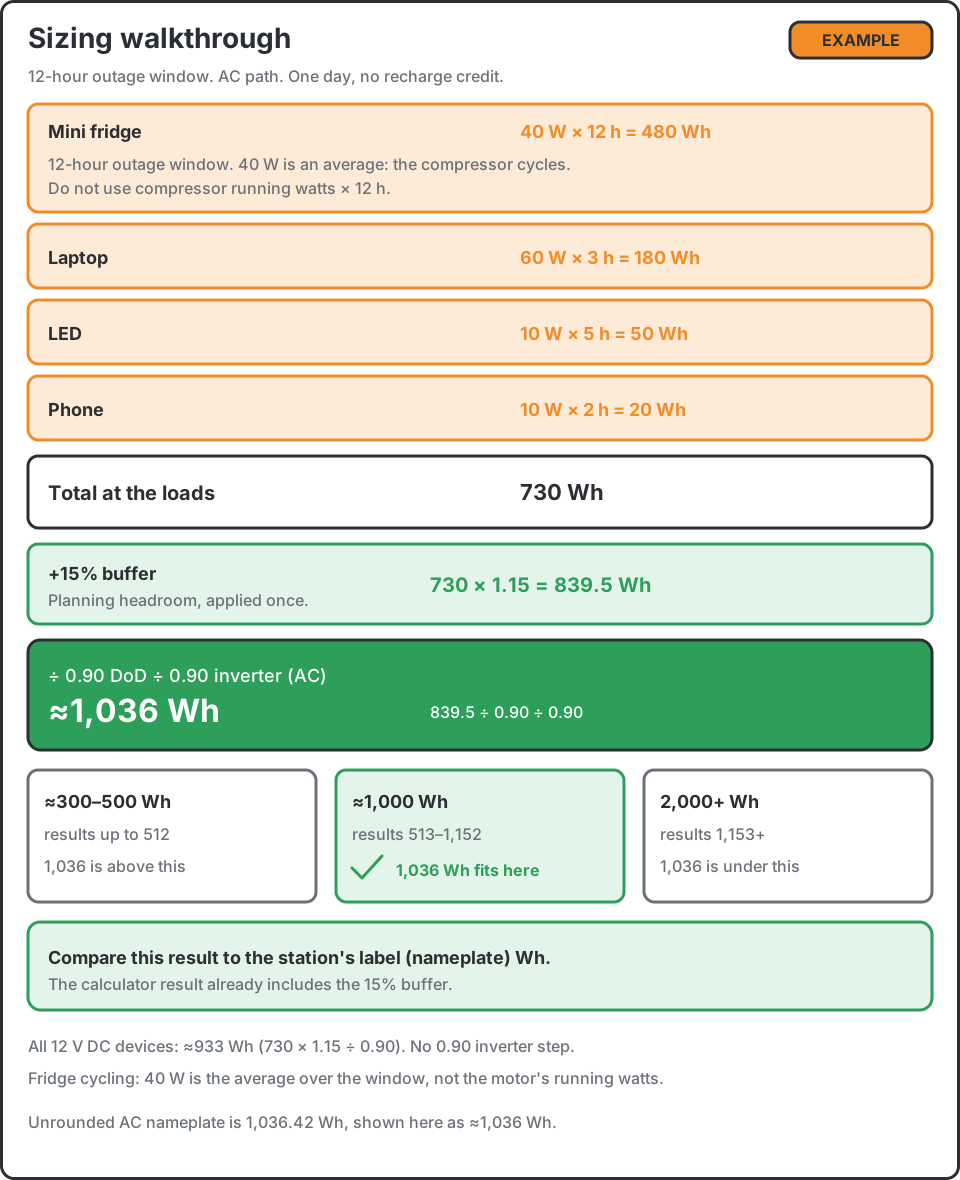
Example sizing for a 12-hour outage: mini fridge 40 watts times 12 hours is 480 Wh, laptop 180 Wh, LED 50 Wh, phone 20 Wh, total 730 Wh. A 15 percent buffer makes 839.5 Wh. Divided by 0.90 depth of discharge and 0.90 inverter efficiency, the AC nameplate is about 1,036 Wh, which fits the about 1,000 Wh class (results 513 to 1,152). Compare that result to the station label. All 12 V DC devices would be about 933 Wh. The fridge 40 W is an average because the compressor cycles.
EXAMPLE. 480 + 180 + 50 + 20 = 730 Wh. 730 × 1.15 = 839.5. 839.5 / 0.90 / 0.90 = 1,036.42, shown as ~1,036 Wh. 12 V DC skips the inverter: 839.5 / 0.90 = 932.78, shown as ~933 Wh. Fridge 40 W is an average over the window.
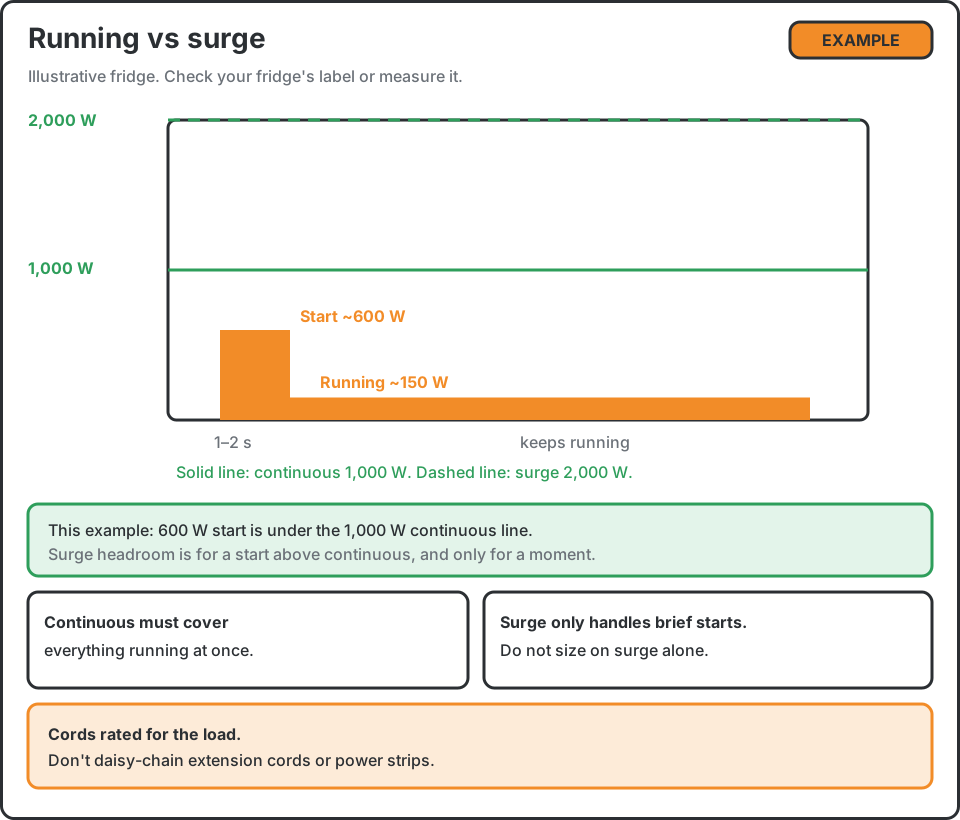
Example, not a measurement: a fridge runs at about 150 W and the motor start is about 600 W for 1 to 2 seconds. Check the fridge label or measure it. Station continuous output is a solid line at 1,000 W and surge is a dashed line at 2,000 W. Continuous watts must cover everything running at once. Surge only handles brief starts. Do not size on surge alone. Use cords rated for the load. Don't daisy-chain extension cords or power strips.
EXAMPLE, not a lab trace. Running ~150 W, start ~600 W for 1–2 seconds. Continuous 1,000 W is the solid line. Surge 2,000 W is dashed. This start is under the continuous line. Do not size on surge alone.
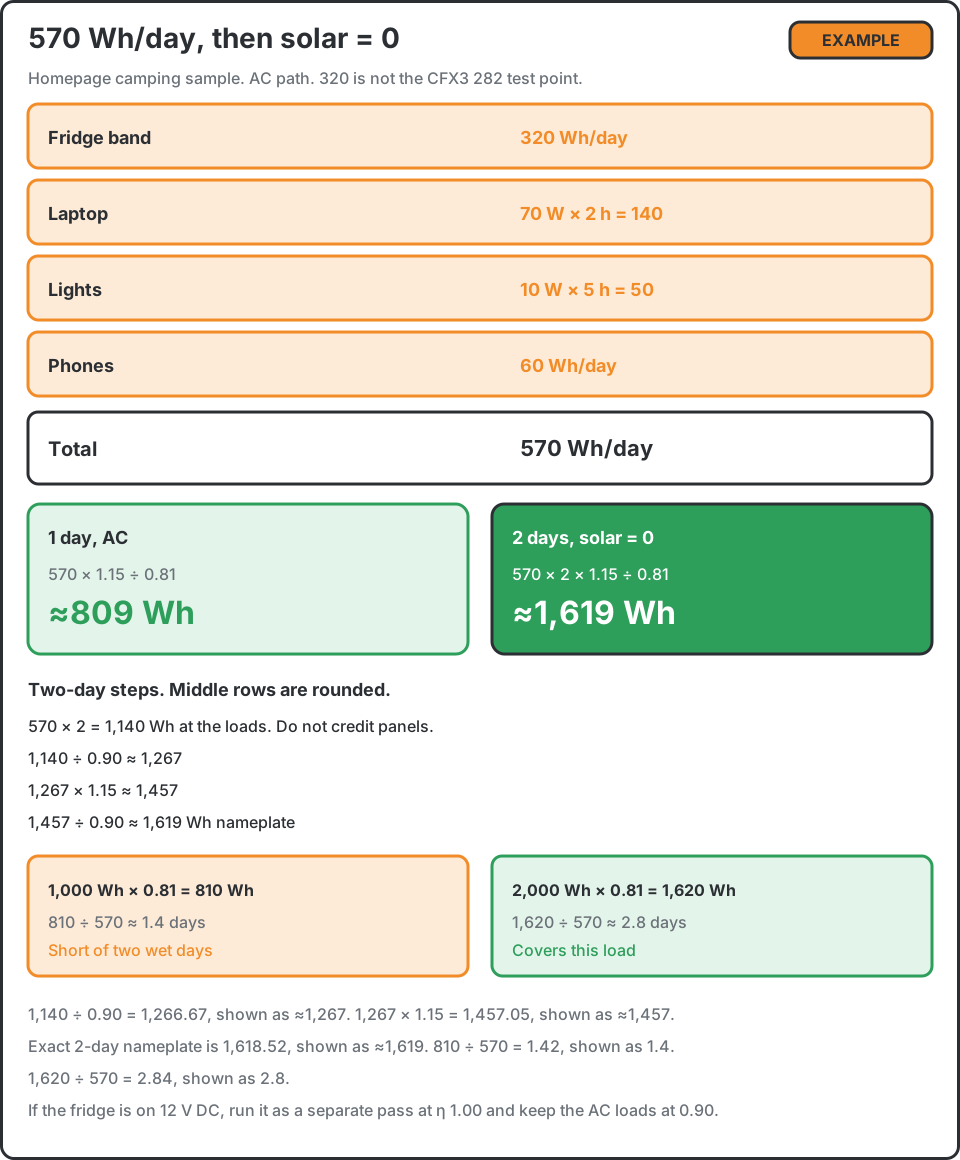
Camping sample: fridge band 320, laptop 140, lights 50, phones 60, total 570 Wh per day. One day AC nameplate is about 809 Wh. Two days with solar at zero: 1,140, then about 1,267, about 1,457, and about 1,619 Wh. The 1,267 and 1,457 steps are rounded. A 1,000 Wh label delivers 810 Wh, about 1.4 days, short of two wet days. A 2,000 Wh label delivers 1,620 Wh, about 2.8 days. If the fridge is on 12 V DC, run it as a separate pass at efficiency 1.00 and keep the AC loads at 0.90.
EXAMPLE. Same 570 Wh/day stack as weekend camping and the rainy weekend. One day ≈809 Wh. Two days, solar = 0, ≈1,619 Wh. No new arithmetic on this page.
TierNameplateCamping fit
Compact~300–500 WhDay trips, no fridge or tiny load
Weekend~800–1200 WhFridge + lights + devices (most common)
Extended~2000 Wh+Multi-day / no solar / heavier AC

When comparing EcoFlow / Jackery / Bluetti-class units, prioritize: usable Wh (LFP vs NMC), continuous AC watts, solar input, weight, and cycle life claims from the manufacturer — not influencer star ratings.

Related: weekend camping size · how to compare brands

Wh calculator — nameplate = (Wh/day × days × 1.15) / (0.90 × 0.90).

Where to check pricing

As an Amazon Associate, we earn from qualifying purchases at no extra cost to you. EcoFlow, Jackery, and Bluetti partner programs are not live yet.

See on Amazon EcoFlow — Coming soon Jackery — Coming soon Bluetti — Coming soon